所屬科目:研究所、轉學考(插大)◆普通化學
2. Of energy, work, enthalpy, and heat, how many are state functions? (A) 0 (B) 1 (C) 2 (D) 3 (E) 4
3. Which of the following does not contain at least one pi bond? (A) H2CO (B) CO2 (C) C2H2 (D) C3H8 (E) All of the above (A-D) contain at least one pi bond
4. In a 0.1 molar solution of NaCl in water, which one of the following will be closest to 0.1? (A) The mole fraction of NaCl. (B) The mass fraction of NaCl. (C) The mass percent of NaCl. (D) The molality of NaCl. (E) All of these are about 0.1.
5. In the molecule C2H4 the valence orbitals of the carbon atoms are assumed to be (A) not hybridized (B) sp hybridized (C) sp2 hybridized (D) sp3 hybridized (E) dsp hybridized
6. How many milliliters (mL) of 18.2 M H2SO4 are needed to prepare 600.0 mL of 0.10 M H2SO4? (A) 0.30 mL (B) 109 mL (C) 3.3 mL (D) 1.6 mL (E) 4.3 mL
7. What is the wavelength of a photon of red light (in nm) whose frequency is 4.55 × 10¹⁴ Hz? (A) 659 nm (B) 1.52 × 10⁶ nm (C) 152 nm (D) 455 nm
8. Which of the following statements is false? (A) An orbital can accommodate at most two electrons. (B) The electron density at a point is proportional to ψ2 at that point. (C) The spin quantum number of an electron must be either + . (D) A 2p orbital is more penetrating than a 2s; i.(E), it has a higher electron density near the nucleus and inside the charge cloud of a 1s orbital.
9. Consider the following Lewis structure:
Which statement about the molecule is false? (A) There are 10 sigma and 2 pi bonds. (B) C-2 is sp2 hybridized with bond angles of 120°. (C) Oxygen is sp3 hybridized. (D) This molecule contains 28 valence electrons.
10. The figure below shows the energy vs reaction progress for a reaction without and with a catalyst. Which letter represents the activation energy of the uncatalyzed reaction?
(A) a (B) b (C) c (D) d (E) e
11. Consider the reaction below:
N2(g) + 3H2(g) 2NH3(g)
What will happen when more N2 is added? (A) The reaction will stop. (B) Equilibrium will shift to the right. (C) Equilibrium will shift to the left. (D) There will be no noticeable change. (E) One more product will be formed.
12. A complex ion is a charged species consisting of a metal ion surrounded by (A) other transition metals (B) hydrogen ions (C) ligands (D) ligands and counter ions (E) none of these
13. What is the electron configuration of the Ni(II) ion? (A) [Ar] 4s23d6 (B) [Ar] 4s13d7 (C) [Ar] 4s23d8 (D) [Ar] 3d8 (E) none of these
14. Which of the following is the Arrhenius definition of a base? (A) A substance that produces H+ ions in aqueous solution. (B) A substance that produces OH- ions in aqueous solution. (C) A substance that is an H+ donor (D) A substance that is an H+ acceptor (E) A substance that is an OH- donor
15. Calculate the [H+] in a solution that has a pH of 9.00. (A) M (B) M (C) M (D) M (E) none of these
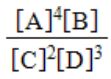
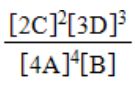
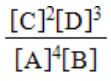
16. Choose the correct equilibrium expression for the following reaction.
(A) (B) (C) (D) (E) none of these
17. Order the intermolecular forces (dipole-dipole, London dispersion, ionic, and hydrogen- bonding) from weakest to strongest. (A) dipole-dipole, London dispersion, ionic, and hydrogen-bonding (B) London dispersion, dipole-dipole, hydrogen-bonding, and ionic (C) hydrogen-bonding, dipole-dipole, London dispersion, and ionic (D) dipole-dipole, ionic, London dispersion, and hydrogen-bonding (E) London dispersion, ionic, dipole-dipole, and hydrogen-bonding
18. What volume of a 0.687 M solution of CaCl2 contains 1.28 g of solute? (A) 59.6 mL (B) 16.8 mL (C) 1.86 mL (D) 7.92 mL (E) 83.2 mL
19. Which of the following is a conjugate acid/base pair? (A) HCl/OCl– (B) H2SO4/SO42– (C) NH4+/NH3 (D) H3O+/OH– (E) more than one of these
20. Which form of electromagnetic radiation has the longest wavelengths? (A) gamma rays (B) microwaves (C) radio waves (D) infrared radiation (E) x-rays
21. Which of the following best describes an orbital? (A) space where electrons are unlikely to be found in an atom (B) space which may contain electrons, protons, and/or neutrons (C) the space in an atom where an electron is most likely to be found (D) small, walled spheres that contain electrons (E) a single space within an atom that contains all electrons of that atom
22. Based on electronegativities, which of the following would you expect to be most ionic? (A) N2 (B) CaF2 (C) CO2 (D) CH4 (E) CF4
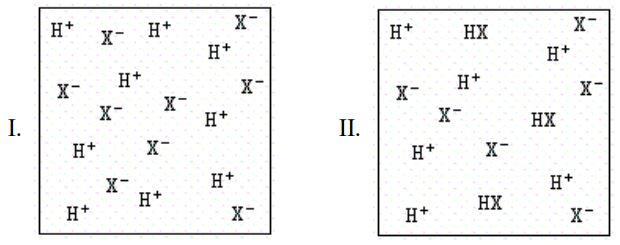
23. A solid acid HX is mixed with water. Two possible solutions can be obtained. Which of the following is true?
(A) In case I, HX is acting like a weak acid, and in case II, HX is acting like a strong acid. (B) In case I, HX is acting like a strong acid, and in case II, HX is acting like a weak acid. (C) In both cases, HX is acting like a strong acid. (D) In both cases, HX is acting like a weak acid. (E) HX is not soluble in water.
24. What is the hybridization of the oxygen atom? (A) sp (B) sp2 (C) sp3 (D) dsp3 (E) d2sp3
25. A salt solution sits in an open beaker. Assuming constant temperature and pressure, the vapor pressure of the solution (A) increases over time (B) decreases over time (C) stays the same over time (D) need to know which salt is in the solution to answer this (E) need to know the temperature and pressure to answer this
 阿摩線上測驗
登入
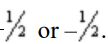 . (D) A 2p orbital is more penetrating than a 2s; i.(E), it has a higher electron density near the nucleus and inside the charge cloud of a 1s orbital.
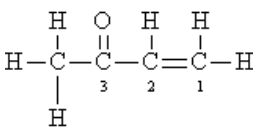
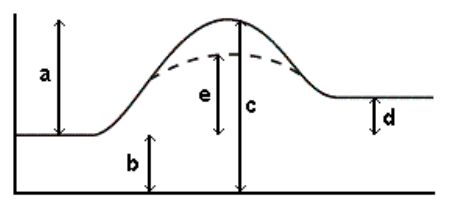 (A) a (B) b (C) c (D) d (E) e
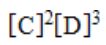 (B)
 (C)
 (D)
 (E) none of these
 (A) In case I, HX is acting like a weak acid, and in case II, HX is acting like a strong acid. (B) In case I, HX is acting like a strong acid, and in case II, HX is acting like a weak acid. (C) In both cases, HX is acting like a strong acid. (D) In both cases, HX is acting like a weak acid. (E) HX is not soluble in water.