所屬科目:研究所、轉學考(插大)-經濟學
1. An increase in an effective federal minimum wage would tend to cause _________. (A) a decrease in wage rates and an increase in employment. (B) an increase in wage rates and employment. (C) a decrease in wage rates and employment. (D) an increase in wage rates and a decrease in employment.
2. Given the accelerationist Phillips curve $\triangle\pi = -0.7 (U - 5) + \rho$, suppose that inflation has increased from 8 percent to 10 percent. If the unemployment rate is 4 percent, then the price shock is _________. (A) 2.7 percent (B) 0.6 percent (C) 1.3 percent (D) 1 percent (E) none of the above
3. The IS curve is Y = 20 - 1.5r, and the aggregate demand curve is $Y = 15.5 - 0.3\pi$. When the inflation rate is 3 percent, output is _________. (A) 20 (B) 14.6 (C) 9.5 (D) 3.6 (E) none of the above
4. Factors that shift the AD Curve include _________. (A) government purchases (B) autonomous investment (C) taxes (D) all of the above (E) none of the above
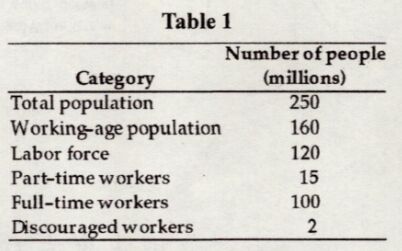
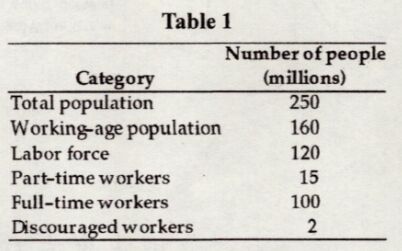
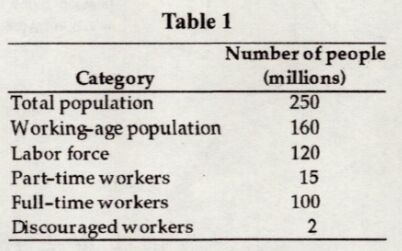
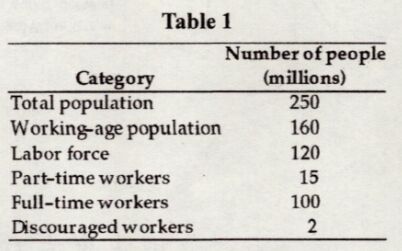
5. Using the Table 1, the unemployment rate is (A) 11.2 percent. (B) 6.3 percent. (C) 4.2 percent. (D) 10 percent. (E) 5.8 percent.
1. On the Figure 1, the wage level at point _______ might represent an efficiency wage. (A) 2 (B) 4 (C) 6 (D) 5
2. On the Figure 1, suppose the labor market is in equilibrium at point 2, then the demand curve shifts down to the position shown on the graph. If the real wage has not changed, then the horizontal distance between points _______ measures the unemployment that results. (A) 2 & 4 (B) 2 & 1 (C) 3 & 4 (D) 6 & 4
3. Referring to the Figure 1, assume that, at first, the labor market is in equilibrium at point 4. In which scenario does unemployment rise, with no change in the quantity of employment? (A) real wage rises to the level of points 1 and 2 (B) supply shifts to pass through point 5, with no change in the real wage (C) demand shifts to pass through point 3, with no change in the real wage (D) supply shifts to pass through point 3, with no change in the real wage
4. Referring to the Figure 1, assume that, at first, the labor market is in equilibrium at point 4. Then, demand shifts to pass through point 3, and the real wage adjusts to the new equilibrium. _______ is _______ at the new equilibrium, compared to the original equilibrium. (A) unemployment; larger (B) unemployment; smaller (C) the labor force; smaller (D) employment; larger
5. On the Figure 2, movement from point to point might occur if there is a negative demand shock, followed by updating of expected inflation. (A) F; G (B) H; I (C) H; F (D) F; H (E) none of the above
6. On the Figure 2, suppose point G is on the short-run aggregate supply curve π = 2.5 + 2*(Y - 22) and aggregate demand curve Y = 29.25 - 0.5π. If output at point G is 25, and inflation expectations are adaptive, then the inflation rate next period will be (A) 11.5 (B) 14.5 (C) 8.5 (D) 2.5 (E) none of the above
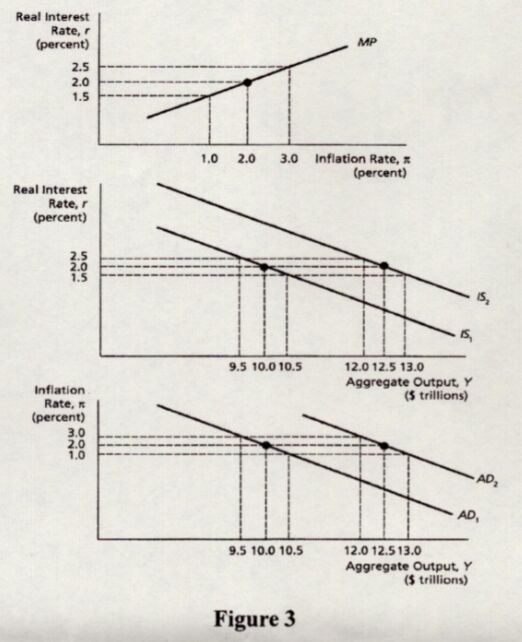
7. In the Figure 3, assume that output is $10.5 trillion, while potential output is $12 trillion. If there is no policy intervention, we should expect _________. (A) rightward shifts of IS & AD, so that both output and inflation rise (B) a decrease in inflation to shift the MP curve, raising the real interest rate (C) declines in both the inflation rate and the real interest rate as output rises (D) a decrease in inflation to shift the AD curve, causing output to rise (E) none of the above
8. In the Figure 3, assume that output is $10.5 trillion, while potential output is $12 trillion. If a fiscal stimulus package is implemented quickly, raising output to $12 trillion, while inflation remains constant at one percent, then the figure implies that the real interest rate will be _________ percent. (A) 1.5 (B) 0 (C) 1 (D) 0.5 (E) 2.5
9. In the Figure 3, assume that output is $10.5 trillion, while potential output is $12 trillion. If autonomous monetary policy (alone) is used to bring output to $12 trillion, then the figure implies that the real interest rate will be _________ percent, and the inflation rate will be one percent. (A) 1.5 (B) 0 (C) 1 (D) 0.5 (E) 2.5
10. In the Figure 3, assume that output is $10.5 trillion, while potential output is $12 trillion. Suppose that a combination of fiscal stimulus and recovery of consumer and business confidence shifts the IS and AD curves, as shown in the figure, while monetary policy sets the real interest rate at one percent. If the short-run aggregate supply curve is $\pi = \frac{4}{3}Y - 13$, then the resulting values of output and inflation are ________. (A) $12 trillion & 3 percent (B) $13.5 trillion & 5 percent (C) $9.75 trillion & 0 percent (D) $13.5 trillion & 0 percent (E) $12.5 trillion & 2 percent
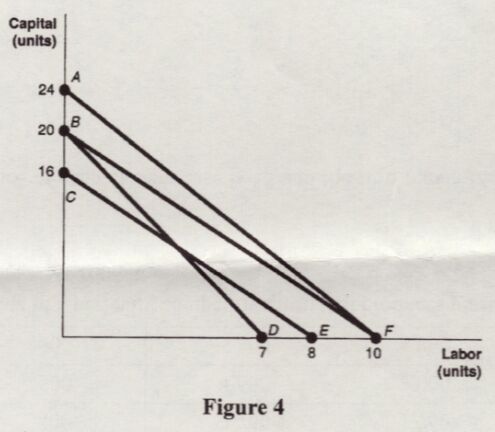
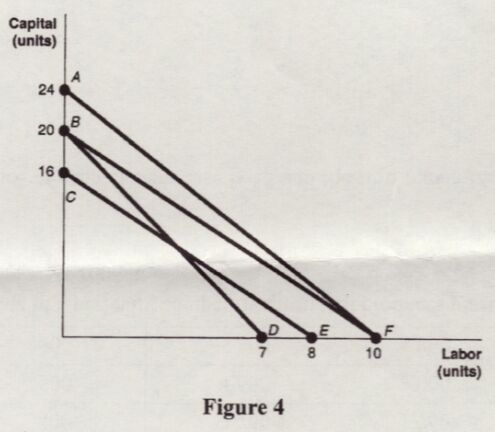
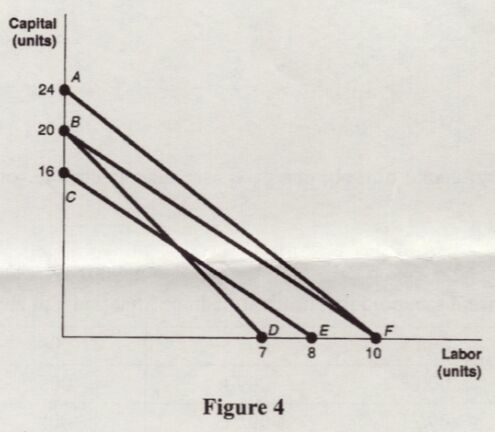
1. Refer to Figure 4. Which of the following shows a decrease in the price of capital while the price of labor remains unchanged? (A) The movement from \( AF \) to \( BF \) (B) The movement from \( {BF} \) to \( {AF} \) (C) The movement from \( {BF} \) to \( {BD} \) (D) The movement from \( {BF} \) to \( {CE} \)
2. Refer to Figure 4. A movement from CE to BD occurs when (A) The price of capital increases while the price of labor remains unchanged. (B)The price of labor decreases while the price of capital remains unchanged. (C)The price of capital increases while the price of labor decreases. (D) The price of capital decreases while the price of labor increases.
3. Refer to Figure 4. The price of labor is $50 per unit, then along the isocost AF, the total cost (A) is $500. (B) is $750. (C) is $1,250. (D) cannot be determined without the price of capital.
4. Suppose two firms in a duopoly implicitly collude and charge a high price. How might each firm benefit from advertising that it will match the lowest price offered by its competitor? (A) The offer to match prices is a way of deterring entry by other large firms, thereby keeping the market share of the existing firms intact. (B) The offer to match prices is a way of signaling to antitrust authorities that the firms are not engaged in illegal collusion. (C) The advertisement ensures that the other firm does not cheat. If a firm cheats on the agreement and charges the lower price, the rival firm will retaliate by doing the same. (D) The advertisement is meant to suggest to consumers that the offered price is actually the lowest price available.
5. Refer to Table 2. If the market price of each camera case is $8 and the firm maximizes profit, what is the amount of the firm's profit or loss? (A) $0 (it breaks even) (B) loss of $1,000 (C) profit of $440 (D) loss of $440
6. Refer to Table 2. Suppose the fixed cost of production rises by $500 and the price per unit is still $8. What happens to the firm's profit-maximizing output level? (A) It must fall. (B) It must rise to offset the increased cost. (C) The firm will shut down. (D) It will remain the same.
7. Refer to Figure 5. The deadweight loss due to the externality is represented by the area (A) abc. (B) abd. (C) \( abf \). (D) ade.
8. Refer to Figure 5. The size of marginal external costs can be determined by (A) \( S_{2} + S_{1} \) at each output level. (B) \( S_{2} - S_{1} \) at each output level. (C) The supply curve \( S_{2} \). (D) The supply curve \( S_{1} \).
9. Refer to Figure 6. Following the entry of Verizon, the subscription price falls from $P_M$ to $P_C$. What is the increase in consumer surplus as a result of this change? (A) The area \( \mathrm{A} + \mathrm{B} + \mathrm{C} \) (B) The area \( \mathbf{B} + \mathbf{C} \) (C) The area \( \mathrm{D} + \mathrm{F} \) (D) The area \( \mathbf{B} + \mathbf{C} + \mathbf{D} \)
10.Refer to Figure 6. What is the size of the deadweight loss prior to Verizon entering the market and wh deadweight loss after Verizon does enter the market ?
(A) The deadweight loss of area D is converted to consumer surplus.
(B) The deadweight loss of area C+D is converted to consumer surplus.
(C) The deadweight loss of area D is converted to producer surplus.
(D)The total deadweight loss is the area D+F; D is converted to consumer surplus and F to producer su
11. A monopolist union that desired to maximize its total wage bill ($w \times l$) would offer that quantity of labor for which (A) The marginal revenue from providing one more worker to the market is zero. (B) Labor's marginal productivity is zero. (C) Labor's wage falls to zero. (D) The quantity of labor hired is as great as possible given the firm's demand curve.
12. If 50 units are sold at a price of $20 and 80 units are sold at a price of $15, what is the absolute value of the price elasticity of demand? Use the midpoint formula. (A) 0.17 (B) 0.62 (C) 1.62 (D) 5
13. Which of the following statements about the prisoner's dilemma is false? (A) The prisoner's dilemma in a one-shot game leads to a noncooperative, equilibrium outcome. (B) The prisoner's dilemma game can never reach a Nash equilibrium as long as players do not cooperate. (C) The prisoner's dilemma in repeated games could lead to cooperation especially if there is some enforcement mechanism that punishes a player who does not cooperate. (D) Players caught in a prisoner's dilemma act in selfish ways that lead to an equilibrium that is sub-optimal.
14. Suppose the production function for good q is given by q = 3k + 2l where k and l are capital and labor inputs. Consider three statements about this function: I. The function exhibits constant returns to scale. II. The function exhibits diminishing marginal productivities to all inputs. III. The function has a constant rate of technical substitution. Which of these statements is true? (A) All of them. (B) None of them. (C) I and II but not III. (D) I and III but not II.
15. Suppose a negative externality exists in a market. If transactions costs are low and parties are willing to bargain, then, according to the Coase theorem, (A) An efficient solution can be reached regardless of the initial assignment of property rights. (B) An equitable solution can be reached only if property rights are assigned to the victims of pollution and not the polluters. (C) An equitable solution can be reached only if property rights are assigned to polluters and not to the victims of pollution. (D) Government intervention is necessary to reach an efficient and equitable solution.
 阿摩線上測驗
登入
 (A) 2 (B) 4 (C) 6 (D) 5
 (A) 2 & 4 (B) 2 & 1 (C) 3 & 4 (D) 6 & 4
 (A) real wage rises to the level of points 1 and 2 (B) supply shifts to pass through point 5, with no change in the real wage (C) demand shifts to pass through point 3, with no change in the real wage (D) supply shifts to pass through point 3, with no change in the real wage
 (A) unemployment; larger (B) unemployment; smaller (C) the labor force; smaller (D) employment; larger
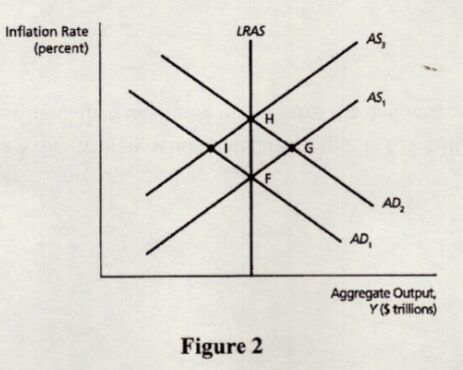 (A) F; G (B) H; I (C) H; F (D) F; H (E) none of the above
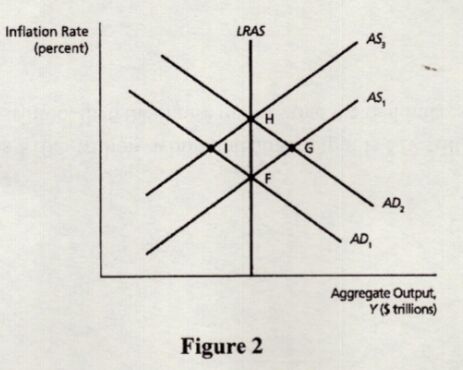 (A) 11.5 (B) 14.5 (C) 8.5 (D) 2.5 (E) none of the above
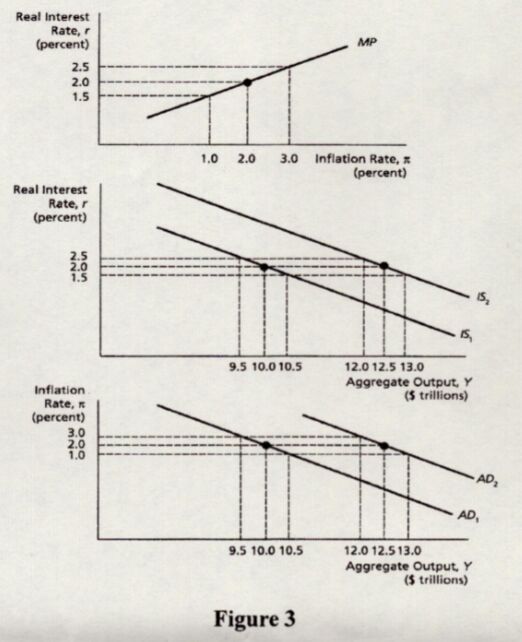 (A) rightward shifts of IS & AD, so that both output and inflation rise (B) a decrease in inflation to shift the MP curve, raising the real interest rate (C) declines in both the inflation rate and the real interest rate as output rises (D) a decrease in inflation to shift the AD curve, causing output to rise (E) none of the above
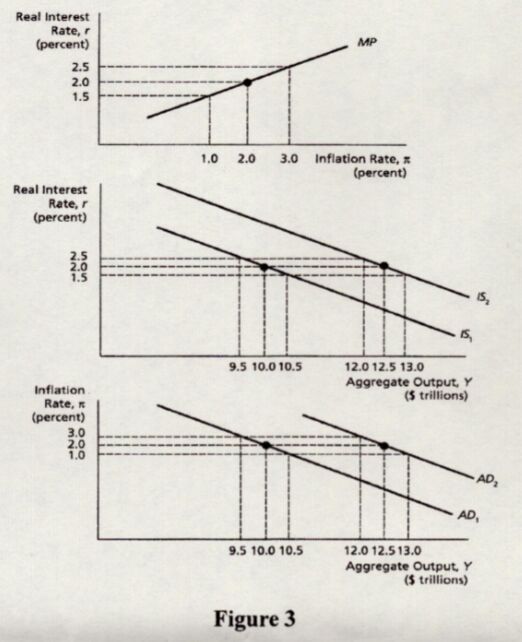 (A) 1.5 (B) 0 (C) 1 (D) 0.5 (E) 2.5
 (A) 1.5 (B) 0 (C) 1 (D) 0.5 (E) 2.5
 (A) The movement from
 (A) The price of capital increases while the price of labor remains unchanged. (B)The price of labor decreases while the price of capital remains unchanged. (C)The price of capital increases while the price of labor decreases. (D) The price of capital decreases while the price of labor increases.
 (A) is $500. (B) is $750. (C) is $1,250. (D) cannot be determined without the price of capital.