所屬科目:研究所、轉學考(插大)◆審計學
1. Which of the following best describes why an independent auditor is asked to express an opinion on the fair presentation of financial statements? (A) The opinion of an independent party is needed because a company may not be objective with respect to its own financial statements. (B) It is management's responsibility to seek available independent aid in the appraisal of the financial information shown in its financial statements. (C) It is difficult to prepare financial statements that fairly present a company's financial position, operations, and cash flows without the expertise of an independent auditor. (D) It is a customary courtesy that all stockholders of a company receive an independent report on management's stewardship of the affairs of the business.
2. The Public Company Accounting Oversight Board (A) performs inspections of the quality controls of firms that audit public companies. (B) establishes auditing standards that must be followed by CPAs on all audits. (C) oversees auditors of private companies. (D) performs all of the above functions.
3. The purpose of establishing quality control policies and procedures to accept or continue a client relationship is to (A) provide reasonable assurance that personnel are adequately trained to fulfill their responsibilities. (B) monitor the risk factors concerning misstatements that arise from the misappropriation of assets. (C) document objective criteria for the CPA firm's peer review. (D) minimize the likelihood of associating with a client whose management may lack integrity.
4. Which of the following is not one of the reasons that auditors provide only reasonable assurance on the financial statements? (A) The auditor commonly examines a sample, rather than the entire population of transactions. (B) Accounting presentations contain complex estimates which involve uncertainty. (C) Fraudulently prepared financial statements are often difficult to detect. (D) Auditors believe that reasonable assurance is sufficient in the vast majority of cases.
5. Which of the following is not true about the report release date? (A) It is defined as the date after which existing documentation must not be deleted, and additions to the documentation file must be documented as such. (B) It is used to define the beginning of the retention period. (C) It is often the date on which the report is delivered to the client. (D) It is the date on which the auditor grants the client permission to use the report.
6. An auditor reviews aged accounts receivable to assess likelihood of collection to support management's assertion about account balances of (A) existence. (B) completeness. (C) accuracy, valuation, and allocation. (D) rights and obligations.
7. Which of the following is the auditor least likely to do when aware of an illegal act? (A) discuss the matter with the client's legal counsel. (B) obtain evidence about the potential effect of the illegal act on the financial statements. (C) contact the local law enforcement officials regarding potential criminal wrongdoing. (D) consider the impact of the illegal act on the relationship with the company's management.
8. In testing for cutoff, the objective is to determine (A) whether all of the current period's transactions are recorded. (B) whether transactions are recorded in the correct accounting period. (C) the proper cutoff between capitalizing and expensing expenditures. (D) the proper cutoff between disclosing items in footnotes or in account balances.
9. _________are used as evidence to provide assurance about an account balance. (A) Substantive analytical procedures. (B) Tests of transactions. (C) Audit risks. (D) Tests of control.
10. Major, Major, and Sharpe, CPAs, are the auditors of MacLain Technologies. In connection with the public offering (IPO) of $10 million of MacLain securities, Major expressed an unqualified opinion as to the financial statements. Subsequent to the offering, certain misstatements were revealed. Major has been sued by the purchasers of the stock offered pursuant to the registration statement that included the financial statements audited by Major. In the ensuing lawsuit by the MacLain investors, Major will be able to avoid liability if (A) the misstatements were caused primarily by MacLain. (B) it can be shown that at least some of the investors did not actually read the audited financial statements. (C) it can prove due diligence in the audit of the financial statements of MacLain. (D) MacLain had expressly assumed any liability in connection with the public offering.
11. Which of the following statements would least likely appear in an auditor's engagement letter? (A) Our engagement is subject to the risk that material errors or fraud, including defalcations, if they exist, will not be detected. (B) After performing our preliminary analytical procedures we will discuss with you the other procedures we consider necessary to complete the engagement. (C) Fees for our services are based on our regular per diem rates, plus travel and other out-of-pocket expenses. (D) Arrangements to be made with the predecessor auditor.
12. The expectation gap (A) exists between the auditor and the SEC. (B) exists because auditors guarantee the accuracy of the financial statements. (C) often results in unwarranted lawsuits against the auditor. (D) is a legal concept supported by the federal courts.
13. Under which of the following circumstances may a CPA charge fees that are contingent upon finding a specific result? (A) If fixed by courts, other public authorities, or in tax matters if based on the results of judicial proceedings. (B) For a compilation if a third party will use the financial statement and disclosure is not made in the report. (C) For an examination of prospective financial statements. (D) For an audit or a review if agreed upon by both the CPA and the client.
14. When a former partner of a registered public accounting firm who left the firm two years ago accepts a financial reporting oversight role at an issuer audit client, the independence of the registered public accounting firm is considered impaired unless which of the following is true? (A) The former partner was employed by the registered public accounting firm for a period of 2 years or less. (B) The former partner discloses the relationship to the issuer audit client's board of directors. (C) The former partner has no remaining capital balance in the registered public accounting firm. (D) The former partner exerts only limited influence over the registered public accounting firm's operations and financial.
15. A CPA purchased stock in a client corporation and placed it in a trust as an educational fund for the CPA's minor child. The trust securities are not material to the CPA's wealth but are material to the child's personal net worth. According to the AICPA Code of Professional Conduct, would this action impair the CPA's independence with the client? (A) Yes, because the stock would be a direct financial interest and materiality is a factor. (B) No, because the CPA would not have a direct financial interest in the client. (C) Yes, because the stock would be a direct financial interest and materiality is not a factor. (D) Yes, because the stock would be an indirect financial interest and materiality is not a factor.
16. Park, CPA, was engaged to audit the financial statements of Tech Co., a new client, for the year ended December 31, Year 3. Park obtained sufficient audit evidence for all of Tech's financial statement items except Tech's opening inventory. Due to inadequate financial records, Park could not verify Tech's January 1, Year 3, inventory balances. Park's opinion on Tech's Year 3 financial statements most likely will be: (A) Balance sheet: Unmodified; Income statement: Adverse (B) Balance sheet: Disclaimer; Income statement: Adverse (C) Balance sheet: Disclaimer; Income statement: Disclaimer (D) Balance sheet: Unmodified; Income statement: Disclaimer
17. Which of the following audit procedures most likely would assist an auditor in identifying conditions and events that may indicate there could be substantial doubt about an entity's ability to continue as a going concern? (A) Confirmation of accounts receivable from principal customers. (B) Review of compliance with terms of debt agreements. (C) Reconciliation of interest expense with debt outstanding. (D) Confirmation of bank balances.
18. When allocating materiality, most practitioners choose to allocate to (A) the income statement accounts because they are more important. (B) the balance sheet accounts because most audits focus on the balance sheet. (C) both balance sheet and income statement accounts because there could be errors on either. (D) all of the financial statements because it is required by GAAS.
19. Assume the auditor confirms accounts payable and, based on the misstatements found, concludes the original control risk assessment as low was inappropriate. The auditor: (A) should revise their estimate of the control risk upward. (B) should revise their estimate of the inherent risk upward. (C) should revise their estimate of the acceptable audit risk downward. (D) should revise their estimate of the inherent risk downward.
20. Which of the following is not a category of inquiry used by auditors? (A) assessment inquiry. (B) declarative inquiry. (C) interrogative inquiry. (D) informational inquiry.
21. If a control total were to be computed on each of the following data items, which would best be identified as a hash total for a payroll IT application? (A) gross wages earned. (B) employee numbers. (C) total hours worked. (D) total debit amounts and total credit amounts.
22. One of the shortcomings in evaluating the allowance for uncollectible accounts by reviewing individual noncurrent balances on the aged trial balance is I. it is difficult to compare the results of the current year with those of the previous year. II. current accounts are ignored in establishing the adequacy of the allowance. (A) I only. (B) II only. (C) both I and II. (D) neither I nor II.
23. An auditor uses monetary unit sampling with a sampling interval of $20,000 and detects an item with a recorded amount of $10,000 with an audited value of $4,000. The projected misstatement of the sample is? (A) $12,000. (B) $10,000. (C) $6,000. (D) $3,000.
24. When determining tolerable exception rate (TER), (A) the auditor considers the degree of reliance to be placed on the control and the significance of the control to the audit. (B) if only one internal control is used to support a low control risk assessment for an objective, TER will be higher for the attribute than if multiple controls are used to support a low control risk assessment for the same objective. (C) control deviations increase both the risk of material misstatements in the accounting record, and will always result in misstatements. (D) a smaller sample size is needed for a low TER than for a high TER.
25. The audit firm issues an audit report for its client. The auditors have no obligation to make further inquiries with respect to the client's audited financial statements unless? (A) a development occurs that may affect the company's long-term viability. (B) final resolution was made on disclosed contingency for which no liability needed to be accrued. (C) new information comes to the auditor's attention concerning an event that occurred prior to the date of the audit report that, if known, would have impacted the audit opinion. (D) a lawsuit, in which the risk of loss was considered remote, was resolved in the company's favor.
1. 針對期末虛擬貨幣餘額之查核,查核人員在意哪些管理當局攸關聲明及對應的查核程序?(請條列簡答)
2. 根據我國審計準則 220 號之說明,你在評估查核團隊是否具備查核虛擬貨幣交易與餘額之適當專業能力及適任能力時,可能考量的因素為何?(請條列簡答)
3. 根據我國審計準則 500 及 620 號之說明,當你考量查核團隊的專業能力可能不足以針對甲公司虛擬貨幣之交易與餘額蒐集足夠且適切之證據時,得以採用哪二類專家意見?
4. 承上題,二類專家意見之適當性的考量因素分別為何?(請條列式回答)
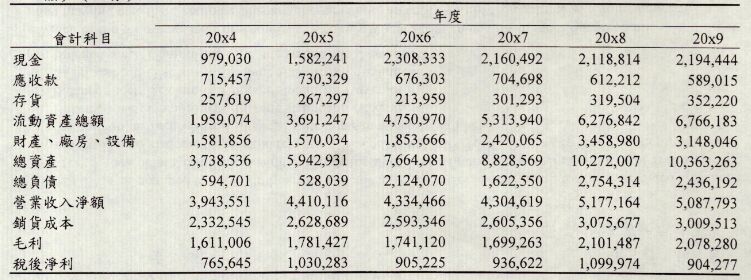
二、以下是甲公司爆發舞弊案件前六年的部分財務數據(單位:千元)。假若你是受託查核甲公司 20x9 年度財務報表的會計師,請運用分析性程序,提出甲公司可能的舞弊風險並簡短解釋理由(至少兩項風險)。(10 分)
 阿摩線上測驗
登入