所屬科目:學士後◆化學
1. The SI prefix that corresponds to a factor of 10–3 is (A) milli (B) centi (C) deci (D) kilo
2. Using zero as your reference point, how much liquid has left the buret? Use the correct number of significant figures. (A) 20 mL (B) 22 mL (C) 22.0 mL (D) 38 mL
3. How many significant figures are in the number 34.00500?(A) 4 (B) 5 (C) 6 (D) 7
4. What is the result of the following multiplication expressed in scientific notation to the correct number of significant figures?(5.45 x 10³)(6.0 x 10⁻³)(A)(B)(C)(D)
5. Convert: 82.7 °F = _____ K.(A) 298.8 (B) 351.5 (C) –194.5 (D) –247.2
6. 483.7 K equals(A) 210.7°F (B) 870.7°C (C) 756.7°F (D) 210.7°C
7. How many liters are in a 15-oz bottle of pop?(1 qt = 32 fluid oz) (1 L = 1.0567 qt)(A) 0.47 L (B) 0.50 L (C) 2.3 L (D) 0.44 L
8. Which of the following conversion factors is incorrect?(A) 1 in/2.54 cm (B) 1 yd/1.094 m (C) 1 kg/2.205 lb (D) 1 ft/12 in
9. Which of the following involves a chemical change?(A) boiling water (B) melting ice (C) chopping wood (D) cooking an egg
10. In a chemical change:(A) a phase change must occur in a chemical reaction.(B) the original material can never be regenerated after a reaction is completed.(C) a phase change never occurs.(D) the compounds obtained as products are always different from the startingmaterials.
11. Which of the following describes a chemical property of gold?(A) Gold is a yellow metal. (B) Gold is an inert (nonreactive) metal.(C) Gold is a soft metal. (D) Gold is a dense metal.
12. _____ is an example of a mixture.(A) Hydrogen fluoride (B) Pure water (C) Gold (D) Air
13. A homogeneous mixture is also called _______________.(A) a heterogeneous mixture. (B) a pure substance.(C) a compound. (D)a solution.
14. Water is an example of(A) a homogeneous mixture (B) a heterogeneous mixture(C) a compound (D) an element
15. Which of the following processes require(s) chemical methods?(A) Separating a homogeneous mixture into pure substances.(B) Separating a heterogeneous mixture into pure substances.(C) Distilling a saltwater mixture.(D) Breaking a compound into its constituent elements.
16. A sample of a liquid does not have a definite(A) mass (B) density (C) volume (D) shape
17. Which of the following phase conversions is usually involved in distillation?(A) Solid to liquid (B) Liquid to solid (C) Liquid to gas (D) Solid to gas
18. The smallest unit of a chemical compound is a(n) _____.(A) atom (B) molecule (C) nucleus (D) electrons
19. What is the most abundant element on the earth (including the crust, oceans, and atmosphere)? (A) silicon (B) oxygen (C) hydrogen (D) carbon
20. What is the most abundant element in the human body?(A) carbon (B) hydrogen (C) calcium (D) oxygen
21. The symbol Sn stands for the element(A) sulfur (B) strontium (C) silicon (D) tin
22. Which of the following statements are true?I. Models are always wrong unless they are proved by a theory.II.Elements, such as lead, are made of tiny particles that mostly consist of openspace.III. The air you breathe is an example of a heterogeneous mixture.IV. Because NH3 always contains the same relative numbers of atoms, it willalways contain 4.6 g of nitrogen for every 1.0 g of hydrogen.(A) II only (B) II, IV (C) I, II, IV (D) I, III
23. Which of the following statements is incorrect?(A) Dalton's statement "All atoms of a given element are identical" is no longeraccepted because of the existence of isotopes and ions.(B). Dalton’s theory states that elements are made of tiny particles called atoms.(C) According to Rutherford, the number of protons is the same as the numberof electrons.(D) According to Rutherford, the nucleus must have a positive charge tobalance the negative charge of the electrons.
24. The chemical formula Al2O3 indicates:(A) two atoms of aluminum and three atoms of oxygen.(B) three atoms of aluminum and two atoms of oxygen.(C) six atoms of each element.(D) five atoms of each element.
25. Which of the following statements is/are true?I. John Dalton provided the first experimental support for the atom.II.Ernest Rutherford proved the existence of a nucleus by shooting positivelycharged particles at a thin gold-foil sheet.III. J. J. Thompson proved that electrons travel in elliptical orbits around thenucleus.IV. Energy in an atom is quantized, so when electrons fall to their ground state,white light can be observed.(A) I, II (B) I, III (C) I, II, III (D) II, IV
26. Which atomic particle determines the chemical behavior of an atom?(A) proton (B) electron (C) neutron (D) nucleus
27. Which particle has the smallest mass?(A) neutron (B) proton (C) electron (D) helium nucleus
28. The following reaction occurs in aqueous acid solution:NO3– + I– → IO3– + NO2In the balanced equation, the coefficient of water is(A) 1 (B) 2 (C) 3 (D) 4
29. In the balanced equation for the following reaction (in acidic solution)ClO3– + Fe2+ → Cl– + Fe3+the coefficient of Fe2+ is(A) 1 (B) 6 (C) 2 (D) 8
30. Which of the following battery types is commonly used in an automobile?(A) dry cell (B) alkaline dry cell (C) lead storage (D) mercury cell
31. When a metal corrodes, what is happening chemically?(A) The metal atoms lose electrons. (B) The metal atoms gain electrons.(C) Electrons are not involved. (D) The metal is combining with nitrogen gas.
32. Balance the following redox equation in acidic solution. What is the coefficient of the H+ion? CH3OH(aq) + Cr2O72-(aq) → CH2O(aq) + Cr3+(aq)(A) 2 (B) 4 (C) 6 (D) 8
33. Balance the following redox equation in acidic solution. What is the coefficient of the H+ion? MnO4-(aq) + H2O2(aq) → Mn2+(aq) + O2(g)(A) 2 (B) 4 (C) 6 (D) 8
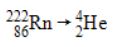
34. Radon is a radioactive isotope which decays by the loss of an alpha particle.What is the second product of this decay?(A)(B)(C)(D)
35. The atomic particle having a mass of 0 amu and a charge of –1 is(A) an electron (B) a neutron (C) an alpha particle (D) a proton
36. The cesium-137 nuclide has a half-life of 30 years. After 90 years, about 9 g remains. The original mass of the cesium-137 is closest to(A) 70 g (B) 50 g (C) 90 g (D) 80 g
37. After 1176 years, 75% of the radioactive nuclides in a particular sample of an isotope have decayed. What is the half-life of this radioactive isotope? (A) 588 years (B) 392 years (C) 2352 years (D) 294 years
38. When the U-235 nucleus is struck with a neutron, the Zn-72 and Sm-160 nuclei are produced along with some neutrons. How many neutrons are emitted? (A) 2 (B) 3 (C) 4 (D) 5
39. decays to . How many beta decays are involved in this decay series?(A) 6 (B) 1 (C) 4 (D) 2
40. Which of the following statements are true?I. The number of protons in an element is the same for all neutral atoms of thatelement.II.The number of electrons in an element is the same for all neutral atoms of thatelement.III. The number of neutrons in an element is the same for all neutral atoms of thatelement.(A) I, II, and III are all true. (B) Only I and II are true.(C) Only II and III are true. (D) Only I and III are true.
41. Which of the following is the correct formula for the alkane that contains ten carbon atoms? (A) C10H22 (B) C10H20 (C) C10H18 (D) C10H10
42. Which of the following is the correct formula for the simplest alkene that contains five carbon atoms? (A) C5H10 (B) C5H8 (C) C5H6 (D) C5H12
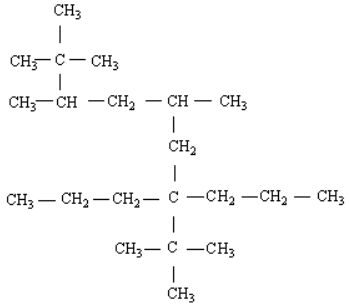
43. Name the following molecule.(A) 7-t-butyl-2,2,3,5-tetramethyl-7-propyldecane(B) 6-propyl-2,6-di-t-butylnonane(C) 2,2,5,7,8,8-hexamethyl-3,3-dipropylnonane(D) isonanane
44. A student gave a molecule the following name:2-ethyl-3-methyl-5-isopropylhexaneHowever, her TA pointed out that although the molecule could be drawn correctlyfrom this name, the name violates the systematic rules. What is the correct(systematic) name of the molecule?(A) 3,4-dimethyl-6-isopropylheptane (B) 2-isopropyl-4,5-dimethylheptane(C) 3,4,6,7-tetramethyloctane (D) 2,3,5,6-tetramethyloctane
45. In a lecture, a professor named a molecule 2-ethyl-4-tertiary-butylpentane. A student pointed out that although the correct structure could be drawn from this name, the name did not follow systematic rules. Which of the following is the correct systematic name for the molecule? (A) 2-t-butyl-5-methylhexane (B) 2-ethyl-4,5,5-trimethylhexane (C) 3,5,6,6-tetramethylheptane (D) 2,2,3,5-tetramethylheptane
46. The general name given to hydrocarbons with triple bonds is(A) alkenes (B) alkynes (C) alkanes (D) unsaturated hydrocarbons
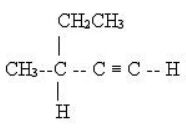
47. Name the following molecule.(A) 1-hexyne (B) 2-ethynyl butane(C) 2-ethyl-3-butyne (D) 3-methyl-1-pentyne
48. Which of the following is the alternative name for 1,3-dichorobenzene(A) m-dichlorobenzene (B) o-dichlorobenzene(C) p-dichlorobenzene (D) benzene dichoride
49. In the three-dimensional structure of methane, CH4, the hydrogen atomsattached to a carbon atom are aligned(A) in a straight line. (B) at the corners of a square.(C) at the corners of a tetrahedron. (D) at the corners of a rectangle.
50. Generally, a solution of an organic compound in water will be electrically(A) highly conductive. (B) highly ionized. (C) nonconductive. (D) insulated.
51. VSEPR theory predicts that simple carbon compounds will form bonds that are(A) as far apart as possible. (B) as close together as possible.(C) arranged in a straight line. (D) pointed to the corners of a cube.
52. As carbon bonds with atoms of increasingly higher electronegativities, thepolarity of the bond(A) decreases. (B) increases. (C) stays the same. (D) reverses.
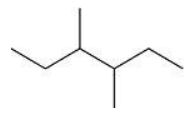
53. What is the IUPAC name for this alkane?(A) 2-ethyl-3-methylpentane (B) 4-ethyl-3-methylpentane(C) 3, 4-dimethylhexane (D) 2, 3-diethylbutane
54. Hydrocarbons are the primary constituents of(A) drugs. (B) food flavors. (C) gasoline. (D) fruit juices.
55. A hydrocarbon with at least one double bond is a(n)(A) alkane. (B) alkene. (C) alkyne. (D) alcohol.
56. Which of the following compounds have cis-trans isomers?(A) CH2 = CH - CH3 (B) CCl2 = CBr2(C) CH3 - CH = CH - CH3 (D) CCl2 = CHBr
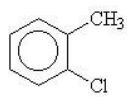
57. What is the name of the compound below?(A) 1-chlorotoluene (B) 2-chlorotoluene(C) 3-chlorotoluene (D) 4-chlorotoluene
58. The compound CH3 - CH2 - SH is in the organic family known as(A) ethers. (B) thiols. (C) alcohols. (D) sulfides.
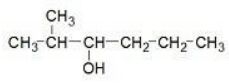
59. Which of the following is the IUPAC name for the compound below?(A) 5-methyl-4-hexanol (B) 5-methyl-4-pentanol(C) 2-methyl-3-hexanol (D) 2-methyl-3-pentanol
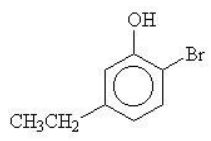
60. What is the name for this compound?(A) 2-bromo-5-ethylcyclohexanol (B) 2-bromo-5-ethylphenol(C) 4-bromo-1-ethyl-5-phenol (D) 6-bromo-3-ethylphenol
61. Which of the following does NOT involve methanol?(A) making plastics (B) racing fuel (C) alcoholic beverages (D) solvents
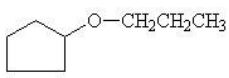
62. What is the common name of this compound?(A) cyclopentyl propyl ether (B) cyclopentyl propyl ketone(C) 1-cyclopropyl-1-propylalcohol (D) propylcyclopentanol
63. The dehydration of an alcohol in the presence of a strong acid yields(A) an alkane. (B) an alkene. (C) a ketone. (D) an alcohol.
64. When 2-methyl-2-butanol undergoes dehydration in acid, the major product is(A) 2-methyl-2-butene. (B) 2-methylbutanone.(C) 2-pentanone. (D) 2-methylbutanal.
65. In the oxidation of an alcohol to a ketone, there is(A) a loss of hydrogen. (B) a loss of oxygen.(C) a loss of carbon. (D) a gain of hydrogen.
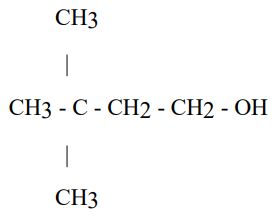
66. What is the product when this compound undergoes oxidation?(A) hexanal (B) 2,2-dimethylbutanal(C) 2,2-dimethyl-4-butanone (D) 3,3-dimethylbutanal
67. Tertiary alcohols cannot be oxidized because (A) there are no oxygen atoms to remove from the alcohol carbon. (B) there are no hydrogen atoms attached to the alcohol carbon. (C) the alcohol carbon is bonded to four groups so no oxygen can be added to it. (D) the alcohol carbon is bonded to four groups so no hydrogen can be added to it.
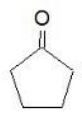
68. Which compound will undergo oxidation to yield the following?(A) pentanol (B) cyclopentane (C) cyclopentanol (D) methylcyclobutanol
69. When a primary alcohol is completely oxidized, the product is(A) another alcohol. (B) a carboxylic acid. (C) an aldehyde. (D) an alkane.
70. What are the bond angles in a typical carbonyl group?(A) 45° (B) 90° (C) 109.5° (D) 120°
71. The compound 2-propanone is also known as(A) acetone. (B) 2-propanone. (C) dimethyl ketone. (D) β-propanone.
72. Formaldehyde is used industrially to make(A) polymers. (B) insulating materials. (C) carpeting. (D) All of the above.
73. Acetone can be produced by the body when a person is(A) exercising. (B) dieting with high protein diets.(C) ill with a flu. (D) recovering from surgery.
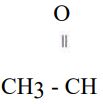
74. What is the IUPAC name for this compound?(A) methyl aldehyde (B) 1-ethanaldehyde (C) 1-ethanone (D) ethanal
75. The reduction of 3-pentanone with hydrogen in the presence of a nickel catalyst will yield(A) pentane. (B) 2-pentene. (C) diethyl alcohol. (D) 3-pentanol.
76. The Benedict's test may be used to distinguish(A) acids from amines. (B) esters from acids.(C) ketones from alcohols. (D) aldehydes from ketones.
77. An acetal is formed from two molecules of an alcohol and a(n)(A) aldehyde. (B) ether. (C) carboxylic acid. (D) alkyl ether.
78. How do sugars form cyclic hemiacetals?(A) Two molecules of a sugar react with one another.(B) A molecule of sugar reacts with an added alcohol.(C) Functional groups within molecule of sugar react with each other.(D) A molecule of sugar reacts with an added aldehyde.
79. A carbohydrate that gives two molecules when it is completely hydrolyzed is known as a(A) monosaccharide. (B) disaccharide. (C) polysaccharide. (D) starch.
80. Which of the following compound is most acidic?(A) ethanol (B) ethanal (C) phenol (D) cyclohexanol
 阿摩線上測驗
登入
 (A) 20 mL (B) 22 mL (C) 22.0 mL (D) 38 mL
 (B)
 (C)
 (D)

 (B)
 (C)


 decays to
 . How many beta decays are involved in this decay series?