所屬科目:研究所、轉學考(插大)◆普通物理學
1. A particle goes through uniform circular motion. At one instant, it is at the xy coordinates (-2.0 m, 3.0 m), has velocity v = -4.0 j m/s, and has acceleration a = +2.0 i m/s². What is the x coordinate (m) of the center of the circle?_____
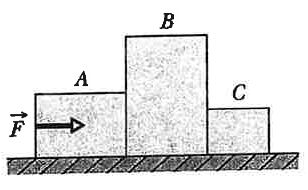
2. The figure shows a horizontal force of magnitude F = 54 N applied to one of three blocks with these masses: = 2.0 kg, = 5.0 kg, and = 2.0 kg. The blocks move rightward across a frictionless floor. What is the magnitude (N) of the force on block B due to block A?_____
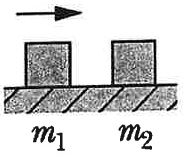
3. The figure shows block 1 (with velocity 10 m/s) sliding into a stationary block 2 (mass m2 = 6.0 kg), which ends up with a velocity of = 5.0 m/s. The collision is elastic. What is the mass (kg) of block 1?_____
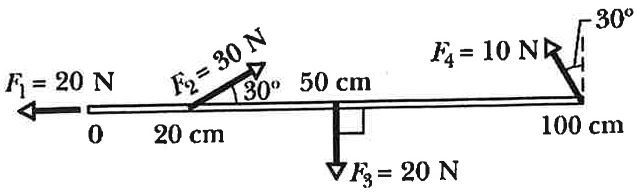
4. The figure is an overhead view of a 4.0 kg meter stick that can rotate around a pivot located at the mark of "20 cm". Four horizontal forces act on the stick (the forces maintain their orientations relative to the stick as the stick rotates). The stick starts from rest at time t = 0 s. What is its angular speed (rad/s) at time t = 6.0 s? Don't round-off early. For a uniform stick rotating around its center of mass, the rotational inertial is given by ML2/12, where M is the mass and L is the length._____
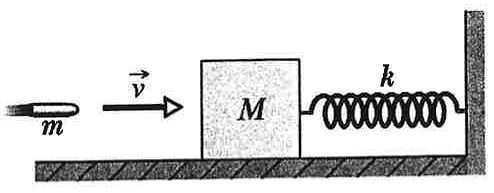
5. As shown in the figure, a block of mass M = 5.40 kg, at rest on a horizontal frictionless table, is attached to a rigid wall by a spring with spring constant k = 6000 N/m. A bullet of mass m = 9.50 × kg and speed v strikes and is embedded in the block. After the bullet is embedded, the block and bullet undergo SHM with amplitude 1.50 × m. What was the bullet speed v (m/s)?_____
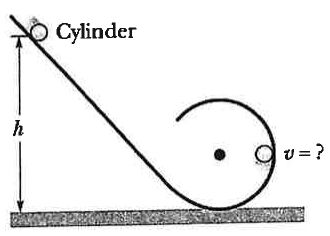
6. The figure shows a cylinder that has an initial speed of 8.00 m/s at an initial height of h = 9.00 m. What is the normal force (N) acting on the cylinder when it reaches mid-height (level with the center) of the circular loop, which has a radius of 5.00 m? It rolls smoothly along the track. The cylinder's mass is 6.00 kg._____
7. Here are three pairs of waves that we can send along a string. Rank the pairs according to the amplitude of the resultant wave that would result on the string, greatest first._____ [Note:請依序排列,並加註大於、小於、或等於符號(>, <, or =)] Pair 1: y1 = (4.0 mm) sin (6πx – 12πt + 0.7π)y2 = (4.0 mm) sin (6πx – 12πt + 0.7π) Pair 2: y1 = (4.0 mm) sin (3πx – 5πt + 0.2π)y2 = (4.0 mm) sin (3πx – 5πt + 1.2π) Pair 3: y1 = (4.0 mm) sin (2πx – 4πt)y2 = (4.0 mm) sin (2πx – 4πt + 0.5π)
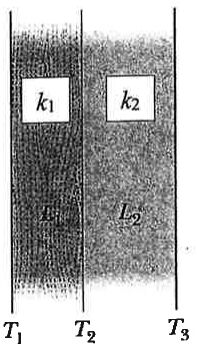
8. The figure shows the cross section of a two-layer wall. The temperatures for the left face, interface, and right face are T₁ = 30 °C, T2 = 20 °C, and T3 = -10 °C. Layer 1 has thickness 0.20 m; layer 2 has thickness 0.60 m. What is the thermal conductivity k of layer 2 in terms of that of layer 1? That is, what goes in the blank here: k2 =_____ k₁?
9. A Carnot engine with a high-temperature reservoir is at 380 K operates at an efficiency of 25.0%. By how much (K) should the temperature of the low-temperature reservoir be changed to increase the efficiency to 35.0%?_____
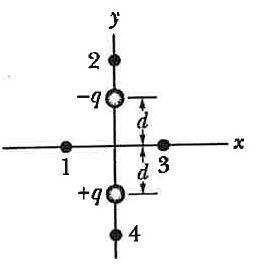
10. Two identical point charges are placed symmetrically at the same distance d from the origin, as shown in the figure. Four labelled points (1, 2, 3, 4) are indicated on the diagram. At which of these labelled points does the net electric field point in the + y-direction?_____
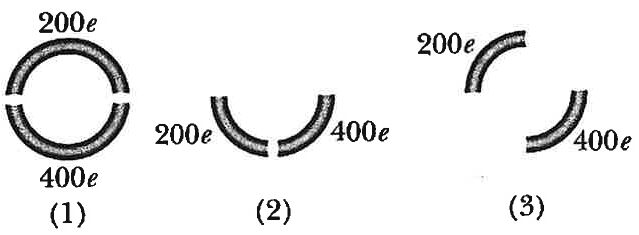
11. The figure shows three arrangements of charged arcs forming a circle or part of a circle. The radii are identical. Rank the arrangements according to the net electric potential at the center of curvature, most positive first, most negative last. _____[Note:請依序排列,並加註大於、小於、或等於符號(>, <, or =)]
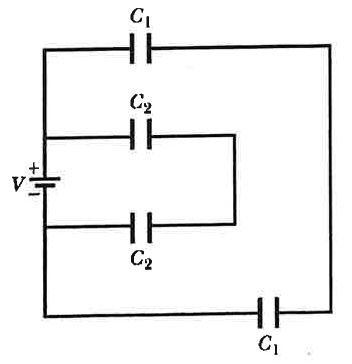
12. The figure shows a 6.00 V battery and four capacitors: C₁ = 10.0 µF and C2 = 20.0 µF. What is the potential (V) across C1?
13. The figure shows a wire that changes in width. However, we don't know if the wire narrows as in the first drawing or widens as in the second drawing. The drift speed in region 1 at the left is 8.00 × m/s. The resistivity is 1.69 × ohm-m. The density of conduction electrons is 8.49 × 1028 m³. In both sections, the current is uniformly distributed over the cross section. In region 2 on the right, in length L = 1.00 cm, the potential change AV = 1.80 × V. What is the ratio of radii r1/r2?
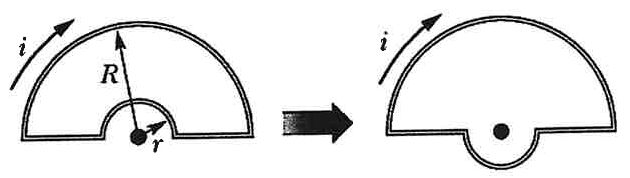
14. The first figure shows a closed loop with current i. The loop consists of a half-circle of radius r and a half circle of radius R = 2r. The second figure shows the same half-circles but the small one has been flipped over. The net magnetic field at the common center of the circular sections is B₁ for the first figure and B2 for the second figure. What is the magnitude of the ratio B2 / B1?
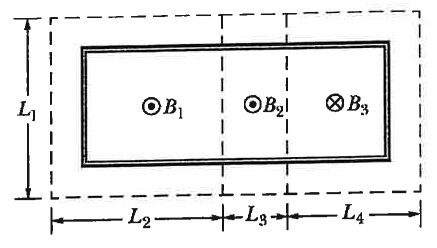
15. The figure shows a rectangular wire loop lying in three magnetic fields given by these functions (in teslas and seconds): B₁ = 3.00t, B2 = 50.0, B3 = 4.00t²+ 5.00. The dimensions are L₁ = 2.00 m, L2 = 3.00 m, L3 = 1.00 m, and L4 = 2.00 m. The directions of the fields are indicated. The resistance is 5.50 2. What is the current
(A) in the circuit at time t = 0.500 s?
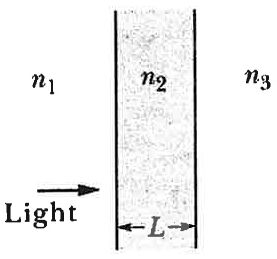
16. The figure shows a thin film (in the middle) with different materials on either side: n₁ = 1.40, n2 = 1.50, and n3 = 1.60. We send in a ray of light that is perpendicular to the two parallel surfaces. In air, that light has a wavelength of 800 nm. For some values of thickness L, the reflections to the left undergo fully destructive interference. What is the second smallest value of L that gives that result? Answer in nanometers._____
(a) Using the Doppler shift between the two spaceships, determine the speed VAB of ship A relative to ship B (express your answer as a fraction of c). (5 points)
(b) Calculate the wavelength λE that an observer on Earth would detect for the same signal (in nanometers). (5 points)
(a) Using the measured photon rate, calculate the radiant power that reaches the face of the telescope objective.
(b) Treating the super-nova as an isotropic source, deduce its total emission power and express your result as a multiple of the Sun's luminosity.
 阿摩線上測驗
登入
 = 2.0 kg,
 = 5.0 kg, and
 = 2.0 kg. The blocks move rightward across a frictionless floor. What is the magnitude (N) of the force on block B due to block A?_____
 = 5.0 m/s. The collision is elastic. What is the mass (kg) of block 1?_____
 kg and speed v strikes and is embedded in the block. After the bullet is embedded, the block and bullet undergo SHM with amplitude 1.50 ×
 m. What was the bullet speed v (m/s)?_____
 m/s. The resistivity is 1.69 ×
 ohm-m. The density of conduction electrons is 8.49 × 1028 m³. In both sections, the current is uniformly distributed over the cross section. In region 2 on the right, in length L = 1.00 cm, the potential change AV = 1.80 ×
 V. What is the ratio of radii r1/r2?
 (A) in the circuit at time t = 0.500 s?