所屬科目:研究所、轉學考(插大)◆普通物理學
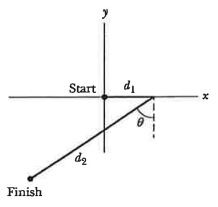
1. In an overhead view, right figure shows two straight segments of the walk of an armadillo: d₁ = 5.00 m, d2 = 12.0 m, θ = 60.0° (not drawn to scale). What is the magnitude (m) of the displacement vector that points from start to finish?
(A) 11.2 (B) 5.05 (C) 9.58 (D) 8.07 (E) 4.10
2. The position vector of a particle is given by in meters and seconds. What is the magnitude (m/s²) of the acceleration at t = 3.00 s? (A) 505 (B) 141 (C) 341 (D) 409 (E) 807
3. The figure shows a train of six blocks that is pulled over a frictionless floor by a horizontal force of F = 81 N. What is the magnitude (N) of the tension T3 of the middle cord?
(A) 12 (B) 21 (C) 36 (D) 48 (E) 67
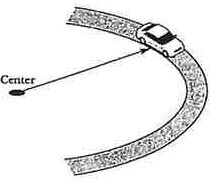
4. The figure shows a car heading toward us as it travels around a circular track of radius 24.0 m. The coefficient of static friction between the tires and the track is 0.600. What speed (m/s) puts the car on the verge of sliding out of the circle?
(A) 11.9 (B) 31.6 (C) 24.7 (D) 5.00 (E) 53.4
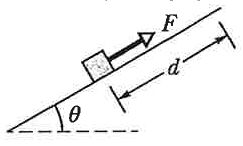
5. The figure shows a 4.00 kg block on a ramp. We pull on the block with force F = 50.0 N, directly up the ramp. The normal force on the block has magnitude = 13.407 N. The block starts from rest. The angle of the ramp is not given. What is the block's speed (m/s) when we have pulled the block up the ramp through displacement d = 3.00 m?
(A) 12.7 (B) 4.4 (C) 1.2 (D) 8.3 (E) 7.9
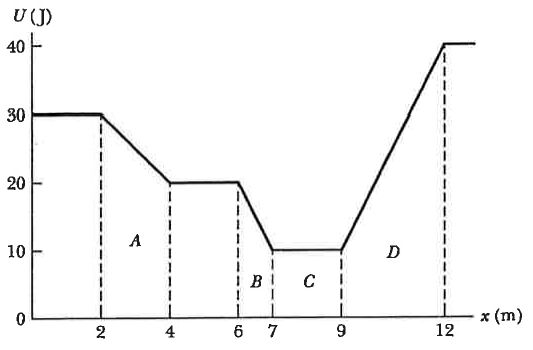
6. The figure shows a potential well for a particle that can move along an x axis. Four regions of the graph are lettered. Rank those regions according to the magnitude of the force that would act on the particle if it is the region, greatest first. () indicates a tie.
(A) C, (A,D), B (B) B, D, A, C (C) A, (B,D), C (D) (A,B,C,D) (E) (B,D), A, C
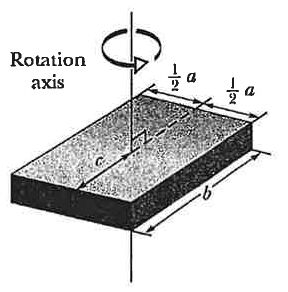
7. The figure shows a book-like object rotating around a perpendicular rotation axis through the given point along the center line that is drawn in dashes. The mass is 2.00 kg. The dimensions are a = 0.010 m, b = 0.020 m, and c = 0.0040 m. What is the rotational inertia (kg-m²)? The rotational inertia about a perpendicular axis through the center of mass is given by I =(a² + b²).
(A) (B) (C)(D) (E)
8. In an experiment, the water level in a container oscillates vertically in SHM with a period of 8.00 hours. The level changes height by 2.40 m. How long (hours) does the level take to drop 2.00 m from the highest point? (A) 2.93 (B) 0.52 (C) 1.55 (D) 4.32 (E) 5.68
9. A stationary listener hears frequency f₁ from a source moving directly toward the listener with a speed of 20.0 m/s. When the listener then moves directly toward the source with a speed of 30.0 m/s, the detected frequency f₂ differs from f₁ by 33.0 Hz. What is the frequency (Hz) of the source? Take the speed of sound to be 340 m/s. (A) 1.14×10³ (B) 899 (C) 352 (D) 2.24×10³ (E) 707
10. A Carnot engine with a high-temperature reservoir is at 380 K has an efficiency of 25.0%. By how much (K) should the temperature of the low-temperature reservoir be changed to increase the efficiency to 35.0%? (A) -18.0 (B) +24.0 (C) +14.0 (D) +32.0 (E) -38.0
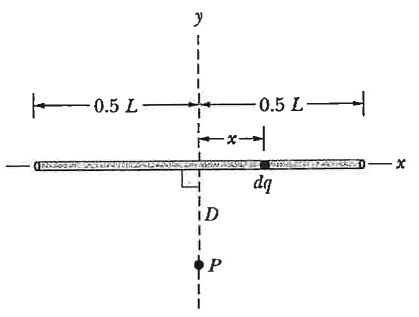
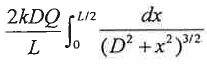
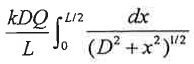
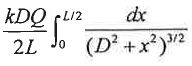
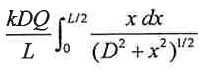
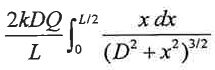
11. The figure shows a uniformly charged rod of total charge Q and total length L. Point P lies on the perpendicular bisector at distance D. Which of the following expressions best gives the magnitude of the electric field at P?
(A)(B)(C)(D) (E)
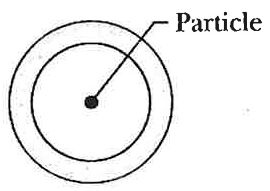
12. The figure shows (in cross section) a metal sphere with a hollow. A particle of charge -8.0Q is at the center of the sphere (at the center of the hollow). The metal of the sphere has a net charge of -12Q. What is the charge on the outside (external) surface of the sphere?
(A) +4.0Q (B) +8.0Q (C) -20Q (D) 0 (E) -4.0Q
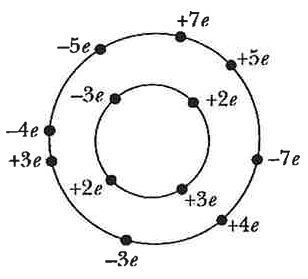
13. The figure shows an array of charged particles on two concentric circles. The smaller circle has radius 0.30 m; the larger one has radius 0.40 m. The charges are given in terms of the elementary charge e. What is the net electric potential (volts) at the center?
(A) (B)(C) (D) (E)
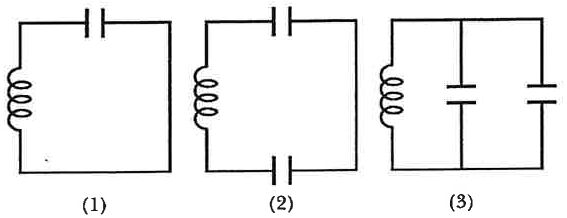
14. The figure shows three LC oscillators with identical inductors and capacitors. Rank the circuits according to the oscillation frequency, greatest first. () indicates a tie.
(A) 3, 2, 1 (B) 1, 2, 3 (C) (1,2,3) (D) (1,2), 3 (E) 2, 1, 3
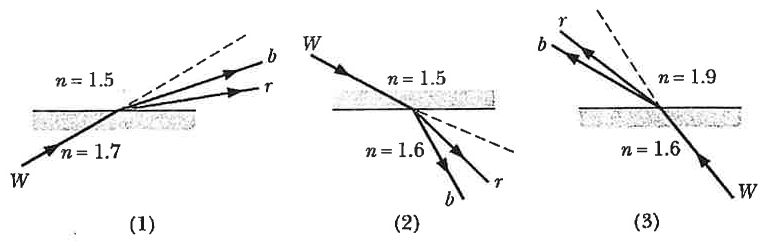
15. The figure shows three situations in which a white light ray (W) undergoes dispersion at an interface (only the blue and red components are drawn). The dashed line shows the straight-through (no deflection) direction. In which are the refracted rays physically possible?
(A) 1 and 2 (B) 1 and 3 (C) 2 and 3 (D) 2 only (E) all three
16. The figure shows a rectangular loop of wire that straddles three regions of uniform magnetic field. With B in teslas and time in seconds, the fields are B₁=3, B₂=4t, B₃=6. The dimensions are L = 2.0 m and d = 2.0 m. The circuit includes an ideal battery of 12 V. What is the magnitude of the net emf (V) in the loop?
(A) 4 (B) 28 (C) 0 (D) 40 (E) 65.0
17. Which is true about speed v of an inertial frame relative to us? (A) As v goes from 0 to infinity, Lorentz factor γ goes from 0 to infinity. (B) As v goes from 0 to infinity, Lorentz factor γ goes from 0 to 1. (C) As v goes from 0 to infinity, Lorentz factor γ goes from 1 to infinity. (D) As v goes from 0 to c, Lorentz factor γ goes from 0 to 1. (E) As v goes from 0 to c, Lorentz factor γ goes from 1 to infinity.
18. If the work function for a certain metal is 1.80 eV, what is the stopping potential (V) for electrons ejected from the metal when light of wavelength 350 nm shines on the metal? (A) 0.844 (B) 3.82 (C) 1.74 (D) 4.67 (E) 1.01
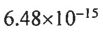
19. If an electron has a de Broglie wavelength of 2.40 pm (that is, 2.40× m), what is its kinetic energy (J)? This is a relativistic situation. Electron rest energy = 0.511 MeV. (A) (B) (C) (D) (E)
20. One-dimensional infinite potential wells: Here are the widths (lengths) L of three wells, each containing an electron. Rank them according to the de Broglie wavelength of the electron in the third excited state, greatest first. () indicates a tie.
L₁ = 100 pm, L₂ = 200 pm, L₃ = 300 pm (A) 3, 2, 1 (B) 1, 2, 3 (C) 3, (1,2) (D) 2, (1,3) (E) (1,2,3)
 阿摩線上測驗
登入
 (A) 11.2 (B) 5.05 (C) 9.58 (D) 8.07 (E) 4.10
 in meters and seconds. What is the magnitude (m/s²) of the acceleration at t = 3.00 s? (A) 505 (B) 141 (C) 341 (D) 409 (E) 807
 (A) 12 (B) 21 (C) 36 (D) 48 (E) 67
 (A) 11.9 (B) 31.6 (C) 24.7 (D) 5.00 (E) 53.4
 = 13.407 N. The block starts from rest. The angle of the ramp is not given. What is the block's speed (m/s) when we have pulled the block up the ramp through displacement d = 3.00 m?
 (A) 12.7 (B) 4.4 (C) 1.2 (D) 8.3 (E) 7.9
 (A) C, (A,D), B (B) B, D, A, C (C) A, (B,D), C (D) (A,B,C,D) (E) (B,D), A, C
 (a² + b²).
 (A)
 (B)
 (C)
 (D)
 (E)

 (A)
 (B)
 (C)
 (D)
 (E)
 (A) +4.0Q (B) +8.0Q (C) -20Q (D) 0 (E) -4.0Q
 (A)
 (B)
 (C)
 (D)
 (E)

 (A) 3, 2, 1 (B) 1, 2, 3 (C) (1,2,3) (D) (1,2), 3 (E) 2, 1, 3
 (A) 1 and 2 (B) 1 and 3 (C) 2 and 3 (D) 2 only (E) all three
 (A) 4 (B) 28 (C) 0 (D) 40 (E) 65.0
 m), what is its kinetic energy (J)? This is a relativistic situation. Electron rest energy = 0.511 MeV. (A)
 (B)
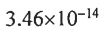 (C)
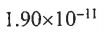 (D)
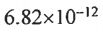 (E)
