所屬科目:研究所、轉學考(插大)-普通生物學
1. Which of the following best describes how an individual with genotype AaBbCCDdEE can make gametes with eight different genotypes. (A) mutations during meiosis form new alleles that are incorporated into the gametes (B) crossing over during prophase I leads to increased genetic diversity (C) the inheritance of a particular copy of one chromosome does not affect the inheritance of a different chromosome (D) dominant alleles tend to be inherited together
2. The following phylogeny shows six living species (a-f) and five ancestral (now extinct) species (1-5). If the phylogeny had been developed on the basis of similarities in bone structure, which of the following predictions would you make in terms of the structure of a particular enzyme? (A) The enzymes of species b and f are very similar. (B) The enzymes of species b and c are more similar to ancestor 4 than to ancestor 2. (C) The enzymes of species a and b are the same as that of ancestor 2. (D) The enzyme of species c is very similar to that of species d.
3. Carolus Linnaeus believed that species remained fixed in the form in which they had been created. Which of the following concepts are inconsistent with Linnaeus's model of classification? (A) a hierarchical classification scheme (B) taxonomy (C) phylogenies (D) nested, increasingly inclusive categories of organisms
4. Which of the following plant structures most directly produces the pollen tube of angiosperms? (A) male gametophyte (B) female gametophyte (C) male sporophyte (D) female sporophyte
5. The chloroplasts of land plants are thought to have been derived according to which evolutionary sequence? (A) cyanobacteria → green algae → land plants (B) cyanobacteria → green algae → fungi → land plants (C) red algae → brown algae → green algae → land plants (D) cyanobacteria → red algae → green algae → land plants
6. An animal cell that lacks carbohydrates on the external surface of its plasma membrane would likely be impaired in which of the following functions? (A) transporting ions against an electrochemical gradient (B) cell-cell recognition (C) attaching the plasma membrane to the cytoskeleton (D) establishing a diffusion barrier to charged molecules
7. Poliovirus is an RNA virus of the picornavirus group, which uses its RNA as mRNA. The RNA genome has a 5' RNA cap instead of a 5' methyl-G cap. This is followed by a non-translated leader sequence and then a single long protein-coding region (~7,000 nucleotides) followed by a poly-A tail. Infected cells were incubated with radioactive amino acids and viral proteins were isolated. After a short incubation with radioactive amino acids only very long viral proteins were seen, while longer periods of labeling result in several short polypeptides of different lengths. Which of the following conclusions is most consistent with the results described? (A) Host cell ribosomes translate the viral coding region and poly-A tail at different times resulting in the different populations of proteins. (B) The RNA is first translated into a single long protein, which is then cleaved into shorter ones. (C) The RNA is translated into short polypeptides, which are then assembled into large complexes. (D) The large radioactive polypeptides are coded by the host, whereas the short ones are coded by the virus.
8. Testosterone is an example of a chemical signal that affects, variously, the very cells that synthesize it in the testis, the neighboring cells, and distant cells outside the gonads. Thus, testosterone is an example of _______. (A) a neurohormone signal, a neuroendocrine signal, and an exocrine product (B) a paracrine signal, a synaptic signal, and an exocrine product (C) an autocrine signal, a neuroendocrine signal, and a synaptic signal (D) an autocrine signal, a paracrine signal, and an endocrine signal
9. Which of the following correctly describes the sequence of developmental milestones in chordates? (A) blastula → gastrula → cleavage (B) cleavage → gastrula → blastula (C) cleavage → blastula → gastrula (D) gastrula → blastula → cleavage
10. Long-term potentiation is required for which of the following functions? (A) elimination of memories, especially after trauma (B) integration of the somatosensory and motor systems (C) the integration of sight and sound into memories (D) memory storage and learning
11. Which of the following describes a way that some birds can navigate on an overcast night with solid cloud cover? (A) by detecting ultraviolet light from stars that penetrates the cloud cover (B) by detecting the Earth's rotation (C) by detecting the magnetic field of the Earth (D) by following rivers and major highways
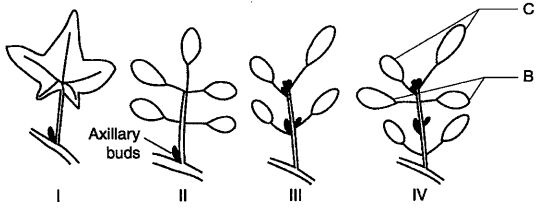
12. The following question is based on the figure below.In the diagram above, the dark "dots" represent axillary buds. Which diagram illustrates a compound leaf? (A) I only (B) II only (C) III only (D) both II and III
13. Which of the following processes reduces the size of a tadpole's tail during metamorphosis? (A) regeneration (B) apoptosis (C) oxidative phosphorylation (D) redifferentiation
14. Researchers were investigating the effects of bicoid in fruit fly development. The gene bicoid controls normal development of anterior structures in flies. In one experiment, they took a normally developing embryo and injected bicoid mRNA into the posterior end of the embryo. What result would they most likely observe? (A) The embryo would develop with a normal anterior end and anterior structures on the posterior end. (B) The embryo would develop with a normal posterior end and posterior structures on the anterior end. (C) The embryo would develop with anterior structures on the posterior end and posterior structures on the anterior end. (D) The embryo would develop with a normal anterior end and a normal posterior end.
15. Which of the following best represents the actions of photoautotrophs? (A) produce oxygen and use carbon dioxide (B) produce, and use, both oxygen and carbon dioxide (C) produce thermal energy to be used by other organisms (D) convert chemical energy to solar energy
16. Which of the following sequences is most likely to be cut by a restriction endonuclease? (A) 5'-AATTCT-3' / 3'-TTAAGA-5' (B) 5'-AATATT-3' / 3'-TTATAA-5' (C) 5'-AAAATT-3' / 3'-TTTTAA-5' (D) 5'-ACTACT-3' / 3'-TGATGA-5'
17. A particular triplet of bases in the template strand of DNA is 5'-AGT-3'. What would be the corresponding codon for the mRNA that is transcribed? (A) 3'-UCA-5' (B) 3'-ACU-5' (C) 5'-AGT-3' (D) 5'-UCA-3'
18. The half-life of carbon-14 is about 5,730 years. A fossil that has 1/16 of the normal proportion of carbon-14 to carbon-12 should be about how many years old? (A) 2,800 (B) 11,200 (C) 16,800 (D) 22,900
19. As you study two closely related predatory insect species, the two-spot and the three-spot avenger beetles, you notice that each species seeks prey at night when present in an area where the other beetle species is absent. However, where their ranges overlap, the two-spot avenger beetle hunts at night and the three-spot hunts in the morning. When you bring them into the laboratory and isolate the two different species, you discover that the offspring of both species are nocturnal. The observations above indicate that the two species most likely demonstrate which of following ecological processes? You have discovered an example of ______. (A) mutualism (B) character displacement (C) Batesian mimicry (D) resource partitioning
20. A newly discovered unicellular organism isolated from acidic mine drainage has a cell wall, a plasma membrane, two flagella, and peroxisomes. Based on this information only, the organism is most likely to be _______. (A) a nonmotile prokaryote (B) a motile bacterium (C) a motile archaea (D) a motile eukaryote
1. Chemiosmosis
2. Endosymbiont Theory
3. Allosteric Regulation
4. Alternative Splicing
5. Polymorphism
6. Homology
7. Monophyletic
8. Ecosystem
9. Homeostasis
10. X inactivation
a) Identify and describe the post-transcriptional modification mechanism that resolves this numerical paradox. (5 points)
b) Contrast the evolutionary and systemic consequences of a point mutation occurring within an exon (protein-coding sequence) versus a mutation occurring within an upstream regulatory sequence (such as an enhancer). Focus your discussion on the concept of Pleiotropy and organismal viability. (5 points)
c) Explain why simple diffusion across the outer body surface is sufficient for a microscopic single-celled organism, but entirely inadequate for a complex, multicellular mammal. (5 points)
d) Identify two distinct organ systems in the human body that have evolved complex, highly folded internal microstructures specifically to bypass this surface area limitation. For each system, identify the specific anatomical structure involved (e.g., a cellular or tissue-level structure) and describe how its specialized shape maximizes functional capacity. (5 points)
e) Describe the fundamental lifecycle known as Alternation of Generations. Clearly differentiate between the ploidy levels, structural roles, and reproductive products of the gametophyte generation versus the sporophyte generation. (5 points)
f) Analyze how the dominant life phase shifts as you move from non-vascular plants (Bryophytes) to seedless vascular plants (Monilophytes/Ferns) and finally to seed plants (Gymnosperms/Angiosperms). Explain the evolutionary advantage of maintaining a reduced, protected gametophyte within a dominant sporophyte body in a terrestrial habitat. (5 points)
 阿摩線上測驗
登入
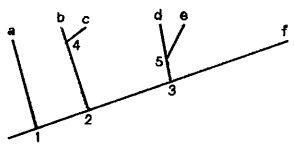 (A) The enzymes of species b and f are very similar. (B) The enzymes of species b and c are more similar to ancestor 4 than to ancestor 2. (C) The enzymes of species a and b are the same as that of ancestor 2. (D) The enzyme of species c is very similar to that of species d.