所屬科目:研究所、轉學考(插大)-普通生物學
1. Which of the following is NOT considered a valid line of scientific evidence supporting biological evolution? (A) The ability of individuals to adapt to their environment during their lifetime. (B) The fossil record showing transitional forms and changes in species over geological time. (C) Homologous structures in different species, indicating common ancestry. (D) Similarities in early embryonic development across vertebrate species. (E) Molecular similarities, such as shared DNA sequences and proteins among organisms.
2. The Hardy-Weinberg principle states that allele and genotype frequencies in a population will remain constant from generation to generation if certain conditions are met. Which of the following is one of the required assumptions for a population to be in Hardy-Weinberg equilibrium? (A) Natural selection favors heterozygotes. (B) Mutations occur at equal rates in both directions. (C) The population is infinitely large and mating is random. (D) Allele frequencies change slowly over time. (E) Individuals acquire beneficial traits during their lifetime.
3. In a population that is in Hardy-Weinberg equilibrium. For a locus with two alleles, A and a. If the allele frequency of A is 0.4. What is the frequency of Aa heterozygotes? (A) 0.04 (B) 0.16 (C) 0.24 (D) 0.48 (E) 0.36
4. Which of the following descriptions is incorrect for a recognized type of natural selection? (A) Directional selection: A mode of natural selection in which individuals with phenotypes at one extreme of a trait distribution have higher fitness than those with intermediate or opposite extreme phenotypes. (B) Stabilizing selection: A mode of natural selection that favors both phenotypic extremes over intermediates, potentially increasing variation and leading to a bimodal distribution or speciation. (C) Balancing selection: A mode of natural selection that maintains genetic diversity in a population by favoring multiple alleles, often through mechanisms like heterozygote advantage or varying selection pressures across environments. (D) Purifying selection: A mode of selection that removes deleterious mutations or alleles, preserving functional genetic sequences and reducing genetic variation at conserved loci. (E) Frequency-dependent selection: A mode of selection where a phenotype's fitness depends on its frequency in the population—often, rare phenotypes have higher fitness.
5. Which of the following situations is best explained by the Biological Species Concept? (A) Two populations of frogs live in the same habitat and overlap in breeding season, but mating between them produces no viable or fertile offspring due to intrinsic reproductive barriers. (B) Fossil shells from different sedimentary layers show gradual changes in shape over millions of years, allowing paleontologists to distinguish "species" based on morphology. (C) Two groups of bacteria are classified as different species because they have less than 70% DNA similarity and differ in several metabolic pathways. (D) Closely related orchid varieties are considered separate species because each is pollinated exclusively by a different insect species, even though they could produce fertile hybrids in a greenhouse. (E) Two populations of birds have diverged genetically on different islands and form a monophyletic group on a phylogenetic tree, distinct from all other birds.
6. Continuing from Question 5, which of the situations above is best explained by the Phylogenetic Species Concept? (A) A (B) B (C) C (D) D (E) E
7. Which of the following is an example of gametic isolation? (A) Two fern species with overlapping ranges produce hybrid spores that germinate poorly and fail to develop into viable gametophytes due to differences in ploidy. (B) In sympatric frog populations, one species calls only at night while the other calls during the day, preventing mating attempts. (C) Pollen grains from one plant species land on the stigma of another species but fail to germinate. (D) Two populations of lizards on adjacent islands rarely meet due to geographic separation by ocean barriers. (E) Two bird species have distinct courtship dances; females mate only with males performing the correct display.
8. Continuing from Question 7, which of above scenarios is an example of postzygotic isolation? (A) A (B) B (C) C (D) D (E) E
9. Which statement best supports the endosymbiotic theory for the origin of mitochondria and chloroplasts? (A) They are found only in multicellular eukaryotes. (B) They contain their own linear DNA similar to nuclear chromosomes. (C) They divide asexually by mitosis within eukaryotic cell. (D) They have circular DNA and 70S ribosomes. (E) Mitochondria and chloroplasts are surrounded by a single membrane, similar to the plasma membrane of some prokaryotes.
10. Which of the following eukaryotic groups lacks a multicellular stage with cellular differentiation in their life cycle? (A) Animals (Metazoa) (B) Land plants (Embryophyta) (C) Red algae (Rhodophyta) (D) Brown algae (Phaeophyta) (E) Diatoms (Diatomeae)
11. Which leaf trait is most directly associated with efficient photosynthesis in high-light environments? (A) A thick cuticle and reduced stomatal density, which primarily limit water loss. (B) Kranz anatomy, in which bundle sheath cells rich in chloroplasts surround the vascular tissue and are encircled by mesophyll cells, enabling spatial separation of initial CO2 fixation and the Calvin cycle. (C) Large intercellular air spaces in the spongy mesophyll that facilitate internal gas diffusion. (D) A thin epidermis lacking chloroplasts, allowing light to penetrate underlying tissues. (E) Increased trichome density on the leaf surface, reflecting excess radiation.
12. What is a primary ecological consequence of spring turnover in dimictic lakes following ice melt? (A) Permanent establishment of thermal stratification that lasts through winter. (B) Redistribution of oxygen from surface to deep layers and nutrients from sediments to the surface photic zone. (C) Depletion of nutrients in surface waters as they sink with dense cold water. (D) Immediate onset of anoxia throughout the water column due to rapid mixing. (E) Suppression of phytoplankton blooms because cold water remains at the surface.
13. Which of the following survivorship curves is most characteristic of a species that exhibits an r-strategy (r-selected) life history? (A) Type I: High survivorship through most of life, with mortality concentrated at old age. (B) Type II: Constant mortality rate throughout life, with a relatively straight line on a log scale. (C) Type III: Extremely high early mortality, with very few individuals surviving to reproductive age, but high survivorship thereafter. (D) Type I with a slight dip in mid-life due to predation pressure. (E) A curve that starts flat and then drops sharply at reproductive maturity.
14. In which type of environment would you most expect a species with a K-selected life history to be favored? (A) Environments with frequent disturbances, rapid population turnover, and strong selection for early reproduction. (B) Highly variable habitats where success depends on producing many small offspring quickly. (C) Stable, resource-limited environments where competitive ability, stress tolerance, and long lifespan are favored. (D) Newly colonized habitats with abundant open space and low competition. (E) Environments dominated by density-independent mortality such as floods or fires.
15. Which of the following scenarios best illustrates commensalism between two organisms? (A) Clownfish live among the tentacles of sea anemones, gaining protection from predators while the anemones benefit from increased nutrient input. (B) Cattle egrets forage near grazing rhinoceroses, catching insects disturbed by the rhinos' movement, without affecting the rhinos. (C) A harmless hoverfly evolves yellow-and-black stripes resembling those of stinging wasps, deterring predators. (D) Mycorrhizal fungi form associations with plant roots, providing nutrients to the plant in exchange for sugars produced by photosynthesis. (E) Orchids of the genus Anguloa produce flowers that mimic the scent and shape of female Euglossine bees, attracting male bees that attempt to mate and inadvertently pollinate the flowers.
16. Continuing from Question 15, which of the situations above is an example of Batesian mimicry? (A) A (B) B (C) C (D) D (E) E
17. Which of the following statements best illustrates the difference between a realized niche and a fundamental niche? (A) The realized niche is the full range of environmental conditions under which a species can survive and reproduce in the absence of competitors or predators, while the fundamental niche is the actual portion of that range the species occupies when biotic interactions are present. (B) The realized niche is limited only by abiotic factors such as temperature and moisture, while the fundamental niche also includes the species' preferred habitat selected through evolutionary adaptation. (C) The realized niche is always larger than the fundamental niche because species evolve to specialize in narrower conditions over time. (D) The realized niche describes where a species currently lives in nature, while the fundamental niche represents the broader conditions it could theoretically tolerate in laboratory experiments. (E) The realized niche and fundamental niche are identical in most species because biotic interactions rarely restrict distribution.
18. Which of the following statements best describes the relationships among species richness, abundance, and the components of regional diversity? (A) Alpha diversity is the total species richness of a region, beta diversity measures evenness of abundance within a single site, and gamma diversity is the average across local sites. (B) Species richness is simply the number of species in a community, while abundance refers to the relative number of individuals per species. (C) Beta diversity is always higher than alpha diversity because it includes rare species missed in local sampling, while gamma diversity is the product of alpha and species abundance. (D) Gamma diversity equals alpha diversity because regional scale simply aggregates local communities without adding new species through turnover. (E) Evenness (abundance distribution) has no effect on species richness, and beta diversity is calculated solely from differences in species abundance, not composition.
19. Which of the following scenarios best illustrates top-down control in an ecosystem? (A) Nutrient enrichment in a lake increases phytoplankton growth, which then supports higher zooplankton and fish populations. (B) Reintroducing wolves to Yellowstone reduces elk grazing pressure, triggering a trophic cascade that allows woody vegetation and associated animal populations to recover. (C) Increased sunlight due to forest clearing boosts primary production, leading to higher herbivore biomass and more predators. (D) Fertilization of a grassland stimulates plant growth, resulting in larger populations of insects and insectivorous birds. (E) Drought reduces plant productivity, causing declines in herbivore numbers and subsequently fewer carnivores.
20. Which of the following best explains why ocean acidification, driven by increasing atmospheric CO2 from global warming, poses a major threat to organisms that build shells or skeletons from calcium carbonate (CaCO3)? (A) Rising sea temperatures directly dissolve existing CaCO3 structures in corals and mollusks. (B) Increased CO2 in seawater reacts to form carbonic acid, lowering pH and decreasing the concentration of carbonate ions (CO3 2−), making it harder for marine organisms to precipitate CaCO3. (C) Global warming reduces ocean salinity, preventing calcium ions from binding effectively with carbonate ions. (D) Ocean acidification increases the availability of carbonate ions, causing excessive and uncontrolled CaCO3 deposition that smothers organisms. (E) Higher CO2 levels promote photosynthesis in calcifying algae, depleting calcium ions from seawater and starving shell-forming animals.
21. Based on the mammalian phylogeny shown in Figure 1, which of the following statements are true? (select all that apply) (A) Marsupialia is much more ancient than all other mammalian lineages. (B) Marsupialia is phylogenetically more closely related to Afrotheria than to Rodentia. (C) Chiroptera is phylogenetically more closely related to Perissodactyla than to Primates. (D) Lagomorpha is the sister group to Rodentia. (E) The rate of nucleotide evolution in Primates is much faster than in Lagomorpha.
22. Based on the inferred evolutionary history of diet shown in Figure 1, which of the following statements are true? (select all that apply) (A) Herbivory is homoplasy within Marsupialia. (B) The occurrence of carnivory in Chiroptera and Eulipotyphla is the result of convergent evolution. (C) Herbivorous Chiroptera forms a paraphyletic group. (D) Omnivory has been lost multiple times within Perissodactyla + Cetartiodactyla. (E) Herbivory is a synapomorphic trait of Lagomorpha.
23. Figure 2 and Figure 1 are derived from the same dataset. Based only on the information shown in Figure 2, which of the following statements can be supported? (Select all that apply). (A) This study addresses macroevolutionary processes, rather than microevolutionary processes. (B) Herbivorous mammals exhibit a higher nucleotide evolutionary rate than omnivorous and carnivorous mammals. (C) Herbivorous mammals exhibit a higher speciation rate than omnivorous and carnivorous mammals. (D) More omnivorous lineages were derived from herbivores than from omnivores. (E) An herbivorous lineage is more likely to transition to omnivory than to carnivory.
24. Considering both Figure 1 and Figure 2 which of the following conclusions are best supported? (7.5%;Select all that apply) (A) Dietary strategy has no effect on mammalian diversification. (B) Repeated transitions among dietary strategies have contributed to mammalian diversification. (C) Omnivory is an irreversible evolutionary state in mammals. (D) The inferred probability of direct transitions between herbivory and carnivory is low, with most transitions occurring via an intermediate omnivorous stage. (E) Ecological specialization, in this case, can promote rather than limit long-term diversification.
25. Figure 3 illustrates the life cycle of a fern, in which four unicellular stages are labeled ①-④. Assuming the haploid chromosome number (n) = 34, which of the following statements are true? (select all that apply.) (A) Cell ① is derived from a spore mother cell through meiosis. Each spore mother cell produces 64 spores in leptosporangiate ferns. (B) Cell ② is produced by mitosis in a female or hermaphroditic gametophyte. (C) Cell ② has 17 chromosomes in its nucleus. (D) Cell ③ is the male gamete of the fern. (E) Cell ④ is expected to be homozygous across the genome.
26. Based on the life cycle of ferns shown in Figure 3, which of the following statements are true? (select all that apply.) (A) The life cycle of this fern is haplodiplontic. (B) The alternation of generations in this fern is isomorphic. (C) This fern is isogamous. (D) Cell ① is the primary dispersal unit in this fern. (E) The young sporophyte is dispersed within maternal protective tissue (a seed).
27. Explain the concept of reinforcement in the context of speciation. Include a definition, how it works, and provide a specific example from nature. Your answer should be clear, concise, and demonstrate understanding of speciation processes.
 阿摩線上測驗
登入
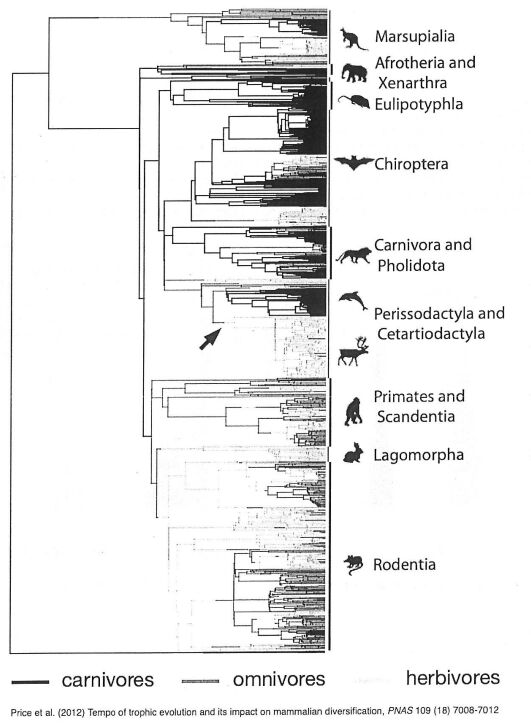
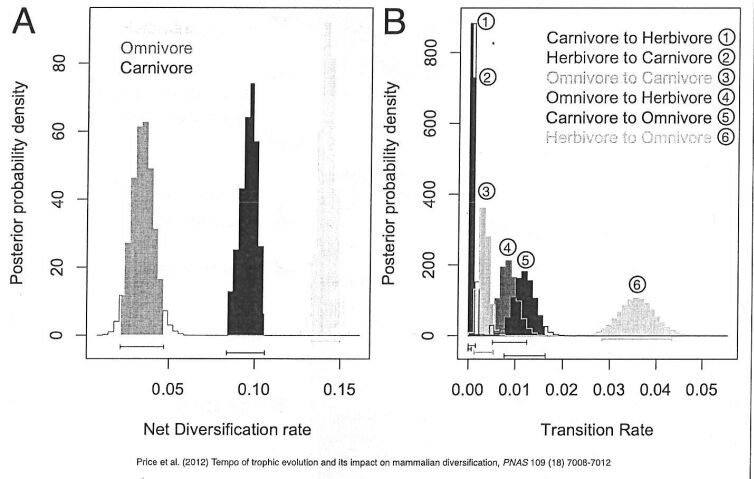 (A) Dietary strategy has no effect on mammalian diversification. (B) Repeated transitions among dietary strategies have contributed to mammalian diversification. (C) Omnivory is an irreversible evolutionary state in mammals. (D) The inferred probability of direct transitions between herbivory and carnivory is low, with most transitions occurring via an intermediate omnivorous stage. (E) Ecological specialization, in this case, can promote rather than limit long-term diversification.