所屬科目:研究所、轉學考(插大)-基礎數學
1. Find the limit for \( \lim_{x\to \pi}(\csc \frac{x}{2})^{\tan^2\frac{x}{2}} = ? \)
2. Find the limit for \( \lim_{n\to \infty}\frac{\pi}{\sqrt{n^2 + 1}} +\frac{\pi}{\sqrt{n^2 + 2^2}} +\dots +\frac{\pi}{\sqrt{n^2 + n^2}} = ? \)
3. Find the slope of the tangent line to the curve$2(x^2 + y^2)^2 + (x^2 - 1) = 25(x^2 - y^2) + 2^x \text{ at point } (3, 1).$
4. Find the indefinite integral \( \int \frac{1}{\sqrt{4 + c^2}} dx = ? \)
5. Find the definite integral \( \int_0^4\int_0^{\sqrt{1 - x^2}}e^{x^2 +y^2}dydx = ? \)
II. Linear Algebra1. (10%) Suppose $\underline{x}$ and $\underline{y}$ are two linearly independent vectors in $R^n$, and let U be the span of $\underline{x}$ and $\underline{y}$, that is $U = \text{span}\{\underline{x}, \underline{y}\}$. Let $A = \underline{x}\underline{y}^T + \underline{y}\underline{x}^T$.Prove that the null space N(A) is orthogonal to U, meaning every $\underline{v}$ in N(A) is orthogonal to every $\underline{w}$ in U.
(a) \( (10\%) \) Show that \( P = QQ^{T} \)
(b) (5%) Let \( Q = \left[ \underline{q}_1 \quad \underline{q}_2 \quad \dots \quad \underline{q}_n \right] \). Show that \( \underline{x} \) can be written as a linear combination of \( \underline{q}_1, \underline{q}_2, \dots, \underline{q}_n \) and represented by$\underline{x} = (\underline{q}_1^T\underline{b})\underline{q}_1 + (\underline{q}_2^T\underline{b})\underline{q}_2 + \dots + (\underline{q}_n^T\underline{b})\underline{q}_n$
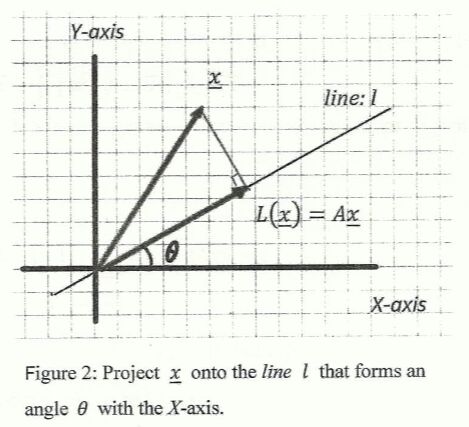
3. Let $L: R^2 \to R^2$ denote the mapping of a vector $\underline{x}$ onto its orthogonal projection on a line l passing through the origin, which forms an angle $\theta$ with the X-axis as shown in Figure 2. Let A be the matrix that corresponds to this mapping, i.e., $L(\underline{x}) = A\underline{x}$. Find A by each method below.(a) (10%) Method 1: According to the formula \( A = \left[L\left(\underline{e}_1\right)L\left(\underline{e}_2\right)\right] \), where \( \underline{e}_1 = \begin{bmatrix} 1 \\ 0 \end{bmatrix} \) and \( \underline{e}_2 = \begin{bmatrix} 0 \\ 1 \end{bmatrix} \), \( A \) is obtained by evaluating the mappings on the standard basis vectors \( \underline{e}_1 \) and \( \underline{e}_2 \).
i. First, apply $L_{-\theta}$ as a clockwise rotation about the origin by $\theta$ radians. Determine $A_1$ such that $L_{-\theta}(\underline{x}) = A_1\underline{x}$.
ii. Next, carry out $L_x$ as an orthogonal projection of any vector $\underline{x}$ onto the X-axis. Determine $A_2$ such that $L_x(\underline{x}) = A_2\underline{x}$.
iii. Finally, execute a counterclockwise rotation $L_\theta$. Determine $A_3$ such that $L_\theta(\underline{x}) = A_3\underline{x}$. Calculate $A = A_3A_2A_1$. (The result should match the answer given in part (a).)
 阿摩線上測驗
登入