所屬科目:研究所、轉學考(插大)-微積分
(i) Find the inverse function of f(x).
(ii) Write down the domain and the range of f(x) and separately, and construct their relationship.
(iii) Check your results in (i) algebraically by evaluating f() and (f(x)) both equal to x.
(iv) Sketch the graphs of f(x) and . Are the graphs of f(x) and reflections of each other? If they were, described the reflection line and prove it; if they were not, explained your results.
(v) Do f(x) and define themselves as functions? Are they one-to-one functions? How do you get your results?
(i) If y = f(x)g(x), then y' = f'(x)g'(x).
(ii) If f(x) is an nth-degree polynomial, then = 0.
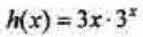
(iii)
(i) h(x) = x²[2x+3]
(ii)
(iii) h(x) = ln|csc(x²) - cot(x²)|
(iv)
(v)
(i)
(v) ∫sec³(x) dx
(vi)
5. Sketch the graph of the function . Label the intercept, relative extremes, points of inflection, and asymptotes. State the domain of the function.
6. Apply Taylor's Theorem to find the power series (centered at 0) for the function , and find the radius of convergence.
 阿摩線上測驗
登入
阿摩線上測驗
登入
 of f(x).
  separately, and construct their relationship.
  ) and
) and  (f(x)) both equal to x.
  . Are the graphs of f(x) and
  reflections of each other? If they were, described the reflection line and prove it; if they were not, explained your results.
  define themselves as functions? Are they one-to-one functions? How do you get your results?
 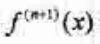 = 0.
= 0.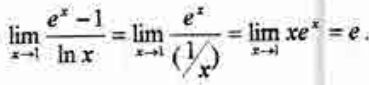
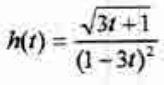
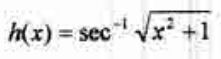
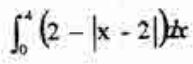
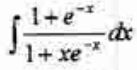
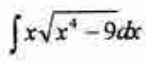
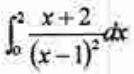
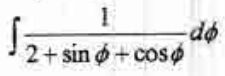
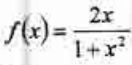 . Label the intercept, relative extremes, points of inflection, and asymptotes. State the domain of the function.
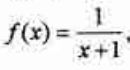 , and find the radius of convergence.