所屬科目:研究所、轉學考(插大)◆普通化學
1. How many electrons are transferred in the following reaction? \[ \text{SO}_3^{2-}(aq) + \text{MnO}_4^{-}(aq) \rightarrow \text{SO}_4^{2-}(aq) + \text{Mn}^{2+}(aq) \](A)6 (B)2 (C)10 (D)4 (E)3
2. What mass of Cr can be produced from CrO3 in 1.0 h with a current of 15 A? (Cr = 52 g/mol, F=96485C) (A) 52 g (B) 3 g (C) 1 g (D) 4.9 g Cr (E) cannot produce Cr from CrO3
3. Which one of the following best describes cathodic protection? (A) cover the metal surface so that no contact occurs between the metal and air. (B) cover the metal surface so that no contact occurs between the metal and air. (C) a more easily oxidized metal is placed in electrical contact with the metal. (D) adding chromium and nickel to steel (E) coating steel with zinc
4. In defining sizes of orbitals, why must we use an arbitrary value, such as 90% of the probability of finding an electron in that region? (A) Because 90% is a nice number (B) 90% is not arbitrary, but a calculated number (C) We arrive at 90% because it is the square of the wavefunction ψ2 (D) 90% is good enough to describe the location of an electron. (E) We can never be 100% certain of the location of the electron due to Heisenburg’s uncertainty principle
5. Rank the following bonds in order of increasing ionic character: N-O, Ca-O, C-F, Br-Br, K-F. Select the best answer below. (AB) N-O<Ca-O<C-F< Br-Br<K-F (AC) N-O<Ca-O<C-F<K-F<Br-Br(AD) N-O<C-F<Ca-O<K-F<Br-Br (AE) K-F<N-O<C-F<Ca-O<Br-Br(BC) Br-Br<N-O<C-F<Ca-O<K-F (BE) Br-Br<C-F<N-O<Ca-O<K-F
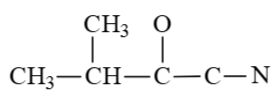
6. Complete the Lewis structure for the molecule This molecule has __________ single bonds and __________ multiple bonds. (A) 4, 2 (B) 6, 3 (C) 11,5 (D)11,2 (E) 13,0
7. 1.7 mols of H2AsO3 contains this many oxygen atoms (A) 17 (B) 214.098 (C) 1.29 x 1026 (D) 3.07 x 1024 (E) None of the above
8. How much energy is needed to heat 4.5 mols of water (specific heat: 4.18 J/g°K) from 10°C to50°C? (MH2O = 18 g/mole) (A) 1350 J (B) 13.5kJ (C) 0.752 kJ (D) 15 kJ (E) 1500 J
9. The oxidation state of selenium in H2SeO3 is (A) 8+ (B) 6+ (C) 5+ (D) 4+ (E) None of the above
10. A system receives 575 J of heat and delivers 425 J of work. Calculate the change in the internal energy, ΔE, of the system. (AB) -150 J (AC) 150 J (AD) -1000 J (AE) 1000 J (BC) 575 J (BD) None of the above
11. The shape of ammonia is (AB) linear (AC) trigonal planar (AD) trigonal pyramidal (AE) tetrahedral (BC) T-shaped (BD) octahedral (BE) See-saw
12. Consider the unbalanced equation: \[ \text{C}_7\text{H}_{16} + \text{O}_2 \rightarrow \text{CO}_2 + \text{H}_2\text{O} \]What coefficient belongs in front of O2 in the balanced equation? (A) 10 (B) 11 (C) 12 (D) 22 (E) None of the above
13. This molecule possesses the strongest bond (A) CH4 (B) I2 (C) C2H2 (D) C2H4 (E) C2H6
14. This molecule possesses the shortest bond (A) I2 (B) Cl2 (C) Br2 (D) F2 (E) Can not be determined
15. Which color of light is associated with the highest energy? (A)Orange (B)Green (C)Blue (D)Yellow (E) Can not be determined
(A)Draw the Lewis Structure of BF3 (3%)
(B)Draw a VSEPR diagram of BF3. Label the bond angles. (3%)
(C) Draw and label all of the empty orbitals and orbitals involved in bonding for BF3 (6%)
(D) Is this molecule polar? Draw all bond dipoles and explain. (3%)
2. A sample of lead is heated to 96.0°C and is placed in a calorimeter that contains 50.0g of water at 21.5°C. The final temperature of the calorimeter is 29.0°C. If the specific heat of lead is 0.128 J/g•°C, what is the mass of the lead sample? (the specific heat of water is 4.18 J/g•°C) (10%)
3. Calculate the standard enthalpy of the formation of acetylene from its elements. The following information will help you. (10%) \( 2\text{C (graphite)} + \text{H}_2\text{(g)} \rightarrow \text{C}_2\text{H}_2\text{(g)} \)\( \text{C(graphite)} + \text{O}_2\text{(g)} \rightarrow \text{CO}_2\text{(g)} \quad \quad \Delta\text{H}^{\circ}=-393.5 \text{ kJ} \)\( \text{H}_2 \text{ (g)}+ 1/2\text{O}_2\text{(g)} \rightarrow \text{H}_2\text{O(g)} \quad \quad \Delta\text{H}^{\circ}= -285.8 \text{ kJ} \)\( 2\text{C}_2\text{H}_2 \text{ (g)} + 5\text{O}_2\text{(g)} \rightarrow 4\text{CO}_2\text{(g)} + 2\text{H}_2\text{O} \quad \quad \Delta\text{H}^{\circ}=-2598.8 \text{ kJ} \)
(A) 50g of ammonia reacts with excess of I2 to produce NI3 in 85% yield. What mass of NI3 is produced? (assume only HI and NI3 are produced) (10%)
(B) All of the NI3 from part a is placed in a 1 L container and detonated, producing I2 and N2 in 100% yield. If the box is at 25°C, an can only support a pressure of 1520 torr, will the box explode? (Gas constant; R= 0.08206 L-atm/(mol-K)) (10%)
 阿摩線上測驗
登入