所屬科目:研究所、轉學考(插大)◆普通物理學
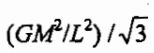
Problem of 1and 2:Three identical stars, each star's mass is M, form an equilateral triangle that rotates around the triangle's center as the stars move in a common circle about that center. The triangle has edge length L. (The gravitational constant is G)1. What is the net force on each star?(A)2(GM²/L²) (B)(C)(GM²/L²)/2 (D)(E)None of the above
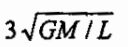
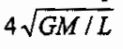
2. What is the speed of the stars? (A)(B) (C) (D) (E)None of the above
3. What is the angular speed of the system just after the putty wad hits?(A)1.148 rad/s (B)11.48 rad/s (C)0.0148 rad/s (D)0.1480 rad/s (E)None of the above
4. What is the ratio of the kinetic energy of the system after the collision to that of the putty wad just before?(A)0.0123 (B)0.123 (C)1.23 (D)12.3 (E)None of the above
5. Inside the sphere, at what distance from the sphere's center are there points where the gravitational acceleration is ag/3? (A)R/5 (B)R/4 (C)R/3 (D)R/2 (E)None of the above
6. Outside the sphere, at what distance from the sphere's center are there points where the gravitational acceleration is ag/3? (A uniform solid sphere of radius R produces a gravitational acceleration of a_g on its surface.) (A) R (B) R (C)2R (D)3R (E)None of the above
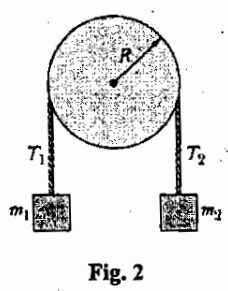
Problem of7and8 :In Fig. 2, the block 1 has mass m₁ = 460 g and block 2 has mass m₂ = 500 g, and the pulley, which is mounted on a horizontal axle with negligible friction, has radius R = 5 cm. When released from rest, block 2 falls 75 cm in 5 s without the cord slipping on the pulley.7. What is the magnitude of the acceleration of the blocks? (A)0.02 m/s² (B)0.2 m/s² (C)2 m/s² (D)20 m/s² (E)None of the above
8. What is the magnitude of the Tension T₁?(A)454 N (B)45.4 N (C)4.54 N (D)0.454 N (E)None of the above
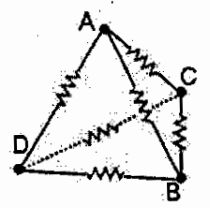
9. A resistor R lies along each edge of a triangular pyramid (6 resistors in total), with connections at the corners. Find the equivalent resistance between point A and B. (A)R/3 (B)R/2 (C)R/6 (D)R (E)None of the above
10. In a double slit experiment, the spacing between the two slits is d, and the slit width is a. On a screen far away, the central diffraction maximum contains exactly seven interference fringes. (The interference maximum m = ±4 fall exactly on the position of the first diffraction minimum. What is the ratio of d/a? (A)4 (B)7 (C)8 (D)9 (E)None of the above
11. The earth can be treated as a conductor with electric charge on its surface. The resulting electric field near the surface is measured to be 150 N/C directed toward the center. The earth's radius is 6.38×10⁶m. What is the surface charge density of the earth? (A)-1.67 nC/m² (B)-1.67 C/m² (C)-1.33 nC/m² (D)-1.33 pC/m² (E)None of the above
12. An Alpha particle (charge = +2e) with kinetic energy 11 MeV makes a head on collision with a lead nucleus at rest (charge of lead nucleus = +82e). What is the distance of closest approach of the two particles? (Assume the lead nucleus remains stationary after the collision and is treated as a point particle.) (A)3.28×10⁻¹⁵ m (B)5.75×10⁻¹⁴ m (C)2.15×10⁻¹⁴ m (D)6.24×10⁻¹⁴ m (E)None of the above
13. John uses a multi-meter to measure the voltage across the battery when the switch S is open, and finds it is 1.5 Volt. When the switch is closed, and the battery is connected to a 10 Ω resistor, he finds the voltage across the battery is 1.25 Volt. What's the internal resistance of the battery? (A)8.33 Ω (B)2.0 Ω (C)1.67 Ω (D)2.5 Ω (E)None of the above
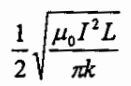
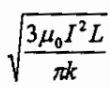
14. A pair of long rigid metal rods, each of length L, lie parallel to each other on a smooth table. Their ends are connected by two identical conducting springs with spring constant k and negligible unstretched length. If a current I runs through this circuit, by how much will each spring stretch?
(A)(B)(C)(D) (E)None of the above
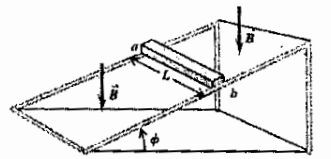
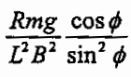
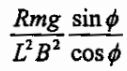
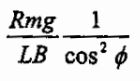
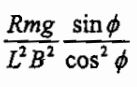
15. A metal bar with length L, mass m and resistance R is placed on frictionless metal rails inclined at an angle φ. A uniform magnetic field B is directed downward. The bar is released from rest and slides down the rails. What is the terminal velocity of the bar?(A) (B)(C)(D)(E)None of the above
16. A 5-μF capacitor is initially charged to 16 Volt, and is then connected in series with a 3.75-mH inductor. They form a loop and current starts to flow. What is the maximum current (in ampere) in the inductor? (A)0.584 (B)0.375 (C)0.06 (D)0.853 (E)None of the above
17. A grating with line spacing d is used to separate light of different wavelength by the second order diffraction. θ is the diffraction angle of light with wavelength λ. The dispersion of the grating defined as dθ/dλ can be expressed as (A)sinθ/λ (B)2cosθ/λ (C)sinθ/2λ (D)tanθ/λ (E)None of the above
18. A proton (m=1.67×10⁻²⁷ kg) has a speed of 0.95c in the laboratory. Its total energy is: (A)20 MeV (B)300 MeV (C)2.0×10³ MeV (D)3.0×10³ MeV (E)None of the above
19. An astronaut in a spaceship traveling at 0.64c passing just above a bridge, parallel to the length of the bridge, measures the length of the bridge over a river on earth nearby to be 146 m. The real length of the bridge is: (A)130 m (B)170 m (C)190 m (D)210 m (E)None of the above
20. A photon γ hits an electron (the electron mass = mₑ) at rest, producing an electron-positron pair, i.e. γ + e⁻ → e⁻ + e⁺ + e⁻. What is the minimum energy of the incident photon? (A)0 (B)mₑc² (C)2mₑc² (D)3mₑc² (E)4mₑc²
21. If the energy of a photon E is expressed in electron-volts and its wavelength in nanometers, they are related by: (A)E=1240 (B)E=1240/λ (C)E=1240 λ² (D)E=1240/λ² (E)None of the above
22. An electron has a kinetic energy of 1.8 KeV. If its momentum is measured with an uncertainty of 0.1%, what is the minimum uncertainty in its position? (A)0 (B)3 m (C)3×10⁻⁸ m (D)3×10⁻¹¹ m (E)None of the above
23. A sample of ideal gas in a cylinder is compressed adiabatically to one-third its original volume. During the process, 63 J of work is done on the gas. How much heat flows to the gas? (A)63 J (B)-63 J (C)31 J (D)-31 J (E)None of the above
24. A mole of an ideal gas undergoes a reversible isothermal expansion from volume V to 2V. What is the change in entropy of the gas. (A)0 (B)R (C)2R (D)R ln 2 (E)None of the above
25. An engine has a maximum theoretical efficiency of 36%. The temperature difference between the input and the output is 432°C. The temperature of the exhaust is: (A)432°C (B)645°C (C)768°C (D)840°C (E)None of the above
 阿摩線上測驗
登入
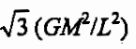 (C)(GM²/L²)/2 (D)
 (E)None of the above
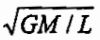 (B)
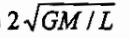 (C)
 (D)
 (E)None of the above
 R (B)
 R (C)2R (D)3R (E)None of the above
 (A)4 (B)7 (C)8 (D)9 (E)None of the above
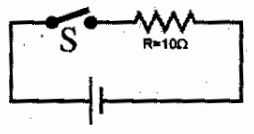 (A)8.33 Ω (B)2.0 Ω (C)1.67 Ω (D)2.5 Ω (E)None of the above
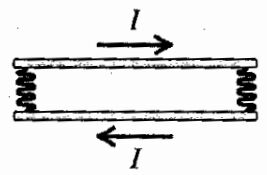 (A)
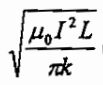 (B)
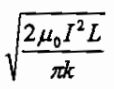 (C)
 (D)
 (E)None of the above
 (A)
 (B)
 (C)
 (D)
 (E)None of the above