阿摩線上測驗
複選題
7 最常見的持續性心律不整為何?(一律給分)
(A)上心室性心搏過速(supraventricular tachycardia)
(B)心室性心搏過速(ventricular tachycardia)
(C)心房顫動(atrial fibrillation)
(D)心房撲動(atrial flutter)
統計: A(42), B(31), C(44), D(27), E(0) #1054362
詳解 (共 3 筆)

2016 Guidelines of the Taiwan Heart Rhythm Society and the Taiwan Society of Cardiology for the Management of Atrial Fibrillation 第一句開場白就說:Atrial fibrillation (AF) is the most common sustained arrhythmia.

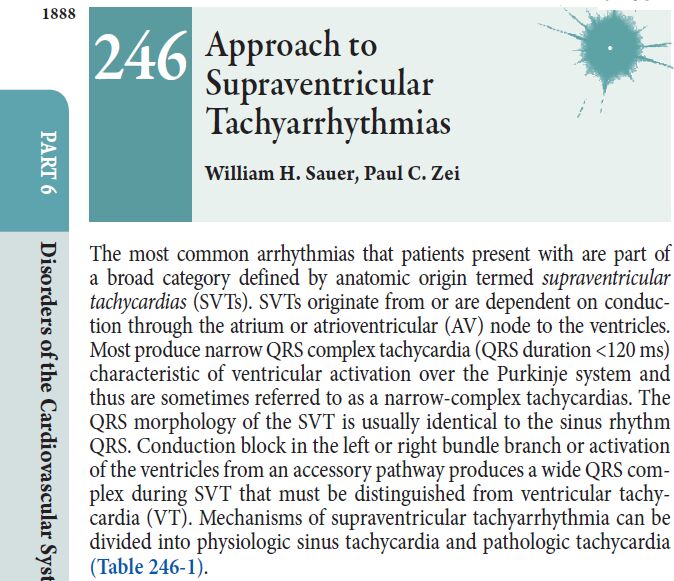
The most common arrhythmias that patients present with are part of a broad category defined by anatomic origin termed supraventricular tachycardias (SVTs). SVTs originate from or are dependent on conduction through the atrium or atrioventricular (AV) node to the ventricles. Most produce narrow QRS complex tachycardia (QRS duration <120 ms) characteristic of ventricular activation over the Purkinje system and thus are sometimes referred to as a narrow-complex tachycardias. The QRS morphology of the SVT is usually identical to the sinus rhythm QRS. Conduction block in the left or right bundle branch or activation of the ventricles from an accessory pathway produces a wide QRS complex during SVT that must be distinguished from ventricular tachycardia (VT). Mechanisms of supraventricular tachyarrhythmia can be divided into physiologic sinus tachycardia and pathologic tachycardia (Table 246-1).