阿摩線上測驗
13.利用 MeOH-d4 作為溶劑所測得之 核磁共振譜中,其溶劑呈現之訊號為何?
(A)triplet
(B)quartet
(C)quintet
(D)septet
答案:登入後查看
統計: A(1021), B(1524), C(652), D(2934), E(0) #2624518
統計: A(1021), B(1524), C(652), D(2934), E(0) #2624518
詳解 (共 10 筆)

禾禾吧液太辣
#4537296
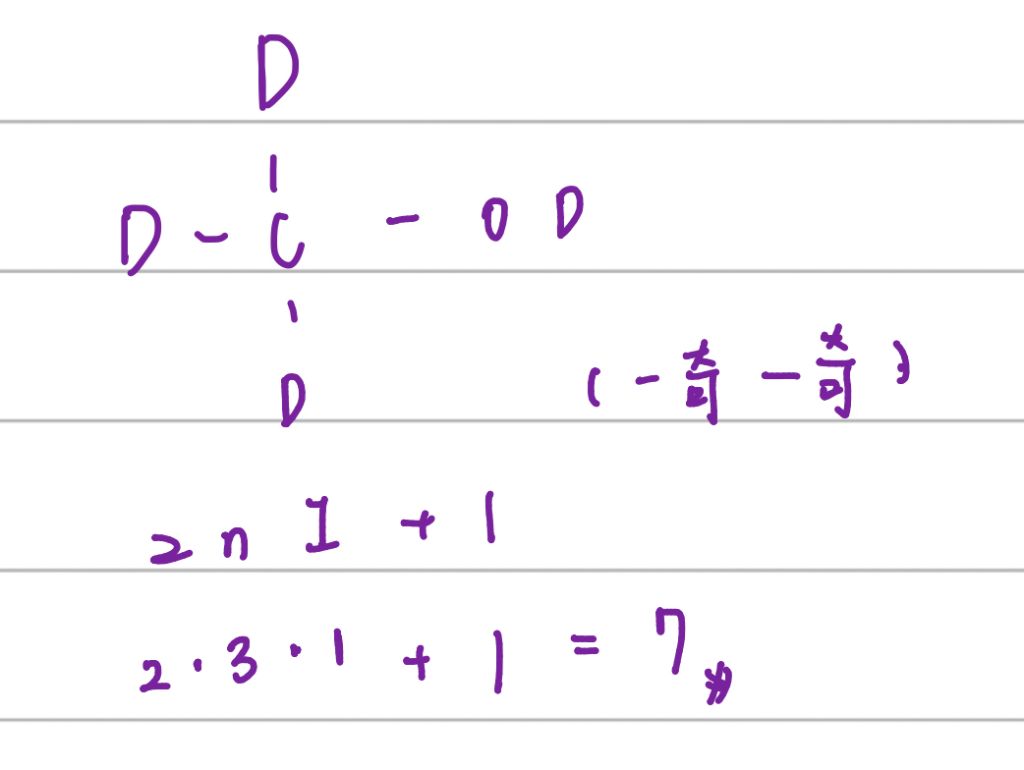
CH3OH-d4:代表在個分子中,有4個H被D取代;但在這個結構中,和C相鄰的H只有3個→n=3
H(中子數0,質子數1)、D(中子數1,質子數1)→I=1
根據2nI+1的公式,可知溶劑混產生的Peak分裂數:2x3x1+1=7
→Septet(七重峰)
375
2


哆拉拉
#4529280
附上103年的考題
感謝Ching-Ju
dimethyl sulfoxide-d6:六個重氫化
dimethyl sulfoxide-d5:只有五個重氫化(不純物)
DMSO: solvent residual peak is found at 2.50 ppm. It is due to the DMSO-d5 residue and is a quintet, because of hydrogen-deuterium coupling. This is based on the generalized 2nI + 1 rule for spin-spin coupling (-CD2H is what gives rise to this signal in the DMSO-d5 molecule: n is 2 and I for deuterium is 1, which gives a multiplicity of five).
註:quintet就是pentet,五重峰
主要差異在D的自旋量子數I是1,而我們平時算的H為1/2,所以不太一樣(就不能直接加1囉~~)。
dimethyl sulfoxide-d6:六個重氫化
dimethyl sulfoxide-d5:只有五個重氫化(不純物)
DMSO: solvent residual peak is found at 2.50 ppm. It is due to the DMSO-d5 residue and is a quintet, because of hydrogen-deuterium coupling. This is based on the generalized 2nI + 1 rule for spin-spin coupling (-CD2H is what gives rise to this signal in the DMSO-d5 molecule: n is 2 and I for deuterium is 1, which gives a multiplicity of five).
註:quintet就是pentet,五重峰
主要差異在D的自旋量子數I是1,而我們平時算的H為1/2,所以不太一樣(就不能直接加1囉~~)。
46
3

100006037735704
#4889501
幫補一題103年的
17.17.下列何者為使用dimethyl sulfoxide-d6為溶劑所測得之氫核磁共振光譜中,其溶劑殘餘訊號型態?
(A)singlet
(B)quartet
(C)pentet
(D)septet
38
1

amostudy123
#4824514
To:4F
請問要如何知道殘餘溶劑會剩幾個d?(像是dimethyl sulfoxide是d5)
那怎麼知道MeOH的殘餘剩一個d?
找不到課本哪裡有寫><
26
3

考運旺旺旺
#5322336
Cl的I=3/2;D的I=1
H譜
1.H旁邊的元素,ex.CH3F 二重峰 (106-1-24)
2.H旁邊接C:看C上的H數,ex.CH3CH2OH
H譜 殘餘
1.氘化沒訊號,ex.CD3-SO-CD3
2.所以會變成未氘化:看C上D數,ex.CHD2-SO-CD3 五重峰 (103-1-17)
C譜
C上的H數,CH3CH2OH、CD3OD 七重峰 (110-1-13)
24
0
c1ts79
#4989811
CD3OD如果氘化不完全是變成CD3OH,
因為O上的H或D是活潑H,可能會進行質子交換。
所以根據2nl+1法則:2*3*1+1=7,分裂成septet。
18
2