阿摩線上測驗
題組內容
2. In macroeconomics, the Ramsey-Cass-Koopmans model assumes that the household's
lifetime utility function takes this form: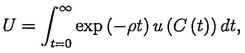
where C(t) is the instantaneous consumption of the household at time t, u(:) is the
instantaneous utility function, and p is the discount rate. 0 < p < 1. Usually the
instantaneous utility function is assumned to take the constant-relative-risl-aversion
(CRRA) form: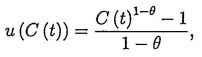
where θ > 0.
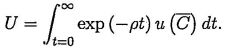
(b) Following (a), suppose that Loretta's instantaneous consumption is at the
steady state. That is, C(t) =  . Determine Loretta's lifetime utility: