 阿摩線上測驗
題組內容
4. Heterogeneity (25 points)
Consider a one-period economy with competitive markets. There are mass one households and mass
one firins. The firms use labor in units of working hours, n, to produce consumption goods, and the
production function is: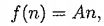
where A > 0 captures the productivity of firms. The housebold's utility is 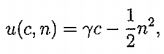
where the c is the consumption, n is the working hour, and the parameter,γ > O, captures the
importance of consumption to households. A household's income comes from working, and the wage
per hour is denoted by w. Thus, the household's budget constraint is
c = wn.
(d) (5 points) Now we go back to the benchmark economy with homogenous households; that is, now the parameter 7 is the same among households, and there is no government, tax, or transfer. However, we consider that firms are heterogeneous. That is, there are two types of firms. Type 1 firms' production function is 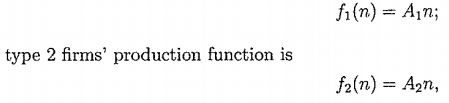
and A1 > A2. Solve for the equilibrium wage rate and type 1 firms' and type 2 firrns' labor hiring in units of working hours.