所屬科目:研究所、轉學考(插大)◆審計學
1. The standard audit report for nonpublic entities refers to GAAS and GAAP in which sections?(A)(B)(C)(D)
2. A qualified opinion can be issued for which of the following?I. When a limitation on the scope of the audit has occurredII. When the auditor lacks independenceIII. When generally accepted accounting principles have not been used(A)I and II(B)I and III(C) II and III(D)I,II and III
3. Has audit quality improved since the passage of Sarbanes-Oxley Act (SOX)? Which of the following statements is true with regards to audit quality since the passage of SOX?(A) The frequency of financial statement restatements has increased since SOX.(B) PCAOB audit engagement findings continue to document a high level of audit deficiencies.(C) Finally, the auditing professions agrees on the definition of audit quality.(D) No progress has been made on the definition of what are called "Audit Quality Indicators" since SOX.
4. When assessing the risk of material misstatements in the financial statements, (A) inadequate internal control procedures will mitigate client business risk.(B) GAAS specifies in detail how much and what types of evidence the auditor needs to obtain.(C) company management is responsible for determining materiality levels.(D) the auditor must understand the client's business and industry.
5. One of the characteristics of professional skepticism is ______, which is a desire to investigate beyond the obvious.(A) self-esteem (B) an interpersonal understanding(C) a search for knowledge(D) a questioning mindset
6. An auditor has a duty to (A) provide reasonable assurance that material misstatements will be detected.(B) be a guarantor of the fairness in the statements.(C) be equally responsible with management for the preparation of the financial statements.(D) be an insurer of the fairness in the statements.
7. Auditing standards make ______ distinction(s) between the auditor's responsibilities for searching for errors and fraud. (A) little(B) a significant(C) no(D) various
8. When an auditor knows that an illegal act has occurred, he or she must (A) report it to the proper governmental authorities.(B) consider the effects on the financial statements, including the adequacy of disclosure.(C) withdraw from the engagement.(D) issue an adverse opinion.
9. Indicate whether confirmation of accounts receivable and accounts payable, provided they each are significant accounts, is required or optional.(A)(B)(C)(D)
10. Which of the following statements is correct regarding the costs involved in obtaining evidence?(A)(B)(C)(D)
11. Likely misstatements can result from(A)(B)(C)(D)
12. A ______ risk represents an identified and assessed risk of material misstatement that, in the auditor's professional judgment, requires special audit consideration. (A) material (B) substantial (C) financial statement(D) significant
13. Company management is often under pressure to increase revenue and/or net income. One approach is to use a "bill and hold" arrangement. "Bill and hold" is an example of which of the following?(A) significant accounting estimates (B) fictitious revenue recorded (C) premature revenue recognized (D) alteration of cutoff documents
14. An auditor uses ______ inquiry to corroborate or contradict prior information. (A) assessment (B) declarative (C) interrogative(D) informational
15. Which of the following represents a correct statement regarding internal control testing?(A) When auditors plan to use evidence about the operating effectiveness of internal control contained in prior audits, auditing standards require tests of the controls' effectiveness at least every other year. (B) The greater the risk, the less audit evidence the auditor should obtain that controls are operating effectively. (C) The auditor uses control risk assessment and results of tests of controls to determine planned detection risk and the related substantive tests for the financial statement audit. (D) Testing of internal controls can only be performed by the auditor at the end of the fiscal year.
16. Which of the following computer-assisted auditing techniques inserts an audit module in the client's application system to identify specific types of transactions? (A) parallel simulation testing (B) test data approach (C) embedded audit module (D) generalized audit software testing
17. You are determining the significance of the following: you set a 5% risk of assessing control risk too low and your computation of the upper deviation risk is 7%. What could you conclude?(A) There is a 95% chance the deviation rate in the population is less than 5%. (B) There is a 5% chance the deviation rate in the population is less than 7%. (C) There is a 95% chance the deviation rate in the population exceeds 95%. (D) There is a 5% chance the deviation rate in the population exceeds 7%.
18. Tolerable misstatement is used to(A)(B)(C)(D)
19. Calculating the sample size using monetary unit sampling depends on which of the following factors?(A)(B)(C)(D)
20. When working with the different variables methods,(A) difference estimation frequently results in larger sample sizes than any other method.(B) ratio estimation is the method preferred by most auditors since it is simpler to calculate confidence intervals.(C) the difference between the mean-per-unit estimate and the difference estimate is the definition of what is being measured.(D) stratification can only be used with difference estimation.
1.乙會計師擬接受委任前,應採取哪些作為,以決定是否接受委任,請詳細說明之。
2. 甲會計師應否對乙會計師之詢問,予以回應,如何回應,請詳細說明之。
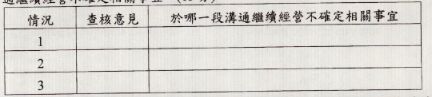
三、甲公司為一家上市公司,會計師受託查核 x1 年及 x2 年之財務報表,惟甲公司連續數年發生營運虧損,且 x3 年亦將有債務即將到期。除下列情況外,會計師已取得足夠及適切的證據,支持甲公司之財務報表已依照所適用之財務報導架構編製及揭露。請依下列格式回答在下列 3 種情況下(各為獨立的情況),會計師應出具之查核意見,以及應於查核報告中的哪一段溝通繼續經營不確定相關事宜。(15 分)1.會計師認為受查者有繼續經營上的不確定性,而受查者已於財務報表中做充分之揭露。2.會計師認為受查者有繼續經營上的不確定性,惟受查者不願於財務報表中做相關之揭露,會計師認為此部分的不實表達具重大性,但未達廣泛性。3.會計師根據所取得之證據認為,甲公司已對繼續經營上的不確定性事項採取適當的因應措施,可以消除會計師對甲公司繼續經營上不確定性的疑慮,也認同甲公司於財務報表無須揭露有關繼續經營不確定性之資訊。惟會計師想要跟查核報告使用者溝通有關繼續經營上不確定性相關的查核事項。
1. 查核人員對所辨認之個別項目聲明評估其固有風險時,應考量固有風險因子 (inherent risk factors) 以評估不實表達發生之可能性及重大程度。何謂固有風險因子?並請說明其主要包括之類型。
2. 查核人員於評估個別項目聲明之固有風險後,應進一步決定該個別項目聲明之固有風險,是否屬顯著風險 (significant risk) 及僅執行證實程序是否無法取得足夠及適切查核證據之風險。何謂顯著風險?並請例舉兩項目前審計準則明定為顯著風險者。
五、管理階層因其職位通常較有機會踰越形式上有效運作之控制,以偽造或操弄會計紀錄並編製不實之財務報表。因此,審計準則 240 號「查核財務報表對舞弊之責任」規定,不論查核人員對管理階層踰越控制之風險評估結果為何,均應設計及執行哪些查核程序?請以條列式回答,否則不予計分。(15 分)
 阿摩線上測驗
登入