所屬科目:研究所、轉學考(插大)-普通生物學
1. The chloroplasts of land plants are thought to have been derived according to which evolutionary sequence? (A) cyanobacteria → green algae → land plants (B) cyanobacteria → green algae → fungi → land plants (C) red algae → brown algae → green algae → land plants (D) cyanobacteria → red algae → green algae → land plants
2. Which of the following is the correct order of organization of genetic material from smallest to largest? (A) gene, nucleotide, chromosome, genome (B) chromosome, genome, nucleotide, gene (C) genome, chromosome, gene, nucleotide (D) nucleotide, gene, chromosome, genome
3. What is the function of reverse transcriptase in retroviruses? (A) It uses viral RNA as a template for DNA synthesis. (B) It converts host cell RNA into viral DNA. (C) It translates viral RNA into proteins. (D) It uses viral RNA as a template for making more viral RNA strands.
4. Which of the following possible causes of speciation is most likely to cause rapid speciation? (A) polyploidy (B) reinforcement (C) colonization (D) natural selection
5. Which of the following is a direct result of alternative splicing in eukaryotes? (A) More than one polypeptide sequence can be produced from a single gene. (B) Each gene can produce multiple copies of the same peptide. (C) Eukaryote genomes can be smaller than prokaryotic genomes. (D) Introns contain coding sequences and exons do not.
6. Which of the following statements is most consistent with the model of evolutionary relatedness represented in the phylogenetic tree? (A) Goats and humans are the only sister group in this tree. (B) Salamanders are a sister group to the group containing lizards, goats, and humans. (C) Salamanders are more closely related to lizards than they are to humans. (D) Goats are more closely related to salamanders than they are to humans.
7. Which of the following characteristics of Taq polymerase make it useful in the PCR process? (A) It is heat stable and can withstand the heating step of PCR. (B) It is isolated from bacteria so there is a large supply. (C) It binds more readily than other polymerases to the primers. (D) It has regions that are complementary to the primers.
8. Which of the following is the most likely phenotypes of a yeast mutant that contains histones that are resistant to acetylation? (A) The mutant will grow rapidly. (B) The mutant will require galactose for growth. (C) The mutant will show decreased levels of gene expression. (D) The mutant will show increased levels of gene expression.
9. Which of the following processes destroys RNA molecules if they have a sequence complementary to an introduced double-stranded RNA? (A) RNA interference (B) RNA obstruction (C) RNA blocking (D) RNA disposal
10. Which of the following processes occurs as part of transcription? (A) DNA is replicated (B) RNA is synthesized (C) proteins are synthesized (D) mRNA attaches to ribosomes
11.Which of the following characteristics of gene expression is shared by eukaryotic and prokaryotic cells? (A) Translation occurs before transcription. (B) Transcription of an mRNA is temporally separated from its translation. (C) Ribosomes attach to the plasma membrane when producing secreted proteins. (D) Signal sequences are needed for the production of membrane proteins.
12. During the elongation phase of translation, which site in the ribosome represents the first location where a codon pairs with an anticodon? (A) E site (B) P site (C) A site (D) the large ribosomal subunit
13. Which list the provides the correct enzyme order required for nucleotide excision repair of a thymine dimer? (A) nuclease, DNA polymerase, RNA primase (B) helicase, DNA polymerase, DNA ligase (C) DNA ligase, nuclease, helicase (D) nuclease, DNA polymerase, DNA ligase
14. After DNA replication, the resulting daughter DNA double helix contains one strand of the original parental DNA and one new strand. What is the explanation for this phenomenon? (A) DNA replication is semiconservative. (B) DNA replication is conservative. (C) DNA replication is not conservative. (D) RNA synthesis is conservative.
15. Asexual reproduction occurs during which of the following processes? (A) meiosis (B) mitosis (C) fertilization (D) the exchange of chromosomes between organisms of different species
16. Albinism is a recessive trait where an individual does not produce the pigment melanin. A man and woman both produce melanin, but both have one parent with albinism. What is the probability that their first child will have albinism? (A) 0 (B) 1/2 (C) 1/4 (D) 1
17. A recessive allele on the X chromosome is responsible for red-green color blindness in humans. A woman with normal vision whose father is color blind has children with a color-blind male. What is the probability that this couple's first son will be color blind? (A) 1/4 (B) 1/2 (C) 2/3 (D) 3/4
18. The drug cytochalasin B blocks the polymerization of actin microfilaments. Which of the following events of the cell cycle in animal cells would be most directly disrupted by cytochalasin B? (A) spindle formation (B) spindle attachment to kinetochores (C) movement of chromosomes to the poles during anaphase (D) cleavage furrow formation and cytokinesis
19. Which of the following statements best describes a characteristic of NAD+? (A) NAD+ is reduced to NADH in glycolysis, pyruvate oxidation, and the citric acid cycle. (B) NAD+ stores more chemical energy than NADH. (C) NAD+ may donate electrons for use in oxidative phosphorylation. (D) NAD+ is oxidized in glycolysis to produce ATP.
20. Which of the following processes occurs in meiosis but not in mitosis? (A) chromosome replication (B) synapsis of chromosomes (C) alignment of chromosomes at the metaphase plate (D) condensation of chromosomes
21. Which of the following statements correctly describes both phototrophs and chemotrophs? (A) Both are also autotrophs (B) Both obtain their energy from chemicals (C) Both obtain their energy from light (D) Chemotrophs obtain energy from chemicals and phototrophs obtain energy from light
22. Rubbing alcohol swab on the skin feels cool because ________. (A) liquid alcohol transfers cold temperature to the skin (B) the density of alcohol is less than water (C) alcohol destroys skin microorganisms and they give off cold heat as they die (D) skin transfers heat to the liquid alcohol and the alcohol evaporates
23. Many aphid species switch between asexual and sexual reproduction. Which of the following is only used during sexual reproduction? (A) mitosis (B) meiosis (C) parthenogenesis (D) fission
24. Which of the following characteristics is exhibited by the water vascular system of echinoderms? (A) it functions as a circulatory system that distributes nutrients to body cells (B) it functions in locomotion and feeding (C) it is bilateral in organization, even though the adult animal is not bilaterally symmetrical (D) it is analogous to the gastrovascular cavity of flatworms
25. A hypothetical dye stains sporophyte tissue blue and gametophyte tissue red. What would a researcher most likely observe if a section through the center of a seed was stained with this dye? (A) a pure blue sample (B) a red center surrounded by blue (C) a blue center surrounded by red (D) a blue center, surrounded by red, inside a blue exterior
26. Which of the following biological molecules contributes to the structural integrity of plant spores? (A) lignin (B) cellulose (C) chlorophyll (D) sporopollenin
27. What do we call a membrane potential in which there is no net movement of an ion across a membrane? (A) a graded potential (B) a threshold potential (C) an equilibrium potential (D) an action potential
28. Which of the following is an example of a simple endocrine pathway? (A) control of metabolism by thyroid hormones (B) release of secretin by cells of the duodenum after exposure to low pH (C) release of antidiuretic hormone from the posterior pituitary gland to regulate water balance (D) regulation of growth by the production of growth hormone
29. If you place a flaccid plant cell in pure water, which of the following will occur? (A) Water will not enter the cell because the flaccid cell has solutes and low water potential. (B) Water enters the cell because the flaccid cell has solutes and low water potential. (C) Water enters the cell because the flaccid cell has solutes and high water potential. (D) Water will not enter the cell because the flaccid cell has solutes and high water potential.
30. Which of the following is an advantage of a complete digestive system? (A) It excludes the need for extracellular digestion. (B) It allows for specialized regions with specialized functions. (C) It allows extensive branching. (D) It facilitates intracellular digestion.
31. Which of the following structures directly produces the fruit of angiosperms? (A) male gametophyte (B) female gametophyte (C) male sporophyte (D) female sporophyte
32. The cortical reaction of sea urchin eggs functions directly in ________. (A) the formation of a fertilization envelope (B) the production of a fast block to polyspermy (C) the generation of an electrical impulse by the egg (D) the fusion of egg and sperm nuclei
33. Materials are returned to the blood from the filtrate by which of the following processes? (A) filtration (B) reabsorption (C) secretion (D) excretion
34. In which part of the brain is hunger and thirst regulated? (A) cerebrum (B) thalamus (C) hypothalamus (D) medulla oblongata
35. During an auditory transduction, across what membrane does ion flow vary? (A) tectorial (B) round-window (C) hair cell (D) basilar
36. The human respiration rate is most closely correlated to the blood levels of which compound during most daily activities? (A) nitrogen (B) oxygen (C) carbon dioxide (D) carbon monoxide
37. Which of the following statements describes an adaptive advantage associated with the filamentous nature of fungal mycelia? (A) the ability to form haustoria and parasitize other organisms (B) the potential to inhabit almost all terrestrial habitats (C) the increased probability of contact between different mating types (D) an extensive surface area well suited for invasive growth and absorptive nutrition
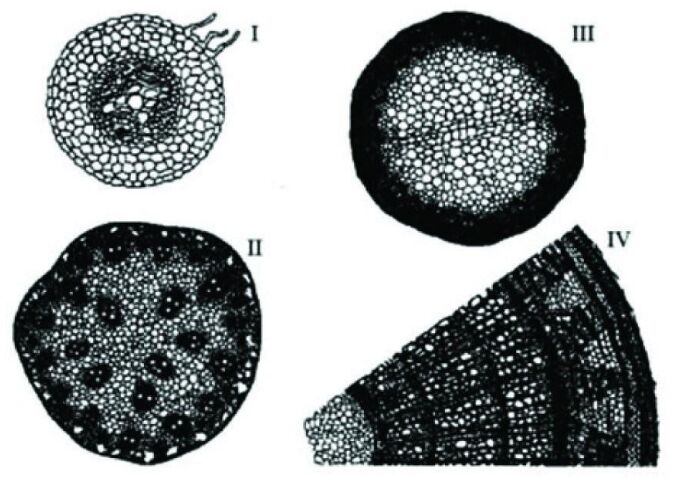
38. The following question is based on the drawings of root or stem cross sections shown in the figure. Refer to the figure. A woody eudicot is represented by which of the following? (A) II only (B) III only (C) IV only (D) I and III
39. Which statement best describes an account of immunological memory? (A) the human body's ability to distinguish self from nonself (B) the observation that some strains of the pathogen that causes dengue fever cause more severe disease than others (C) the ability of a helper T cell to signal B cells via cytokines (D) the observation that someone who had recovered from the plague could safely care for those newly diseased
40. Which of the following characteristics is functionally important in gametophyte cells of both angiosperms and gymnosperms? (A) diploid nuclei (B) mitochondria (C) endosperm (D) chloroplasts
41. Which of the following genetic processes may be most helpful in accounting for the Cambrian explosion? (A) binary fission (B) random segregation (C) the origin of Hox genes and the addition of new microRNAs (D) chromosomal condensation
42. Using the symbols +, −, and 0 to indicate interspecific species interactions, where the first symbol refers to the first organism mentioned, which interactions of the following would exist between a lion pride and African wild dogs, if the dogs are the lions' prey and are found to typically avoid areas with lions? (A) +/+ (B) +/− (C) 0/0 (D) −/−
43. In creating global climate patterns, which of the following factors is most likely the primary cause of all of the other factors that are listed? (A) precipitation differences between tropical and polar regions (B) global ocean currents (C) global wind patterns (D) variation in the heating of Earth's surface
44. If all individuals in the last remaining population of a particular frog species were all highly related, which type of diversity would be of greatest concern when planning to prevent the species from going extinct? (A) global diversity (B) local diversity (C) ecosystem diversity (D) genetic diversity
 阿摩線上測驗
登入
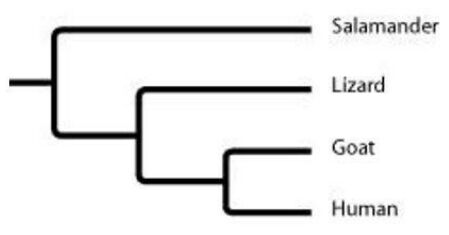 (A) Goats and humans are the only sister group in this tree. (B) Salamanders are a sister group to the group containing lizards, goats, and humans. (C) Salamanders are more closely related to lizards than they are to humans. (D) Goats are more closely related to salamanders than they are to humans.