所屬科目:研究所、轉學考(插大)◆基礎分子生物學
1. Which of the following biological mechanisms in the cell can be the target of regulation of gene expression? (A) Transcription (B) mRNA processing (C) mRNA export and localization (D) Translation (E) Protein modification
2. Which physical or chemical factor of the following list can cause DNA mutation? (A) Heat (B) Ultra-violet light (C) Ethidium bromide (D) Nitrous acid (E) 5-Bromouracil
3. U-rich small nuclear RNAs (snRNAs) are important for base pairing with the pre-mRNA and are required for pre-mRNA splicing. They include (A) U1 (B) U2 (C) U3 (D) U4/U6 (E) U5
4. Which organism listed below would need spliceosome-based pre-mRNA splicing to remove introns? (A) Homo sapiens (B) Drosophila melanogaster (C) Caenorhabditis elegans (D) Saccharomyces cerevisiae (E) Escherichia coli
5. MicroRNAs are small non-coding regulatory RNAs that down regulate gene expression by the mechanisms including (A) Repress translation of target mRNAs (B) Trigger cleavage of target mRNAs (C) Trigger decapping of target mRNAs (D) Enhance polyadenylation of target mRNAs (E) Accumulate targets mRNAs in the P-bodies for storage or degradation
6. RNA interference (RNAi) is an evolutionarily conserved mechanism to degrade RNA molecules in a sequence-specific manner. This mechanism does NOT exist in (A) Homo sapiens (B) Drosophila melanogaster (C) Caenorhabditis elegans (D) Saccharomyces cerevisiae (E) Escherichia coli
7. During the first stage of translation, the small and large ribosomal subunits assemble around an mRNA that has an aminoacylated initiator tRNA correctly positioned at the start codon. The process is mediated by a special set of proteins known as translation initiation (IFs). In eukaryotes, the translation initiation complex contains the 40S subunit, the Met-tRNA and IFs NOT including (A) eIF1 (B) eIF2 (C) eIF3 (D) eIF4 (E) eIF6
8. Which of the following techniques can be used to measure the amount of a specific mRNA in a sample? (A) RT-real time quantitative PCR (B) Northern blot analysis (C) Southern blot analysis (D) Western blot analysis (E) RNase protection assay
9. Scott wants to set up a RT-real time quantitative PCR experiment. Which enzyme(s) will he need? (A) E. coli DNA polymerase I (B) T4 DNA ligase (C) Taq DNA polymerase (D) Reverse transcriptase (E) T7 RNA polymerase
10. Although there are numerous kinds of yeast shuttle vectors, those used currently can be broadly classified in either of following three types: integrative vectors, YIp; autonomously replicating high copy-number vectors, YEp; or autonomously replicating low copy-number vectors, YCp. Scott wants to insert a DNA fragment into the yeast chromosome and he has chosen YIp as the shuttle plasmid. Which of the following sequence components are in this plasmid? (A) E. coli genes or segments ori, bla or tet for amplification the plasmid in E. coli (B) Yeast nutrition selectable markers (ex. URA3, HIS3, LEU2, TRP1 or LYS2) (C) Yeast 2µ(2-micron) plasmid sequence (D) Yeast autonomous replication sequences (ex. ARSI, ARS2 or ARS3) (E) Yeast chromosomal centromere sequences (ex. CEN3, CEN4 or CENII)
11. Which of the following statements regarding the human genome are CORRECT ? (A) The protein-coding regions (exons) represent a significant portion (around 10%) of the human genome. (B) Repeated sequences (present in more than one copy) account for >50% of the human genome. (C) The human genome contains around 3.2 billion nucleotide base pairs. (D) There are many duplications of large chromosome regions in the human genome. (E) None of the non-coding regions of the human genome contains important genetic information, so they can be considered garbage (useless) DNA sequences.
12. Which of the following statements regarding the eukaryotic nucleosome are CORRECT ? (A) The nucleosome is the subunit of all chromatin. (B) The nucleosome contains ~200 bp of DNA, organized by an octamer of small, basic proteins, called histones, into a bead-like structure. (C) Nucleosomal DNA is divided into core DNA and linker DNA depending on its susceptibility to micrococcal nuclease. (D) The length of core DNA is 146 bp. (E) Histone H1 is associated with the core DNA; histones H2A, H2B, H3 and H4 are associated with the linker DNA.
13. Eukaryotic messenger RNA (mRNA) is modified during or after its transcription and is exported from the nucleus to the cytoplasm only after all modifications have been completed. Which of the following processes are INCLUDED in these mRNA modifications? (A) 5' capping (B) Splicing (C) Addition of 3' poly A tail (D) Formation of hairpin structure (E) Phosphorylation
14. Which of the following statements in regard to transcription of messenger RNA (mRNA) are CORRECT ? (A) mRNA is transcribed by RNA polymerase II. (B) Transcription factors are proteins that bind to the promoter and regulate mRNA transcription. (C) The RNA polymerase II promoter can be located at both the upstream and downstream of the transcription start site. (D) RNA polymerase II requires general transcription factors (called TFIIX) to initiate transcription. (E) RNA polymerase II can be inhibited by low concentrations of alpha-amanitin.
15. Which of the following statements regarding the techniques of molecular biology are CORRECT ? (A) Northern blotting can be utilized to detect DNA (B) Southern blotting can be used to detect RNA (C) Chromatin immunoprecipitation can be used to detect DNA-protein interaction. (D) Western blotting can be used to measure the protein expression (E) PCR can be used to amplify a particular DNA sequence
16. Which of the following amino acids have basic side chains at neutral pH? (A) Histidine (B) Cystine (C) Arginine (D) Aspartate (E) Lysine
17. Protein phosphorylation by kinases are important in signal transduction. Which amino acids of the target proteins can be phosphorylated? (A) Alanine (B) Tyrosine (C) Asparagine (D) Serine (E) Threonine
18. Which of the following statements regarding apoptosis are CORRECT ? (A) Apoptosis is a process of programmed cell death, and does not cause significant inflammatory response. (B) Caspases are proteases that are involved in multiple stages of the apoptotic pathway. (C) Caspases are synthesized as inactive forms and can be activated through autophosphorylation under several pro-apoptotic stimuli. (D) Apoptosis can be triggered by activating surface receptors, like Fas. (E) Release of cytochrome C from the mitochondria can activate the downstream caspase and induce apoptosis.
19. Which of the following statements regarding the genetic codon are CORRECT ? (A) Genetic codons are composed of nucleotide triplets. (B) 61 of the 64 possible nucleotide triplets (codons) code for 20 amino acids. (C) 3 codons do not represent amino acids and cause termination. (D) "Wobble hypothesis" states that the pairing between codon and anticodon at the first codon position always follows the usual base-pairing rules, but the exceptional wobbles occur at the second and third codon positions. (E) Protein synthesis (translation) is fulfilled through the recognition of the codon of mRNA by the anti-codon of tRNA attached with a specific amino acid.
20. Which of the following statements in regard to cell cycle are CORRECT ? (A) DNA replication starts from the G1 phase. (B) DNA damage can cause cell cycle arrest. (C) Mitosis occurs in the M phase. (D) Protein phosphorylation and desphosphorylation control the cell cycle. (E) Degradation of cyclins is important in mitosis.
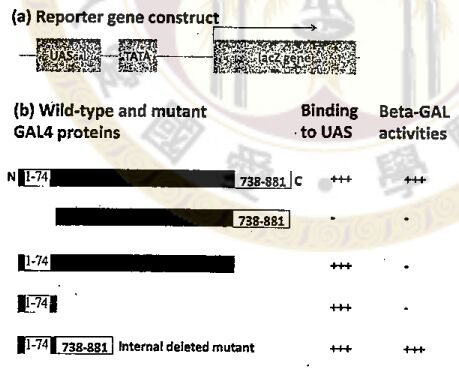
21. GAL4 is a transcription activator in yeast which promotes expression of a group of genes. In the upstream of genes driven by GAL4, there are one or more copies of a related 17-bp sequence known as UASGAL.
To show that UASGAL is the GAL4 responsive element, one constructed a lacZ reporte shown in (a) and showed that the expression of lacZ is activated in galactose media in wild-type cells but not in gal4 mutants. She also did another set of experiments, in which various mutant GAL4 molecules are examined for their transcription activator activities. Which of the following conclusions can be drawn from her experiments?
(A) N terminal aal-74 is required for GAL4 binding to UAS sequence (B) N terminal aal-74 is sufficient to bind to UAS sequence (C) C terminal aa738-881 is required for GAL4 to activate lacZ expression (D) the fusion protein composed of aal-74 and aa738-881 is sufficient to activate lacZ expression.(E) aa75-737 is not dispensable for lacZ express
22. DNA recombination refers to moving a DNA segment from one to another DNA molecule. This process makes the following biotechnology procedures possible (A) biogenesis of miRNA (B) linkage mapping human mutations that cause diseases. (C) gene targeting, replacing a gene by a mutant allele. (D) tissue specific inactivation of a target gene by the Cre/loxP system. (E) to repair a DNA double strand break.
23. Which of the following descriptions about exon, intron, 5' UTR, and 3' UTR is(are) correct (A) nonsynonymous mutation is a nucleotide change in exon that changes amino acid sequence of the encoded protein. (B) synonymous mutation is a single nucleotide change in intron that would never cause any change in the amino acid sequence of the encoded protein. (C) although not translated, the nucleotide sequence in the 5' UTR of mRNA corresponds to genomic sequence of exons but not introns. (D) although not translated, mutation in 3' UTR could profoundly affect mRNA stability. (E) mutation in intron may affect protein sequence by introducing mRNA splicing errors.
24. BrdU is an analog of thymine that can be incorporated into double stranded DNA during DNA polymerization in. S phase. Unsynchronized cells at various stages of cell cycle are first treated with BrdU for 2 hours and then cultured in the absence of BrdU for another 4 hours. What would happen to those unsynchronized cells exposure to BrdU? (A) BrdU is incorporated into all the unsynchronized cells. (B) If a cell is labeled by BrdU, only one of the sister chromatins is labeled. (C) If a cell is labeled by BrdU, only one strand of DNA is labeled. (D) In the 2-hour BrdU pulse, only mitotic cells are labeled. (E) In the 2-hour BrdU pulse, only mitotic cells are not labeled.
25. The fluidity of lipid membranes in cells on depends on (A) temperature (B) the amount of unsaturated fatty acyl chain (C) the length of the fatty acid chain (D) the amount of cholesterol (E) nature of membrane associated proteins
26. Cellular proteins give cells structure and perform many cellular tasks except (A) RNA polymerase (B) RNA interference (C) RNA splicing (D) ribozymes (E) RNA editing
27. Which of the following statement is(are) wrong (A) DNA severs as a template for DNA synthesis (B) mRNA severs as a template for codon specific tRNA recognition in ribosome during protein synthesis (C) DNA serves as a template for miRNA synthesis (D) DNA serves as a template for mRNA synthesis (E) piRNA serves as a template for rRNA synthesis
28. Proteins could be covalently modified by chemicals and small peptides, such as (A) phosphorus (B) ubiquitin (C) methyl group (D) acetyl group (E) fatty acid
29. Which of the following descriptions about G protein-coupled receptors (GPCR) is (are) CORRECT? (A) GPCRs constitute one of the largest protein families encoded by the mammalian genomes, including adrenalin receptors, odorant receptors, rhodopsin and EGF (epidermal growth factor) receptors. (B) The general structure of GPCRs includes seven transmembrane a-helices with the N-terminus facing the extracellular space and C-terminus in the cytosol. (C) Activation of the GPCR by its ligand triggers dissociation of GDP from the B-subunit of the G protein, which in turns activates the a-subunit. (D) The specificity of GPCR signaling is determined solely by the unique ligand that a receptor binds. (E) Desensitization of GPCR signaling requires receptor-mediated endocytosis that depends on clathrin, AP2 and ẞ-arrestin.
30. Which of the following descriptions regarding signal transduction downstream of GPCR is (are) CORRECT? (A) Adenylyl cyclase, which produces cyclic AMP, is a direct target of G protein (B) GPCR may induce depolarization of neuronal membrane by activating cyclic nucleotide-gated channels (CNG) (C) Cyclic AMP activates protein kinase A (PKA) by promoting the association of the PKA catalytic subunits with the PKA regulatory subunits (D) G protein may activate phospholipase C, which in turn catalyzes the production of diacylglycerol (DG) and inositol 1,4,5-triphosphate (IP3) (E) G protein may activate or inhibit adenylyl cyclase, and this property of G protein is determined by the By-subunit
31. There are several key steps in receptor-mediated endocytosis and its subsequent trafficking in the cell, which are: (1) cargo sorting in the recycling endosomes (2) recognition of the endocytic motif of the receptor by adaptor protein complex 2 (AP-2) (3) scission of the coated endocytic pits by dynamin (4) recruitment of clathrin (5) disassembly of clathrin coats (6) maturation into late endosome or multivesicular bodies. Please order these events in the correct temporal sequence. (A) 214536 (B) 234165 (C) 213456 (D) 243516 (E) 215346
32. Which of the following statements about actin is (are) CORRECT? (A). It constitutes intermediate filaments and is one of the major components of cytoskeleton (B) The growth rate of actin filament is faster at the (+) end, which contains GDP-bound actins (C) Branching of actin filaments is mainly mediated by the Arp2/3 complex (D) Ras is the major small GTPase that regulates actin dynamics (E) Transport along the actin filaments is mediated by myosin motors
33. Which of the following statements about microtubules is (are) CORRECT? (A) Microtubules are an important target of several anti-cancer drugs, such as taxol and vincristine (B) Growth of microtubule dynamics occurs at the plus end, where as disassembly or catastrophe occurs at the minus end (C) Kinesins and dynein are responsible cargo transport towards the plus and the minus ends of microtubules, respectively (D) Centrosomes are microtubules organizing center (MTOC) that emit microtubule polymers with minus end towards the cell membrane and plus end towards the MTOC (E) The three tubulins, α, β, and y tubulins, are incorporated into regular microtubule polymers that are present throughout the entire cell
34. Which of the following protein modifications could be found on histones that are important for epigenetic regulation of gene functions? (A) Glutamylation (B) Acetylation (C) Methylation (D) Tyrosination (E) Palmitoylation
35. Which of the following statements about apoptosis is (are) CORRECT? (A) A set of core apoptotic proteins, including BCL-2, APAF, and Caspase 3, are conserved in all eukaryotes, including yeast (B) Apoptosis is mainly regulated by extrinsic signals, and intrinsic genetic mechanisms are generally not involved in most apoptosis (C) Immune cell gathering around the dying apoptotic cell is an important feature of apoptosis, which distinguishes it from necrosis (D) Failure of energy production in apoptotic cells exposes phosphoserine on the extracellular surface of plasma membrane, which signals the phagocytic cells to engulf the corpse of apoptotic cells (E) Triggers of apoptosis include lack of trophic factors, DNA damage and excessive cellular activity (e.g., glutamate excess triggers neuronal death)
36. Which of the following statements about protein phosphorylation is (are) CORRECT? (A) Phosphorylation is an important way to modulate enzymatic activity: phosphorylated enzymes are active and dephosphorylated enzymes are all inactive and will be degraded (B) Receptor tyrosine kinase undergoes autophosphorylation and adds phosphate group to itself on the same molecule (C) Mutations of a serine residue that is normally phosphorylated to aspartic acid often mimic the effects of phosphorylation (D) Phosphorylation of a protein could trigger its degradation by the proteasome (E) Phosphorylation could serve as a localizing signal to retain the protein in the cytosol or localizes it to the nucleus
37. Which of the following descriptions about synaptic transmission is (are) CORRECT? (A) Release of neurotransmitters depends fusion of the synaptic vesicles with the membrane of presynaptic terminal, and this process requires the SNARE complex (B) Local sodium influx at the presynaptic terminal triggers synaptic vesicle release (C) Whether a postsynaptic neuron is activated or inhibited is determined by the type of neurotransmitters instead of the postsynaptic receptors (D) Synaptic vesicle release follows a quantal principle and is discontinuous in intensity (E) Neurotransmitters and neuropeptides from the same neuron are packaged together in the same vesicle and are co-released upon stimulation
38. Which of the following statements about stem cells is (are) CORRECT? (A) Stem cells are widespread during development and continue to exist in all human and mammalian tissues in adult (B) The proliferative potential of a cell is gradually restricted when it becomes more differentiated (C) A differentiated somatic cell nucleus could be reprogrammed into a more undifferentiated state when transplanted into an oocyte whose own nucleus is removed (D) A limited number of transcription factors are sufficient to confer stemness to the cell, and activation of this set of genes could reprogram somatic cells to become pluripotent stem cell (iPS cell) (E) Differentiation of a stem cell into more mature cell types is determined by both genetic factors and extrinsic signals
39. Which of the following compartments is (are) the major site(s) for intracellular calcium regulation? (A) Golgi (B) Mitochondria (C) Lysosome (D) Smooth endoplasmic reticulum (E) Proteasome
40. Which of the following molecules is (are) primarily or absolutely found in lysosomes? (A) Cathepsins (B) Calmodulin (C) Cytochrome P450 (D) Calbindin (E) Calreticulin
 阿摩線上測驗
登入