所屬科目:研究所、轉學考(插大)◆生物化學
1. Please choose the answer from the following descriptions:1. Glc(1αβ1) Fru is sucrose.2. Some sugars occur naturally in their L form.3. Dextran is homopolysaccharide.4. Hyaluronate and heparin are sulfated heteropolysaccharides.5. Starch is the most abundant polysaccharide in nature.(A) 1, 3, and 4 are incorrect.(B) 2 and 3 are correct.(C) 3 and 5 are incorrect.(D) 2,4, and 5 are incorrect.(E) 2, 3, and 4 are correct.
2. Please choose the answer from the following descriptions:1. a-Keratin is a protein which provides strength in connective tissue.2. Disulfide linkages are important for keratin structure.3. Gly residues are particularly abundant in collagen.4. L-isoleucine is an diastereomer of D-leucine.5. a-Keratin is a protein in which the polypeptides are mainly in the a-helix conformation.(A) 1 and 4 are incorrect.(B) 1 and 5 are incorrect.(C) 1, 2, and 3 are correct.(D) 3 and 4 are correct.(E) Only 2 and 5 are correct
3. Which of the following amino acids has more than one chiral carbon?(A) Val.(B) Leu.(C) Ile.(D) His.(E) Ser.
4. Which of the following part of antibody molecule is involved in binding to an antigen?(A) Fab.(B) Constant domain.(C) Fc.(D) Heavy chain.(E) Light chain.
5. The reaction GTP GDP + P; is an example of a(n)_____ reaction.(A) homolytic cleavage.(B) internal rearrangement.(C) free radical.(D) group transfer.(E) oxidation/reduction.
6. Oxidation-reduction reactions in biological system always involve:(A) direct participation of oxygen.(B) transfer of electron(s).(C) mitochondria.(D) formation of water.(E) transfer of hydrogens.
7. Consider the reaction A+B → C+D. Which of the following equation regarding the relationship between the free energy change (AG) at any condition and the free energy change (AGº) at standard state is true?(A) AG° = AG+RTin(A/C).(B) AG = AG+RTln(A/C).(C) AG° = AG+RTln(C/A).(D) AG = AG+RTln(C/A).(E) None.
8. Which statement about glycolysis is not true :(A) Conversion of glucose-6-phosphate to fructose-6-phosphate is an isomerization reaction.(B) In the conversion of glucose to pyruvate, only one step actually involve electron transfer.(C) Conversion of glyceraldehyde-3-phosphate to give 1,3-bisphosphoglycerate is an oxidative reaction.(D) Conversion of 2-phosphoglycerate to give phosphoenolpyruvate is an oxidative reaction(E) All of above are true
9. Which statement of citric acid (CA) cycle is true?1. In eukaryotes, CA cycle take places in mitochondrial matrix.2. CA cycle plays roles in both catabolism and anabolism.3. GTP is a direct source of energy produced in the CA cycle.4. All enzymes of the cycle are located in the matrix, except malate dehydrogenase.(A) 1, 2 and 3.(B) 2, 3 and 4.(C) 1, 3 and 4.(D) 1, 2, and 4.(E) All of above are true.
10. In movief of which one of the following statements is not correct?(A) EPA and DHA from oceanic fish could reduce the assault behaviors.(B) The head in sperm whales is largely made up of triacyglycerols and waxes.(C) Luminous jellyfish contain fluorescent dolicols.(D) In starvation, Pi might have plenty of ketone bodies.(E) Dehydration might result in defective secretion of dopamine or serotonin.
11. Which one of the following statements regarding sphingolipid is not correct?(A) Biosynthesis of ceramide shares the same precursor, palmitoyl-CoA, with glycerophospholipid.(B) Serine is a precursor for the biosynthesis of ceramide.(C) Ceramide promotes apoptosis by inducing mitochondrial outer membrane permeabilization.(D) Sphingomyelin is consisted of ceramide and ethanolamine.(E) Glycosphingolipids are major determinants of blood groups.
12. Which one is not a derivative of cholesterol?(A) Cortisol.(B) Testosterone.(C) Arachidonic acid.(D) Bile acid.(E) Vitamin D3.
13. Which one does not regulate the triacyglycerol cycle?(A) Insulin.(B) Glucagon.(C) PEP carboxykinase.(D) Thiazolidinedione.(E) PPARa.
14. Which one does not appear in rafts?(A) Cholesterol.(B) GPI-linked protein.(C) Acyl-linked protein.(D) Prenylated protein.(E) Caveolin.
15. Which of the following descriptions about nucleotide and nucleic acid structures is(are) correct?1. The double helix of DNA in the B-form is stabilized by covalent bonds between the 3' end of one strand and the 5' end of the other.2. The double helix of DNA in the B-form is stabilized by nonspecific base-stacking interaction between two adjacent bases in the same strand.3. In nucleotides and nucleic acids, syn and anti conformations relate to rotation around the phosphodiester bond.4. C-5 of the pentose in nucleic acids is joined to a nitrogenous base.5. The phosphodiester bond that joins adjacent nucleotides in DNA is susceptible to alkaline hydrolysis.(A) 1 and 2.(B) 2 and 3.(C) 3 and 4.(D) 2 only.(E) 2 and 5.
16. Which of the following statements about type II restriction enzymes is(are) false?1. They are sequence-specific DNA endonucleases.2. Many make staggered (off-center) cuts within their recognition sequences. Some cut DNA to generate blunt ends.3. They cut both DNA strands at the same base pair.4. They are part of a bacterial defense system in which foreign DNA is cleaved.5. The size of the DNA region specifically recognized by type II restriction enzymes is typically 8 to 12 base pairs.(A) 1 and 3 are false.(B) 2 and 4 are false.(C) 3 and 5 are false.(D) Only 4 is false.(E) Only 5 is false.
17. Several nucleotide bases undergo spontaneous loss of their exocyclic amino groups (deamination). Deamination of the nucleotide bases cytosine and 5-methylcytosine yields nucleotide bases:(A) thymine and uracil, respectively.(B) hypoxanthine and xanthine, respectively.(C) uracil only.(D) uracil and thymine, respectively.(E) uracil and hypoxanthine, respectively.
18. Urea cycle takes place primarily in the liver in mammals. Excess ammonia generated in other tissues is delivered to the liver by:(A) glutamine.(B) alanine.(C) glutamate.(D) glutamine and alanine(E) glutamate and alanine.
19. Which two amino acids are important for ammonia assimilation (吸收) by an organism:(A) Glu and Gln.(B) Glu and Asp.(C) Gln and Asn.(D) Lys and Trp.(E) Lys and Arg.
20. Which of the following statement about neurotransmitters and hormones is not correct:(A) Both neurotransmitters and hormones act via binding to specific protein targets called receptors.(B) Each hormone has its own receptor.(C) Most receptors are membrane-bound proteins.(D) Some receptors are soluble proteins that modulate the expression of genes; these are called nuclear receptors.(E) Membrane-bound receptors of hormones are protein tyrosine kinases.
21. In gastrointestinal tract, hydrochloric acid is secreted by:(A) Parietal cells.(B) Chief cells.(C) gastric mucosa cells.(D) a cells.(E) ẞ cells.
22. Nitric oxide (NO) is synthesized from:(A) Arg.(B) citrulline.(C) spermine.(D) spermidine.(E) Lys.
23. Skeletal muscle does not use which of the following nutrient as fuel:(A) Free fatty acids.(B) Ketone bodies.(C) Glucose.(D) Amino acids.(E) None of the above.
24. An isoschizomer is a(n)(A) enzyme that cuts DNA from the 3' end.(B) restriction enzyme that has the same sequence specificity as another restriction enzyme from a different organism.(C) DNA sequence that is identical to one in a different organism.(D) DNA sequence from a virus that mimics a sequence in bacteria.(E) None of these is correct.
25. Cartilage and mucous are both slippery because:(A) Short polymers comprise these compounds.(B) The charge repulsion between the many acid groups in these polymers.(C) The sticky nature of sugars.(D) Both charge repulsion of acidic groups and the sticky nature of sugars.(E) All of these.
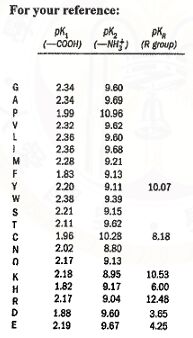
26. Mr. Bean synthesizes a pentapeptide "DIRTY". Choose the correct answer from the following descriptions (To calculate pl, use the pK2 of the N-terminal amino acid residue as the pKa of the N-terminal amino group of the peptide and pK, of the C-terminal amino acid residue as the pKa of the C-terminal carboxylate group of the peptide):1. The pl value of the peptide is 6.625.2. The pl value of the peptide is 2.925.3. The pl value of the peptide is 6.38.4. When 0.1 mg of the peptide is dissolved in 100 mM Tris (pH 9), it could bind to anion exchange column.5. When 0.1 mg of the peptide is dissolved in 100 mM Tris (pH 9), it could bind to cation exchange column.(A) 1 and 4 are correct.(B) 2 and 4 are correct.(C) 1 and 5 are correct.(D) 3 and 4 are correct.(E) 3 and 5 are correct.
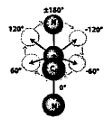
27. Please choose the answer from the following descriptions:1. This figure (right side) tells you & angle is 180 degree.2. Glycogen is more extensively branched than starch.3. Run SDS-page twice is the way to get 2D-PAGE for proteomic analysis.4. 180 g glucose and 180 g sucrose have the same osmotic pressure.5. 1M glucose and 1 M sucrose have the same osmotic pressure.(A) 1,2, and 5 are correct.(B) 1 and 5 are correct.(C) 1, 2, and 4 are correct.(D) 3 and 5 are incorrect.(E) 2 and 5 are correct.
28. Emma wants to analyze the sequence of the following peptide "SMALLCATSNICKASHIRT". She uses several agents to treat the sample. Which of the following description is correct?(A) If she uses trypsin, she could get the peptide "KASHI".(B) If she uses phenylisothiocynate, she could only know that the first residue is "S".(C) If she uses trypsin, she could get the peptide "SMALLCATSNICK".(D) In order to know whether this peptide has disulfide bond, she can treat the sample with or without cyanogen bromide (CNBr) before trypsin digestion and compare the result. If the treatment of cyanogen bromide makes no difference, the result suggests no disulfide bond formation in this peptide.(E) If she uses pepsin, she can get the peptide "ATSNICKASHIRT",
29. Comparing X-ray Crystallography, Circular Dichroism (CD) spectroscopy, Mass spectroscopy and Nuclear Magnetic Resonance (NMR) spectroscopy, choose the incorrect answer:(A) X-ray diffraction data yields electron density map; CD data yields protein secondary structure.(B) Mass spectroscopy could be used in peptide sequencing; NMR could be used to study protein secondary structure.(C) CD data yields protein secondary structure; Mass spectroscopy could be used in peptide sequencing.(D) X-ray diffraction data yields interatomic distances; NMR yields electron density map.(E) Both CD and NMR could be used to study protein secondary structure.
30. Which of the following statements about protein-ligand binding is correct?(A) The Ka is equal to the concentration of ligand when all of the binding sites are occupied.(B) The Ka is independent of such conditions as salt concentration and pH.(C) The larger the Ka (association constant), the weaker the affinity.(D) The larger the Ka, the faster the binding.(E) The larger the Ka, the smaller the Ka (dissociation constant).
31. Which of the following statements about a plot of Vo vs. [S] for an enzyme that follows Michaelis-Menten kinetics is false ?(A) As [S] increases, the initial velocity of reaction Vo also increases.(B) At very high [S], the velocity curve becomes a horizontal line that intersects the y-axis at Km.(C) Km is the [S] at which V₁ = 1/2 max.(D) The shape of the curve is a hyperbola.(E) The y-axis is a rate term with units of mM/min.
32. DIFP inactivates serine proteases by binding covalently to the catalytic serine residue at the active site; this enzyme-inhibitor bond is not cleaved by the enzyme. This is an example of what kind of inhibition?(A) Non-competitive.(B) Competitive.(C) Irreversible.(D) Mixed.(E) pH.
33. Which one of the following statements is true?1. The substance that loses electrons is called oxidizing agent.2. There is entropy gain when ADP is phosphorylated.3. Flavin adenine dinucleotide (FAD) is a biological oxidizing agent.4. NADH, NADPH, FAD and coenzyme A all contain ADP unit.(A) 1 and 2 are true.(B) 3 and 4 are true.(C) 1 and 3 are true.(D) 2 and 4 are true.(E) All are true.
34. Which statement about glycolysis is true?1. The phosphorylation of fructose 6-phosphate to fructose-1,6-bisphosphate is the committed step in glycolysis because fructose 1,6-bisphosphate can undergo no other reactions than those of glycolysis.2. The enzyme catalyze the phosphorylation of fructose 6-phosphate to fructose-1,6-bisphosphate is activated only when cells need pyruvate.3. NADH is the cozezyme for glyceraldehyde-3-phosphate dehydrogenase.4. During glycolysis, ATP use and production is exactly even after the conversion of glyceraldehyde-3-phosphate to 1,3-bisphosphoglycerate(A) 1 and 2 are true.(B) 3 and 4 are true.(C) 1 and 4 are true.(D) 2 and 3 are true.(E) 1 is true.
35. A eukaryotic cell can use glucose and hexanoic acid as fuels for cellular respiration. Which statement below is correct?1. Glucose yields more energy upon complete combustion to CO2 and H2O.2. Hexanoic acid is more soluble in water than that of glucose.3. Hexanoic acid is more reduced.(A) 1 is correct.(B) 2 is correct.(C) 3 is correct.(D) 2 and 3 are correct.(E) None of above is correct,
36. The following fatty acid, , COOH, is fed to mice. After fatty acid oxidation, the would be most likely recovered in:(A) acetyl-CoA.(B) butyryl-CoA.(C) myristoyl-CoA.(D) palmitoyl-CoA.(E) propionyl-CoA.
37. Which one of the following statements concerning life span and fat metabolism is not correct?(A) Increased life span is associated with markedly elevated lipid storage.(B) Obesity often shortens life span.(C) Increased lipase activity can shorten life span.(D) Addition of steroid hormone facilitates normal fat metabolism.(E) Hypogonadism can cause fat accumulation and insulin resistance.
38. Triple-helical DNA structures can result from Hoogsteen (non Watson-Crick) interactions. These interactions are primarily:(A) hydrogen bonds involving the bases.(B) covalent bonds involving deoxyribose.(C) covalent bonds involving the bases.(D) hydrogen bonds involving deoxyribose.(E) hydrophobic interactions involving the bases.
39. The Sanger sequencing procedure uses dideoxynucleoside triphosphate (ddNTP) analogs to interrupt DNA synthesis. When a ddNTP is inserted in place of a dNTP, the strand elongation is halted, because it:(A) lacks the 5'-phsophate group needed for the next step.(B) lacks the 2'-hydroxyl group needed for the next step.(C) lacks the 3'-hydroxyl group needed for the next step.(D) possesses the additional 2'-hydroxyl group, which interrupts DNA synthesis.(E) possesses the additional 3'-hydroxyl group, which interrupts DNA synthesis.
40. Organic molecules, such as the intermediate citrate in the citric acid cycle, have no chiral center but are potentially capable of reacting asymmetrically with an asymmetric active site. These molecules are called:(A) anomeric molecules.(B) stereoisomers.(C) enantiomers.(D) prochiral molecules.(E) structural isomers.
41. Which one of the following statements about human mitochondria is true?1. Mitochondrial genes are inherited from both maternal and paternal sources.2. The mitochondrial genome is subject to mutations.3. rRNA and tRNA are imported from the cytoplasm and used in mitochondrial protein synthesis.4. In normal mitochondria, the rate of NADH consumption (oxidation) will be very low if the ATP synthase is inhibited, but increase when an uncoupler is added.5. A drug that inhibits the ATP synthase in the mitochondrion will also inhibit the flow of electrons down the chain of carriers.(A) 1 and 4.(B) 2 and 3.(C) 4 and 5.(D) 2, 3, and 5.(E) 2, 4, and 5.
42. During oxidative phosphorylation, the proton motive force that is generated by electron transport is used to:(A) create a pore in the inner mitochondrial membrane.(B) generate the substrates (ADP and Pi) for the ATP synthase.(C) induce a conformational change in the ATP synthase.(D) oxidize NADH to .(E) reduce O₂ to H₂O.
43. The effect of uncoupling reagents in oxidative phosphorylation is a consequence of their ability to carry _____ through mitochondrial inner membranes.(A) protons(B) ATP(C) metal ions(D) phosphate groups(E) electrons
44. The light reactions of photosynthesis in photosynthetic higher plants result in:(A) splitting of H₂O, yielding O2.(B) splitting of O₂, yielding H₂O.(C) assimilation of CO2 into organic compounds.(D) splitting of H₂O, but not yielding O2.(E) splitting of O₂, but not yielding H₂O.
45. Which of the following descriptions about the photosynthesis is(are) correct?1. The assimilation of CO2 into organic compounds (triose phosphates) in green plants takes place at equal rates in light and darkness.2. The pathway of CO2 assimilation has a greater energy cost in C4 plants than in C3 plants.3. Photorespiration is a costly side reaction of photosynthesis. It is driven by light.4. The light reactions in photosynthetic higher plants do not require chlorophyll.5. Photorespiration is a costly side reaction of photosynthesis. It results from rubisco's carboxylase activity.(A) 1 and 5.(B) 2 and 4.(C) 3 and 5.(D) 2 and 3.(E) 1 and 2.
46. During seed germination, the glyoxylate pathway is important to plants because the glyoxylate cycle, in conjunction with the citric acid cycle, enables them to:(A) accomplish the net synthesis of long-chain fatty acids from citric acid cycle intermediates.(B) complete oxidation of acetyl-CoA to CO2.(C) obtain glyoxylate for cholesterol biosynthesis.(D) form acetyl-CoA from malate.(E) carry out the net synthesis of glucose from acetyl-CoA.
47. Which of the following correctly describes a difference between RNA and DNA polymerases?(A) RNA polymerases usually do not need a template, while DNA polymerases do.(B) DNA polymerases usually require a primer, while most RNA polymerases do not.(C) RNA polymerases usually synthesize introns, while DNA polymerases synthesize introns.(D) RNA polymerases polymerize from 5' to 3' end, while DNA polymerases polymerize from 3' to 5' end.(E) DNA polymerases usually require the sigma subunit, while most RNA polymerases do not.
48. Which of the following best describes leucine zipper motifs?(A) They allow protein-protein interactions via electrostatic interactions.(B) They allow protein-protein interactions via hydrogen bonds.(C) They allow protein-protein interactions via hydrophobic bonds.(D) They allow protein-DNA interactions by fitting into the major groove of DNA.(E) They allow protein-DNA interactions by fitting into the minor groove of DNA.
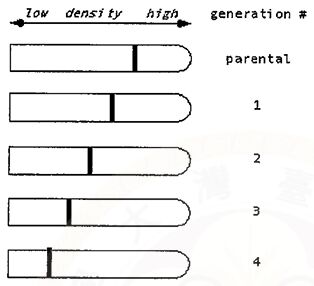
49. Suppose Meselson & Stahl had observed the following data in their famous experiment involving a switch from medium containing 15N to "N. What would they have concluded about the nature of DNA replication?(A) They would have concluded that DNA replication is dispersive/random, i.e., each strand of each double helix contains a mixture of parental and newly synthesized sequences.(B) They would have concluded that DNA replication is conservative, i.e., one double helix contains only the parental strands, while the other contains only newly synthesized DNA.(C) They still would have concluded that DNA replication is semiconservative, i.e., each double helix contains one parental strand and one newly synthesized strand.(D) They would have been unable to distinguish which is correct.(E) None of the above
50. Which of the following is true concerning protein synthesis and memory?(A) Animals that cannot make new proteins have no memories.(B) New protein synthesis in neurons is not required for making long term memory.(C) Inhibition of protein synthesis in eukaryotes leads to lack of long term memory.(D) Production of CREB is inhibited when strong memories are made.(E) None of these is true.
 阿摩線上測驗
登入
 as fuels for cellular respiration. Which statement below is correct?
 , COOH, is fed to mice. After fatty acid oxidation, the
 would be most likely recovered in:
 .