所屬科目:研究所、轉學考(插大)◆分子生物學
1. A Double-stand DNA can be peeled off by a _____ to become 2 single-strand DNAs. (A) DNA polymerase (B) helicase (C) RNA polymerase (D) ligase
2. DNA replication normally occurs at the _____ phase of cell cycle. (A) S (B) G1 (C) G2 (D) M
3. The catalytic center of a prokaryotic RNA polymerase is formed by _____(A)oa (B) Ba (C) yy (D) BB
4. Linear chromosomes are protected from replicative senescence by a stretch of repetitive sequence called _____ and the enzyme that synthesizes it. (A) telomere (B) centromere (C) promoter (D) replication origin
5. The one recombinase employed in the bacteria homologous recombination is _____ (A) RecA (B) CRE recombinase (C) Flippase (D) Spo11
6. The transposition of _____ element involves a RNA encoded genome stage. (A) P-element (B) Tn10 (C) Tyl (D) Tn3
7. Mismatch repair of newly replicated DNA can be facilitated by _____ . (A) nicking of the parental strand in bacteria (B) nicking ofthe nascent strand in prokaryotes (C) methylation of the GATC in parental strand in eukaryotes (D) methylation ofthe GATC in parental strand in prokaryotes
8. A graduate student accidentally cloned a cDNA from an economically important animal whose genomic sequence has not been resolved. The sequence of this cDNA can be summarized as below:
5'-gegatagtataatatcggccaggATGccg..ggccgggtattctcatttTAAggcaggttctta-3 The start and stop codons are shown in bold capital. If he/she likes to amplify the coding region ofthis gene, which one of the following PCR primer sets will work for him/her? (A). 5'-cggccaggATGccg-3'/5'-ttctcatttTAAggcaggttctta-3 (B). 5'-gccggtcCTAcggc -3'/5'-ttctcatttTAAggcaggttctta-3 (C). 5'-cggccaggATGccg-3'/5'-taagaacctgccTTAaaatgagaa -3 (D). 5'-gccggtcCTAcggc -3'/ 5'-aaaATTccgtccaagaat -3
9. Attenuation of Trp operon is performed by (A) binding of ribosome to 5'-UTR (B) pairing of helices 3/4 of leader peptide (C) pairing of helices 2/3 of leader peptide (D) pairing of 5'-UTR and leader peptide
10. Okazaki fragments can be found at _____. (A) transating mRNA (B) transcribing rRNA (C) leading strand of replicating DNA(D) laggering strand of replicating DNA
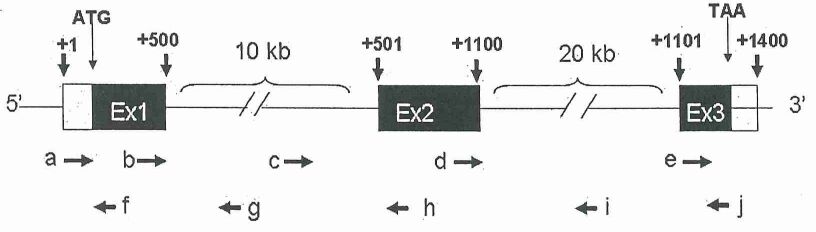
11. The genomic organization of a gene with 3 exons is shown below. The exons are shown as 3 boxes and their boundaries are denoted according to their location in mRNA. The size of the introns as well as location of start and stop codons are also shown on the top. If one wants to detect its expression level with the primer set a/h, what will be the closest size of its PCR product?
(A) 15 kb (B) 500 bp (C) 10 kb (D) 800 kb ATG TAA +1 +500 10 kb +501 +1100 +1101 +1400 20 kb
12. Following question 11, the part of exon 1 between TAA and +1400 is called as: (A) terminator (B) 5'-UTR (C) 3'-UTR (D) initiator
13. Reverse transcriptase is an enzyme that can use RNA as a template to synthesize single strand DNA. As like all DNA polymerase, it needs a primer for the initiation of polymerization. If one wants to detect the expression levels of several protein-coding genes in mammalian cells with RT-PCR, which of the following primers is best for his reverse transcription reaction? (A) 5'-AAAAAAAAAAAAAAA-3' (B) 5'-TTTTTTTTTTTTTTT-3 (C) 5'-TATATATATATATATA-3 (D) 5'-ATGATGATGATGATG-3
14. Which of the following elements/genes is not included in the immunity region of lambda phage genome? (A)(B)cl (C) (D)CII
15. The_____element in the chromosome can stop the spreading of heterochromatin and prevent the effect of an enhancer on genes located on other side. (A) insulator (B) promoter (C) centromere (D) initiator
16. In a replication fork, you can find _____. (A) Okazaki fragments in the leading strand (B) one DNA polymerase synthesizing new DNA of both strands (C) DNA primase making DNA primer (D) nascent DNA synthesized from 5' to 3' in the leading strand.
17. The primosome in a prokaryotic replication fork is formed by_____(A) topoisomerase/helicase (B) DNA polymerase/pirmase fragment/topoisomerase (D) DNA primase/helicase (C) okazaki
18. The _____ enzyme cuts single strand DNA to resolve the tension ahead of replication fork. (A) polymerase (B) primase (C) topoisomerase I (D) topoisomerase II
19. Digestion of chromatin with nuclease to cut the linker DNA between nucleosomes and then isolate DNA from nucleosomes will most likely get DNA ladder of _____ bp. (A) 200 (B) 500 (C) 700 (D) 1000
20. Deamination of 5-methyl cytosine will generate a _____ base. (A) G (B) A (C)T (D) U
21. XIAP is an inhibitor of caspases. How does it work? (A) It prevents the cleavage of prodomians from executioner caspases. (B) It has a RING domain, which blocks the active site of initiator caspases. (C) It uncoils zymogen granules before than be activated by executioner caspases. (D) It attaches ubiquitin to caspases so they get degraded before they are active.
22. During mitochondrial outer membrane permeabilization (MOMP) what is allowed to escape from the mitochondria? (A) Caspases (B) Cytochrome C (C) Bcl proteins (D) ATP
23. UV light induces non-defective prophages to enter the lytic pathway by which of the following mechanisms? (A) SOS response. (B) Conversion of RecA to a protease. (C) Prevention of dimerization of the DNA-binding domain of the repressor. (D) Cleavage of the connector region of the repressor.
24. Enzymes that are involved in catabolic pathways are characteristically controlled by what type of genes? (A) Inducible genes. (B) Repressible genes. (C) Constitutive genes. (D) Enhance genes.
25. In its active form, the RAS protein is associated with. (A) DNA (B) ATP (C) GTP (D) RNA
26. In Saccharomyces cerevisiae, the _____ protein inhibits progression of the cell cycle into mitosis in response to DNA damage. (A) p53 (B) RAD9 (C) Rb (D) E2F protein inhibits progression of the
27. CDKs associate with cyclins at specific stages of the cell cycle. The CDK subunit is responsible for phosphorylating a substrate protein, while the cyclin is responsible for _____(A) degradation of the CDK after phosphorylation. (B) ubiquitin function. (C) determining which specific proteins will be phosphorylated. (D) dephosphorylating Rb.
28. Normal alleles of tumor suppressor genes function to encode proteins that (A) promote transition from G1-to-S. (B) can slow the rate of cell division. (C) increase the rate of mutagenesis. (D) activate oncogenes.
29. The sigma factor that mediates a global heat shock response in E. coli is (A) sigma 70. (B) sigma 32. (C) sigma 34. (D) sigma 72.
30. The critical step in the regulation of most bacterial genes occurs 參考用(A) during transcription. (B) at release of mRNA. (C) during translation. (D) post-translationally.
31. Which of the following is not directly required for chain elongation during translation? (A) Ef-Tu (B) A site on the ribosome (C) GTP (D) IF2
32. Amino acids differ from one another by the _____ that are present. (A) Amino group (B) R group (C) Core group (D) Carboxyl group
33. Which of these processes are coupled (linked) in prokaryotes but NOT in eukaryotes? (A) transcription and translation (B) replication and transcription (C) replication and translation (D) replication, transcription, and translation are not separate in prokaryotes
34. RNA molecules that can act as enzymes and catalyze specific biochemical reactions are known as (A) donors (B) splice acceptors (C) ribozymes (D) tRNAS
35. Which of the following is a form of RNA editing?
1. The polyadenylation of the pre-mRNA sequence.
2. The changing of the structures of individual bases
3. The insertion or deletion of uridine monophosphate residues (A) 1 (B) 3 (C) 1 and 3 (D) 2 and 3
36. Translation takes place at which part of the cell? (A) Nucleus (B) Mitochondria (C) Ribosome (D) Cytosol
37. The isolation of conditional cell cycle mutations in yeast helped identify many of the key proteins involved in cell cycle control. Many of these mutations were given the name cdc (cell division cycle) and are temperature sensitive. A cdc temperature sensitive mutant will:
(A) grow normally at the permissive temperature and arrest at a specific phase in the cell cycle at non-permissive temperature.
(B) grow normally at non-permissive temperature and arrest at a specific phase in the cell cycle at permissive temperatures.
(C) grow slower at permissive temperature and speed up through the cell cycle at non-permissive temperatures.
(D) grow normally at permissive temperature and have an extended period of time in G1 of the cell cycle at non-permissive temperatures.
38. In addition to Cdk1, mitosis is controlled by other kinases including polo-like kinases (PLKs). PLKs participate in mitosis by being recruited to the mitotic spindle and activated by: (A) direct phosphorylation of PLKs by Cdk1. (B) autophosphoylation. (C) binding to a phosphorylated consensus sequence called polo boxes. (D) binding to phosphorylated Cdk1.
39. The eukaryotic transcription factor CREB is active when it is phosphorylated and it binds cAMP response elements (CREs) in the promoters of genes, activating transcription. The mechanism of transcription activation is best described by the following statements. (A) CREB binds the CREs and recruits a complex of proteins that acetylates histones in nucleosomes at the promoter; thereby displacing nucleosomes and facilitating the assembly of basal transcription factors on the promoter. (B) CREB binds the CREs and recruits nucleosome assembly proteins that increase the amount of DNA assembled into nucleosomes in the promotere; thereby increasing the rate of basal transcription factor binding. (C) CREB binds to the CREs and prevents the repressor form binding; thereby increasing the rate of basal transcription factor binding. (D) CREB binds the CREs and directly recruits the basal transcription factors to bind the promoter.
40. What is aminoacyl t-RNA synthetase? (A) The protein that adds amino acids to the growing peptide chain. (B) The protein that recruits the initiator tRNA. (C) The protein that matches the anti-codon of the tRNA and the codon of the mRNA. (D) The protein that adds the appropriate amino acid to the tRNA, matching anti-codon to amino acid. II. Essay questions (20%): Please answer the following question as sufficient as you can.
1. How does phage maintain in the prophage state?
2. Please describe the mechanism of strand-directed mismatch repair in prokaryotes.
3. Approximately 90% of human cancer cells exhibit significant levels of telomerase. Does this mean that telomerase is an oncogene? Explain.
4. Define "CDK"
5. Define "Astrocyte"
 阿摩線上測驗
登入
 (A) 15 kb (B) 500 bp (C) 10 kb (D) 800 kb ATG TAA +1 +500 10 kb +501 +1100 +1101 +1400 20 kb
 (B)cl (C)
 (D)CII