所屬科目:研究所、轉學考(插大)◆普通物理學
1. A particle moves along the y axis. Its position is given by the equation \( y(t) = 2 + 3t - 4t^2 \), with y in meters and t in seconds. What's its position when it changes direction?(A)2.56 m(B)1.28 m(C)4.23 m(D)2.12 m(E)3.84 m
2. A particle moves along a straight line starting at t = 0. Its position is given by the equation \( x(t) = 75t - 1.0t^3 \), where t is in seconds. When it stops (v=0), its acceleration is:(A)0(B)-73 m/s²(C)-30 m/s²(D)-9.8 m/s²(E)49 m/s²
3. A single closed loop of chain of mass m and length l rests on the surface of a smooth, frictionless cone. The chain lies in a horizontal plane. The half-angle of the cone is α. What's the tension in the chain?(A)\( T = \frac{mg}{\tan\alpha} \)(B)\( T = \frac{mg}{2\pi} \)(C)\( T = mg \)(D)\( T = \frac{mg}{2\pi\cot\alpha} \)(E)\( T = \frac{mg}{2\pi\tan\alpha} \)
4. If the net work done by external forces on a particle is zero, which of the following statements about the particle must be true?(A)Its velocity is zero.(B)Its velocity is decreased.(C)Its velocity is unchanged.(D)Its speed is unchanged.(E)More information is needed.
5. A car of mass m moving at a speed \( v_1 \) collides and couples with the back of a truck of mass 2m moving initially in the same direction as the car at a lower speed \( v_2 \). What is the speed \( v_f \) of the two vehicles immediately after the collision?(A)\( v_f = \frac{2}{3}(v_1 - 2v_2) \)(B)\( v_f = \frac{2}{3}(v_1 + v_2) \)(C)\( v_f = \frac{1}{3}(v_1 - 2v_2) \)(D)\( v_f = \frac{1}{3}(v_1 + 2v_2) \)(E)\( v_f = \frac{1}{2}(v_1 + v_2) \)
6. Objects A and B interact with each other via both conservative and nonconservative forces. Let \( K_A \) and \( K_B \) be the kinetic energies, U be the potential energy, and \( E_{int} \) be the internal energy. If no external agent does work on the objects then:(A)\( K_A + U \) is conserved(B)\( K_A + U + E_{int} \) is conserved(C)\( K_A + K_B + E_{int} \) is conserved(D)\( K_A + K_B + U \) is conserved(E)\( K_A + K_B + U + E_{int} \) is conserved
7. A uniform stick of length l is pivoted at one end, and released from rest in a horizontal position. How long will it take for it to swing down to the vertical position?(A)\( 1.311\sqrt{\frac{l}{3g}} \)(B)\( 2.622\sqrt{\frac{l}{3g}} \)(C)\( 1.311\sqrt{\frac{l}{2g}} \)(D)\( 2.622\sqrt{\frac{l}{2g}} \)(E)\( 2.622\sqrt{\frac{l}{g}} \)
8. The displacement of a string is given by \( y(x,t) = y_m \sin(kx + \omega t) \). The speed of the wave is(A)\( \frac{2\pi k}{\omega} \)(B)\( \frac{\omega}{k} \)(C)\( \omega k \)(D)\( \frac{2\pi}{k} \)(E)\( \frac{k}{2\pi} \)
9. A diffraction-limited telescope, designed for use in space, has an aperture of 1 m and a focal length of 20 m. At the focus in a TV detector whose "resolution element" size is \( 10^{-5} \) m. At what wavelength is the telescope optimal in the sense that \( 10^{-5} \) m corresponds to the diffraction limit?(A)4,000 Å(B)2,000 Å(C)1,000 Å(D)3,000 Å(E)5,000 Å
10. An ideal monatomic gas at room temperature is adiabatically decompressed so that the final volume is 8 times the original. What's the final temperature?(A)55 K(B)75 K(C)150 K(D)85 K(E)100 K
11. How long would it take for a 1000 W heater to melt 1.00 kg of ice at −20.0°C, assuming all the energy from the heater is absorbed by the ice?(A)4.18 s(B)41.8 s(C)5.55 min(D)6.25 min(E)38.4 min
12. The units of \( \frac{1}{4\pi\varepsilon_0} \) are:(A)\( N^2 \cdot C^2 \)(B)\( N \cdot m/C \)(C)\( N^2 \cdot m^2/C^2 \)(D)\( N \cdot m^2/C^2 \)(E)\( m^2/C^2 \)
13. A hollow metal sphere is charged to a potential V. The potential at its center is(A)V(B)0(C)−V(D)2V(E)πV
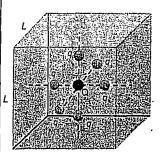
14. A charge Q is located at the center of a cube of edge L, and six other identical charged q are positioned symmetrically around Q as shown in Figure. What's the electric flux through one face of the cube?(A)\( \frac{Q+6|q|}{6\varepsilon_0} \)(B)\( \frac{Q+6|q|}{\varepsilon_0} \)(C)\( \frac{Q-6|q|}{\varepsilon_0} \)(D)\( \frac{Q-6|q|}{4\varepsilon_0} \)(E)\( \frac{Q-6|q|}{6\varepsilon_0} \)
15. Copper contains \( 8.4 \times 10^{28} \) free electrons/m³. A copper wire of cross-section area 1m² carries a current of 1A. The electron drift speed is approximately:(A)1 m/s(B)\( 10^{-4} \) m/s(C)\( 10^{-11} \) m/s(D)\( 10^8 \) m/s(E)\( 10^3 \) m/s
16. Which of the following describes the Faraday's law?(A)\( \oint \vec{B} \cdot d\vec{l} = \mu_0 I \)(B)\( \oint \vec{E} \cdot d\vec{l} = -\frac{\partial \Phi_B}{\partial t} \)(C)\( \oint \vec{E} \cdot d\vec{A} = 0 \)(D)\( \oint \vec{B} \cdot d\vec{A} = 0 \)(E)\( \oint \vec{B} \cdot d\vec{l} = \mu_0\varepsilon_0\frac{d\Phi_E}{dt} \)
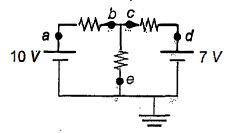
17. Rank the electric potentials at points a, b, c, d, and e from highest to lowest, as shown below, noting any cases of equality in the ranking. All the resistors have equal resistance.(A)d > a > b = c > e(B)a > b > d = c > e(C)a > d > b = c = e(D)a > d > b = c > e(E)a > b > d > c > e
18. What's the angular frequency of resonance of a series LC circuit?(A)(B)(C)LC(D)(E)
19. Assume you charge a plastic stick by rubbing it with fur and then hold the stick next to a bar magnet. Do the electric and magnetic fields produced constitute an electromagnetic wave?(A)Yes they do, necessarily.(B)Yes they do because charged particles are moving inside the bar magnet.(C)They can, but only if the electric field of the comb and the magnetic field of the magnet are perpendicular.(D)They can, but only if both the comb and the magnet are moving.(E)They can, if either the comb or the magnet or both are accelerating.
20. A sodium surface is illuminated with light having a wavelength of 300 nm. The work function for sodium metal is 2.46 eV. What's the maximum kinetic energy of the ejected photoelectrons?(A)1.67 eV(B)3.34 eV(C)5.01 eV(D)2.14 eV(E)4.28 eV
 阿摩線上測驗
登入