阿摩線上測驗
登入
首頁
>
教甄◆英文-國小
> 105年 - 105 國立南科國際實驗高級中學教師甄選_國小部:英文科#52958
105年 - 105 國立南科國際實驗高級中學教師甄選_國小部:英文科#52958
科目:
教甄◆英文-國小 |
年份:
105年 |
選擇題數:
35 |
申論題數:
2
試卷資訊
所屬科目:
教甄◆英文-國小
選擇題 (35)
1. Which biome is characterized by cool winters, hot summers, thick fertile soil, and many animals with teeth designed for grinding? (A)deciduous forest (B)taiga(C)grassland(D)tropical rain forest
2. The job of decomposers is to break down dead plants and animals into useful substances. This job is their _____. (A)adaptation(B)skill (C)niche (D)habitat
3. A _____ is an animal that gets nutrients from dead animals that it did not hunt or kill.
(A)predator (B)scavenger
(C)producer (D)carnivore
4. Which statement is not true about environmental change?
(A)It affects the organisms that live in the ecosystem where it occurs.
(B)It always happens quickly.
(C)It can be caused by natural disasters.
(D)It can cause destruction of food.
5. All are functions of a wetland except _____.
(A)erosion control (B)flood protection
(C)water filters (D)air pollution control
6. Which can change a rock into a metamorphic rock?
(A)compaction and cementation (B)heat and pressure
(C)weathering and erosion (D)melting and cooling
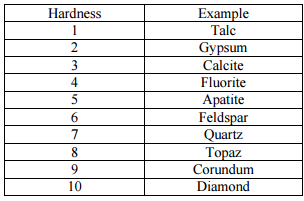
___ 7. Glass has a hardness of 5.5. According to the table, which could glass scratch?
(A)topaz (C)feldspar ((B)apatite(D)diamond
8. When one space object crosses in front of another, the first object can sometimes block the view of the second. This process is called a(n) _____.
(A)umbra (B)penumbra
(C)gibbous (D)eclipse
9. The gravitational pull between Earth and _____ causes tides.
(A)the Sun (B)Mercury
(C)the Moon (D)Mars
10. Which is the largest of all the planets?
(A)Neptune (B)Saturn
(C)Uranus (D)Jupiter
11. A planet is a large object that orbits a(n) _________.
(A)asteroid (B)meteor
(C)star (D)moon
12. How do the reactants and products compare in a chemical reaction? (A)The reactants have more mass. ((B)The products have more mass. (C)The products are much simpler substances. (D)The reactants and products have different physical and chemical properties.
13. Which process involves splitting a nucleus into two or more pieces?
(A)radioactive tracing (B)radiation therapy
(C)nuclear fission (D)nuclear fusion
14. Which measures the average kinetic energy of the molecules in a material?
(A)temperature (B)velocity
(C)heat (D)calories
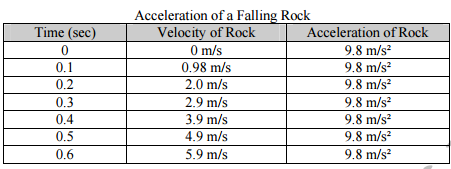
15. A rock falls from a cliff. The table shows the speed and acceleration of the rock at different times.
The weight of the rock is 250 N. What is the mass of the rock?
(A)2.5 kg (B)240 kg
(C)25 kg (D)2,500 kg
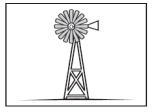
16. A windmill harnesses the power of _____.
(A)electrical energy that can be converted into heat energy ((B)chemical energy that can be converted into light energy (C)mechanical energy that can be converted into electrical energy. (D)chemical energy that can be converted into mechanical energy.
17. An object at rest tends to stay at rest, and an object in motion tends to stay in motion. Which one of Newton’s laws of motion does this statement represent?
(A)fourth (B)third
(C)second (D)first
18. The conversion of one form of energy into another is called _____.
(A)thermal transformation (B)kinetic energy
(C)energy transformation (D)work transformation
19. A change in the velocity of an object over time is __________.
(A)acceleration (B)speed
(C)force (D)distance
20. When one object exerts a force on another (A)action-reaction forces ((B)balanced-unbalanced forces (C)friction-drag forces ((D)positive-negative forces
21) The theme that reflects the idea that there has been a gradual change in the time is _____. (A)energy (B)unity within diversity (C)reproduction (D)evolution
22) Some birds are known as honey guides because they may be followed by humans to wild beehives. When the humans take honey from the hi relationship can best be described as _____. (A)parasitism (B)commensalism (C)mutualism (D)symbiosis
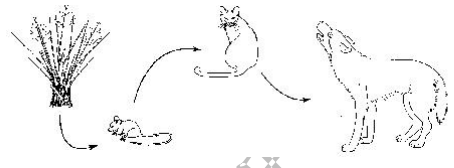
23) Referring to the figure below energy _____. (A)increases (B)decreases (C)decreases then increases (D)increases or decreases but population size remains the same
24) The nucleus of an atom contains _____. (A)protons and neutrons (B)neutrons and electrons (C)protons and electrons (D)protons, neutrons, and electrons
25) What are the basic building blocks of proteins? (A)nucleic acids (B)peptide bonds (C)amino acids (D)glycerol and fatty acids
26) Which of the following organisms do not have cell walls? (A)plants (B)fungi (C)bacteria (D)animals
27) Each of the following is a main idea of the cell theory (A)all organisms are composed of cells (B)the cell is the basic unit of organization of organisms (C)all cells are similar in structure and function (D)all cells come from preexisting cells
28) Which of the following equations best represents photosynthesis?
(A)C + O
2
+ H
2
O → CO
2
+ HOH
(B)6CO
2
+ 6H
2
O → C
6
H
12
O
6
+ 6O
2
(C)6C + 6H
2
O → C
6
H
12
O
6
(D)C
6
H
12
O
6
→ 6CO
2
+ 6H
2
O
29) The statement: “In meiosis, the way in which a chromosome pair separates does not affect the way other pairs separate,” is another way of expressing Mendel’s law of _____.
(A)dominance (B)first filial generations
(C)independent assortment (D)Punnett squares
30) Scientists agree that two developments must have occurred for life to come into being: the formation of simple organic molecules important to life and _____. (A)development of prokaryotic cells in early oceans (B)organization of molecules into complex organic molecules (C)appearance of amino acids, monosaccharides, and lipids (D)an atmosphere rich in water vapor, oxygen, and ATP
31) Natural selection can best be defined as the _____. (A)survival of the biggest and strongest organisms in a population (B)elimination of the smallest organisms by the biggest organisms (C)survival and reproduction of the organisms that occupy the largest area (D)survival and reproduction of the organisms that are genetically best adapted to the environment
32) What is the primary function of plant leaves?
(A)to support the plant (B)to produce flowers
(C)to take in water (D)to trap sunlight for photosynthesis
33) Animal communication can occur through _____.
(A)sounds (B)touches
(C)smells (D)all of these
34) The hormone that causes a decrease in blood glucose is _____.
(A)glucagon (B)insulin
(C)gastrin (D)nuclease
35) Which of the following is part of the digestive tract?
(A)liver (B)small intestine
(C)gallbladder (D)pancreas
申論題 (2)
Essay Question (15 pts/ each, 30 pts in total)
1. In general terms, we may divide assessment into two types of formative assessment (形成性評量) and summative assessment (總結性評量). Which type do you prefer for your measuring of students’ course performance? Explain your reasons.
2. Please make a comparison between the way you were taught and the way you are going to teach in science class.
相關試卷
115年 - 115 桃園市國民小學教師聯合甄選初試試題:語文科-B#140954
115年 · #140954
115年 - 115 臺南市市立國民小學_教師暨學前特教師聯合甄選基礎科目︰英文#140478
115年 · #140478
115年 - 115 中區縣市政府教師甄選策略聯盟_國小:英語科#140391
115年 · #140391
115年 - 115 桃園市國民小學教師聯合甄選初試試題:語文科A-英文#140308
115年 · #140308
115年 - 115 新北市國民小學暨幼兒園教師甄選試題:普通科-英文#139918
115年 · #139918
115年 - 115 新北市國民小學暨幼兒園教師甄選試題:英語文科#139892
115年 · #139892
115年 - 115 臺北市公立國民小學教師聯合甄選初試專門類科知能試題:英語科#139886
115年 · #139886
115年 - 115 臺北市公立國民小學教師聯合甄選初試基礎類科知能試題:英文#139883
115年 · #139883
115年 - 115-1 國立屏科實驗高級中等學校_專任教師甄選初試試題_小學部:英語文#138665
115年 · #138665
114年 - 114 文藻外語大學_國小教師教育學程新生甄選試題:英文#130723
114年 · #130723
 阿摩線上測驗
登入
阿摩線上測驗
登入
 (A)topaz (C)feldspar ((B)apatite(D)diamond
 The weight of the rock is 250 N. What is the mass of the rock?
 (A)electrical energy that can be converted into heat energy ((B)chemical energy that can be converted into light energy (C)mechanical energy that can be converted into electrical energy. (D)chemical energy that can be converted into mechanical energy.