所屬科目:中山◆電機◆電磁學
1.(10%) (a) Explain Gradient, Divergence, and Curl. (b) Curl of a Gradient field, ∇✖ ∇v =0 Divergence of a Curl,∇. ∇✖ A= 0. Vis a scalar field, A is a vector field.說明其物理意義(why?) 或舉例。
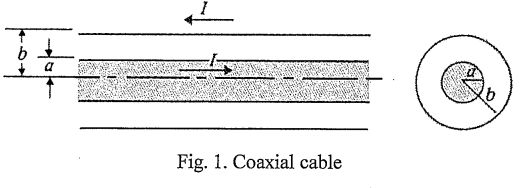
2.(10%) For a coaxial transmission line, Fig. 1, the capacitance per unit length is , and the inductance per unit length is. At high frequencies, the internal inductance drops off. Find the characteristic impedance of the coaxial line, , at high frequencies. Please also write down the unit of Zo, i.e,, what is the square root of (H/F)? What is the speed the wave travels in the coaxial cable? You can find it by calculating velocity = .
3.(10%) In the following configurations, Fig. 2, assuming both grounds are perfect conductors, current directions are as indicated (the solid arrows); the image current for both cases are shown. Using an✖H = J, H is the magnetic field intensity on the ground, an is the normal vector of the top surface of the grounds, determine the direction of the currents on the top surface of the grounds.Current relative to the ground. Considering both the original current and its induced current on the ground, which one, left or right, is likely to be an effective antenna structure, why?
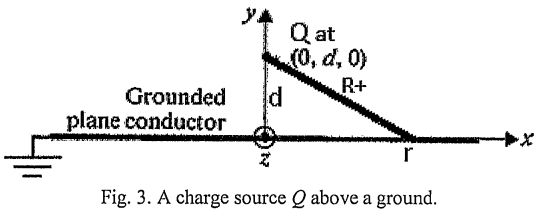
4.(5%) Using the Method of Image, wite down the potential distribution, V(x, y, z), for an observing point P(x, y, z) in the space, Fig. 3. The dielectric constant of the space is ε0. Q is a positive point charge of Q Coul.
5.(10%) 下圖 Fig. 4 之 magnetic flux density B can be found as, 簡化上列之Bas a function of,o and @ when >. In cylindrical coordinate system,.Show that∇•B=0.
6.(5%) What are the permittivity e and permeability μ of Copper, a very good conductor? Provide your reasoning.
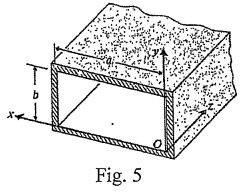
8. (15%) As shown in Fig. 5, a waveguide filled with a material whose εr = 2.25 has dimensions a = 2 cm and b = 1.4 cm. If the guide is to transmit 13.5 GHz signals, what possible modes can be used for the transmission? Please respectively calculate the cutoff frequencies of the possible modes.
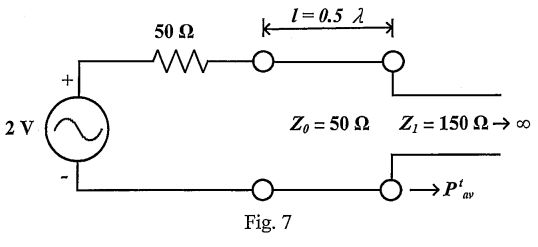
10. (10%) As shown in Fig. 7, calculate the average power transmitted into the infinite 150 Ω line. The λ/2 line is lossless and the infinitely long line is slightly lossy. (Hint: The input impedance of an infinitely long line is equal to its characteristic impedance so long as the line is not lossless)
 阿摩線上測驗
登入
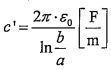 , and the inductance per unit length is
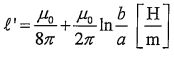 . At high frequencies, the internal inductance drops off. Find the characteristic impedance of the coaxial line,
 , at high frequencies. Please also write down the unit of Zo, i.e,, what is the square root of (H/F)? What is the speed the wave travels in the coaxial cable? You can find it by calculating velocity =
 .
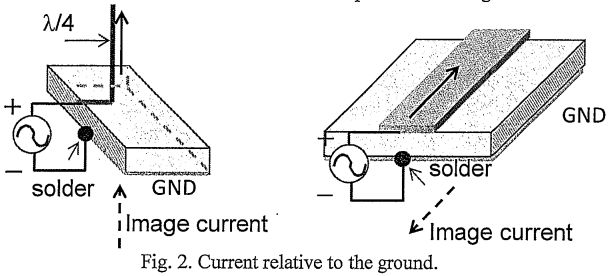 Current relative to the ground. Considering both the original current and its induced current on the ground, which one, left or right, is likely to be an effective antenna structure, why?
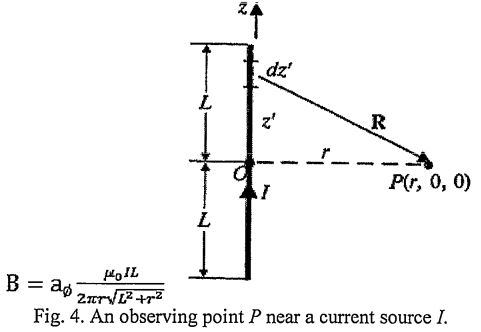
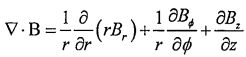 .Show that∇•B=0.