所屬科目:研究所、轉學考(插大)◆生物化學
1. The PCR reaction mixture does not include: (A) all four deoxynucleoside triphosphates. (B) DNA containing the sequence to be amplified. (C) DNA ligase. (D) heat-stable DNA polymerase. (E) oligonucleotide primer(s).
2. In the laboratory, recombinant plasmids are commonly introduced into bacterial cells by: (A) electrophoresis - a gentle low-voltage gradient draws the DNA into the cell. (B) infection with a bacteriophage that carries the plasmid. (C) microinjection. (D) mixing plasmids with an extract of broken cells. (E) transformation - heat shock of the cells incubated with plasmid DNA in the presence of CaCl2.
3. The biological role of restriction enzymes is to: (A) aid recombinant DNA research. (B) degrade foreign DNA that enters a bacterium. (C) make bacteria resistant to antibiotics. (D) restrict the damage to DNA by ultraviolet light. (E) restrict the size of DNA in certain bacteria.
4. It is correct to say that DNA supercoiling cannot: (A) be induced by strand separation. (B) be induced by underwinding of the double helix. (C) form if there is Z-DNA structure present. (D) occur if a closed-circular, double-stranded DNA molecule has a nick. (E) result in compaction of the DNA structure.
5. The main reason that separated proteins on an SDS-PAGE gel is: (A) negative charge on protein (B) protein shape (C) protein density (D) protein molecular weight (E) resistant to protein mobility.
6. Which is the amino acid that delivers nitrogen wastes from most tissues to the liver for catabolism? (A) glutamate (B) glutamine (C) alanine (D) aspartate (E) asparagine.
7. Which of the phospholipid is found in the outer layer facing extracellular space of a lipid bilayer? (A) phosphatidyl choline (B) phosphatidyl ethanolamine (C) phosphatidyl serine (D) phosphatidic acid (E) phosphotidyl inositol.
8. Which of the following is NOT considered branched amino acid? (A) valine (B) leucine (C) isoleucine (D) proline (E) 2-aminoisobutyric acid.
9. Which of the following polymerases is inhibited by a-amanitin? (A) DNA-dependent RNA polymerase I (B) DNA-dependent RNA polymerase II (C) RNA-dependent RNA polymerase (D) Reverse transcriptase (E) Telomerase
10. Which of the following choices is belonged to cis-element of eukaryotic transcriptional regulation? (A) TATA box (B) Pribnow box (C) GC box binding protein SP1 (D) CAAT box binding protein CTF (E) Repressor
11. Small nuclear RNA (snRNA) U2 bound to which part of the primary transcripts for RNA splicing? (A) Transcriptional start site (B) 5' splice site (C) 3' splice site (D) Branch point encompassing the A site (E) Polyadenylation signal
12. 1,6-allolactose binds to which of the following choices to induce the transcription of lactose operon in E. coli.: (A) Operator (B) Promoter for regulatory gene (C) Promoter for lac operon (D) lac repressor (E) Catabolite gene activator protein (CAP)
13. Apolipoprotein CII (Apo-CII) deficiency is usually associated with (A) hypercholesterolemia (B) hypocholesterolemia (C) hyperglycemia (D) hypoglycemia (E) hypertriglyceridemia
14. Which of the following is not required for synthesis of palmitic acid from acetyl-CoA? (A) acetyl-CoA carboxylase (B) fatty acid synthase (C) elongase (D) NADPH (E) Biotin
15. Which of the following is responsible for the reverse cholesterol transport? (A) VLDL (B) IDL (C) LDL (D) HDL (E) Chylomicron
16. Which of the following is not elevated in the plasma after fasting for48 hours? (A) acetone (B) acetoacetate (C) D-3-hydroxybutyrate (D) free fatty acid (E) glucose
17. Which of the following is not reducing sugar? (A) Lactose (B) Maltose (C) Sucrose (D) Glucose (E) None of the above
18. Which of the following enzyme is NOT required to metabolize galactose? (A) Galactokinase (B) UDP-galactose-4-epimerase (C) UDP-galactose-1-epimerase (D) Galactose-1-phosphate uridylyltransferase (E) None of the above
19. A three-month-old baby is diagnosed with pyruvate dehydrogenase complex deficiency. Which of the following coenzyme is NOT required by this enzyme complex to convert pyruvate to acetyl-CoA? (A) Thiamine pyrophosphate (B) Nicotinamide adenine dinucleotide (C) Lipoamide (D) Flavin adenine dinucleotide (E) None of the above
20. The following enzymes involved in the citric acid cycle are all reversible except (A) Succinyl-CoA synthetase (B) Succinic dehydrogenase (C) Fumarase (D) Citrate synthase (E) None of the above
21. Which of the following statements about aromatic amino acids is correct? (A) All are strongly hydrophilic. (B) Histidine's ring structure results in its being categorized as aromatic or basic, depending on pH. (C) On a molar basis, tryptophan absorbs more ultraviolet light than tyrosine. (D) The major contribution to the characteristic absorption of light at 280 nm by proteins is the phenylalanine R group. (E) The presence of a ring structure in its R group determines whether or not an amino acid is aromatic.
22. Proteins may be separated according to size by (A) Isoelectric focusing (B) Affinity chromatography (C) Ion exchange chromatography (D) Molecular exclusion chromatography (E) Reverse phase HPLC
23. Hemoglobin and myoglobin both have, are, can, or do all of the following except (A) highly a helical (B) bind one molecule of heme per globin chain (C) subunits that provide hydrogen bonds to and nonpolar interaction with other subunits (D) bind heme in a hydrophobic pocket (E) bind one O2 per heme
24. A protein has one transmembrane domain composed entirely of a-helical secondary structure. Which of the following amino acids would you expect to find in the transmembrane domain ? (A) Proline (B) Glutamate (C) Lysine (D) Leucine (E) Arginine
25. How Ca++ can increase the enzymatic activity of phosphorylase for glycogen metabolism? (A) Ca++ increases the activity of calmodulin-dependent protein kinase and then activate the enzymatic activity of phosphorylase (B) Ca++ increases the activity of calmodulin-dependent phosphatase and then activate the enzymatic activity of phosphorylase (C) Ca++ increases the activity of calmodulin-dependent protein kinase and then regulates glycogen synthase kinase activity, leading to up-regulation of phosphorylase activity (D) Ca++ binds to the 8 subunit of the phosphorylase kinase and then promotes the activity of phosphorylase (E) Ca++ inhibits the protein phosphatase 1 and increases increases the activity of calmodulin-dependent phosphatase and then the enzymatic activity of phosphorylase.
26. Which following condition we cannot observe any glucosuria syndrome? (A) loss of function of pancreatic ẞ cells (B) liver damage (C) insulin increases glucose tolerance (D) inherited defects in the kidney (E) none of the above.
27. In human body what compound cannot be used for glycine biosynthesis? (A) choline (B) alanine (C) glyoxylate (D) serine (E) none of the above.
28. What following enzyme can generate ammonium (NH3)? (A) uroporphyrinogen I synthase (B) uroporphyrinogen II synthase (C) uroporphyrinogen III synthase (D) coproporphyrinogen oxidase (E) protoporphyrinogen oxidase.
29. Which one below is not the component of membrane? (A) Lipid (B) Protein (C) Cholesterol (D) Sterol (E) None of above all
30. Phosphatidylinositol (PtdIns) is a small lipid to regulate diverse biological function. The activity/function of PtdIns can be modulated by kinases and phosphatases. The kinases-mediated phosphorylation is happening on hydroxyl positions of the inositol ring. Which position below is not the site for phosphorylation? (A) 3 hydroxyl position (B) 4 hydroxyl position (C) 5 hydroxyl position (D) 3 and 4 hydroxyl positions (E) 6 hydroxyl position
31. Which one below is not membrane-bound organelles/vesicles in cells? (A) Giant unilamella vesicles (GUV) (B) Mitochondria (C) Late endosome (D) Chloroplast (E) Lysosome
32. Which one below is not the feature of signal-transducing systems? (A) Specificity (B) Desensitization (C) Integration (D) Amplification (E) None of above all
33. In G-protein coupled receptors what subunit binds to GTP and has GTPase activity? (A) Alpha (B) Beta (C) Gamma (D) Delta (E) Epsilon
34. All G-protein coupled receptors are? (A) 1 membrane-spanning receptors (B) 5 membrane-spanning receptors (C) 7 membrane-spanning receptors (D) 10 membrane-spanning receptors (E) 13 membrane-spanning receptors
35. What enzyme converts ATP into cAMP? (A) ATPase (B) Cyclic nucleotide phosphodiesterase (C) Adenylate cyclase (D) Serine kinase (E) All of the above
36. Phosphatidylinositol 4,5-bisphosphate (PIP2) is cleaved into what secondary messengers? (A) IP3 (inositol triphosphate) and DAG (diacylglycerol). (B) IP3 and NO (nitric oxide) (C) Calcium and DAG (D) NO and DAG (E) All of the above
37. In protein translation, release factors are required in which stage: (A) activation of amino acids. (B) initiation. (C) elongation. (D) termination. (E) protein folding.
38. For targeting nuclear proteins, nuclear localization sequences are recognized by: (A) SRP. (B) proteasome. (C) Ion channels. (D) microtubule. (E) importin.
39. In genome, a silent mutation in protein coding region will lead to: (A) a wrong amino acid incorporated into protein. (B) premature termination. (C) no change of amino acid sequence. (D) a frame shift. (E) initiation failure.
40. Which molecule can catalyze the formation of peptide bond? (A) ribosomal RNA. (B) transfer RNA. (C) micro RNA. (D) messenger RNA. (E) initiation factors.
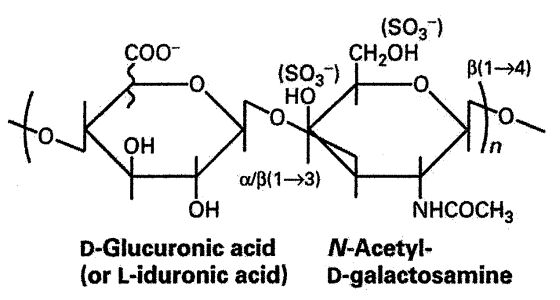
41. Which descriptions about the sugar polymer above are corrects: (A) Proteoglycan (B) Glycosaminoglycan (C) Hyaluronan (D) Chondroitin sulfate (E) repulsive(inhibitory) signal for neurite out growth
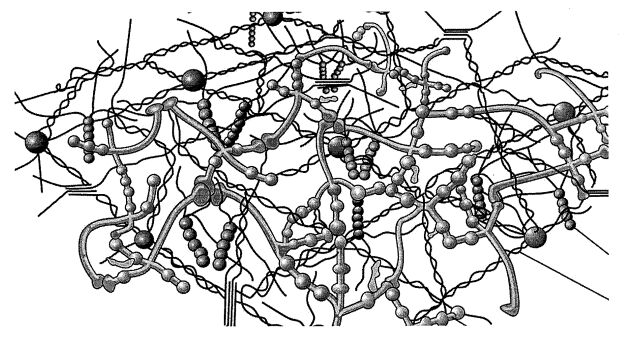
42. Which descriptions about the mosaic structure above are corrects: (A) cell membrane (B) most components can be degraded by DNAse or RNAse (C) basement membrane (D) containing type 4 collagen, laminin, perlecan. (E) containing type I collagen, laminin, fiberonectin
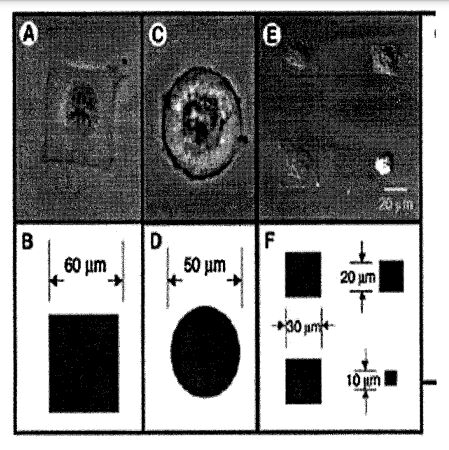
43. Which ECM receptor is critical for NIH3T3 cells grown on the chip? (A) L-selectin (B) E-cadherin (C) I-CAM (D) a5b1 Ε) α3β1
44. which descriptions of the growth pattern are correct: (A) fibronectin decide the growth pattern (round or circle) (B) anchorage-dependent growth (C) anchorage-independent growth (D) 20 µm square is the minimum area for cells growth (E) 10 µm square is the minimum area for cells growth
45. According to the Michaelis-Menten equation, the of an enzymatic reaction can be deduced by plotting (A) substrate concentration vs time (B) initial velocity vs time (C) product concentration vs time (D) initial velocity vs product concentration (E) initial velocity vs substrate concentration
46. The reaction " AB" is most likely catalyzed by a(an)** (A) Oxidoreductase (B) Transferase (C) Isomerase (D) Ligase (E) hydrolase
47. Which of the following descriptions as to theophylline is RIGHT ? (A) The structure left is theophylline. (B) Theophylline is a trimethylxanthine. (C) Theophylline is the hypoxanthine derivative of tea. (D) Theophylline is similar with caffeine but lack the methyl group at N-1 of the heterocycle. (E) None of them.
48. Continue the above, a phosphodiesterase inhibitor can (A) raise intracellular cyclic adenosine monophosphate (cAMP). (B) reduce intracellular cAMP. (C) raise intracellular AMP. (D) reduce intracellular CMP. (E) none of them.
49. Continue the above, which of the following descriptions as to cAMP is RIGHT ? (A) 3',5'-cyclic AMP. (B) The intracellular cAMP concentration is three orders of magnitude below that of ATP. (C) CAMP can serve as the second messengers in hormonally regulated events. (D) all are right. (E) none of them.
50. CH3(CH2)5CH=CH(CH2)9COOH is an unsaturated fatty acid, which of the following nomenclature names is RIGHT for it? (A) ω3, C18:1 (B)ω5, C18:1 (C) 07, C18:1 (D) 9, C18:1 (Ε) ω11, C18:1.
 阿摩線上測驗
登入
阿摩線上測驗
登入
 (A) ribosomal RNA. (B) transfer RNA. (C) micro RNA. (D) messenger RNA. (E) initiation factors.
 (A) Proteoglycan (B) Glycosaminoglycan (C) Hyaluronan (D) Chondroitin sulfate (E) repulsive(inhibitory) signal for neurite out growth
 (A) cell membrane (B) most components can be degraded by DNAse or RNAse (C) basement membrane (D) containing type 4 collagen, laminin, perlecan. (E) containing type I collagen, laminin, fiberonectin
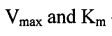 of an enzymatic reaction can be deduced by plotting (A)
 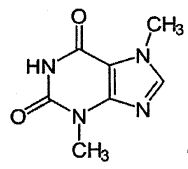 The structure left is theophylline. (B) Theophylline is a trimethylxanthine. (C) Theophylline is the hypoxanthine derivative of tea. (D) Theophylline is similar with caffeine but lack the methyl group at N-1 of the heterocycle. (E) None of them.