所屬科目:研究所、轉學考(插大)◆工程數學
Problem 4. (2.5 %) Which of the following statement is NOT true? (A) If A ⊂ B, then P(A)≤ P(B). (B) If P(B)> 0, then P(A|B) ≥ P(A). (C) P(A∩B) ≥ P(A)+P(B) - 1. (D) P(A∩Bc) = P(AUB) - P(B).
Problem 6. (2.5 %o) Suppose X, Y and Z are three independent discrete ran- dom variables. Then X and Y + Z are. _____ independent. (A) always(B) sometimes (C) never
Problem 7. (2.5 %) Consider two random variables X and Y, each taking values in {1,2,3}. Let their joint PMF be such that for any 1 ≤ x,y ≤ 3, Then, (A) X and Y can be independent or dependent depending upon the strictly positive values (B) X and Y are always independent (C) X and Y can never be independent
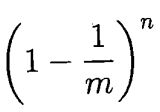
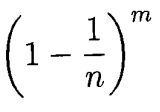
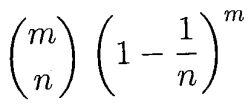
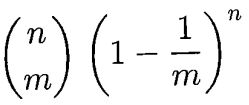
Problem 8. (2.5 %o) We throw n identical balls into m urns at random, where each urn is equally likely and each throw is independent of any other throw. What is the probability that i-th urn is empty? (A) (B)(C) (D)
Problem 9. (2.5 %) For a biased coin, the probability of 'heads" is 1/3. Let h be the number of heads in five independent coin tosses. What is the probability P(first toss is a head | h = 1 or h = 5)?(A) (B)(C) (D)
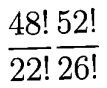
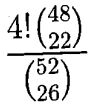
Problem 10. (2.5 %) A well-shuffled deck of 52 cards is dealt evenly to two players (26 cards each). What is the probability that player 1 gets all the cases (A) (B)(C)(D)
Problem 12. (25 %) Let Xi, 1 ≤ i < 4 be independent Bernoulli random variable each with mean p = 0.1. Let X = That is, X is a Binomial random variable with parameters n = 4 and p = 0.1. Then, (A)E[X1 | X=2]=0.1(B)E[X1 | X= 2]=0.5(C)[X1 | X=2]= 0.25
Problem 17. (2.5 %) N people put their hats in a closet at the start of a party, where each hat is uniquely identifed. At the end of the party each person ran- domly selects a hat from the closet. Suppose N is a Poisson random variable with parameter. If X is the number of people who pick their own hats, then E[X] is equal to (A) (B) (C) (D)1
Problem 18. (3.0 %) Suppose X and Y are Poisson random variables with parameters respectively, where X and Y are independent. Define W = X + Y, then, (A) W is Poisson with parameter (B) W is Poisson with parameter (C) W may not be Poisson but has mean equal to(D) W may not be Poisson but has mean equal to
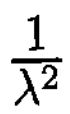
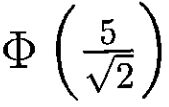
Problem 20. (3.0 %) Let Xi,i = 1,2, ... be independent random variables all distributed according to the pdf fX(x) = x/8 for 0 ≤ x ≤ 4. Let S = . Then P(S >3) is approximately equal to (A) (B)(C) (D)
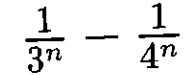
Problem 21. (3.0 %) Let Xi,i = 1,2, ... be independent random variables all distributed according to the pdf fX(x) = 1 for 0 ≤ x ≤ 1. Definc Yn = X1X2X3... Xn for some integer n. Then var(Yn) is equal to (A)(B)(C)(D)
Problem 1. (10 %) Given a matrixwhere a is a real number. Find the rank ofand give the corresponding range of a.
(i) (10 %) Find the Eigenvalues and Eigenvectors for .
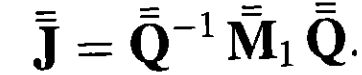
(ii) (5 %) Show that there exists a matrix, which is similar to the matrixin the Jordon form, i.e.,
(i) (15 %) Letwith r singular valuesUr= [u1,⋯,ur]consisting of the associated r left singular vectors and Vr= [v1,⋯,vr]consisting of the associated r right singular vectors. (1) Find the range space (i.e., column space) of A, denoted as R(A), and the row space of A (i.e., R(AT)) where AT denotes the transpose of A ;(2) find the projection matrix PA such thatand;(3) find the eignevalues and eigenvectors of AAT.
(ii) (10 %) Suppose that A,and Tr(A) denotes the trace of A (i.e., the sum of all the diagonal elements of A).(1)Is Tr(AX)≥0 true? (2)Is it true that if Tr(AX) = 0, then(zero matrix)?Prove or disprove your answer.
 阿摩線上測驗
登入

 (B)
 (C)
 (D)
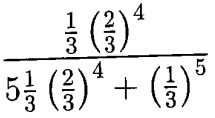 (B)
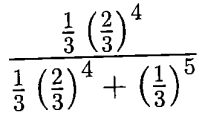 (C)
 (D)

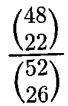 (B)
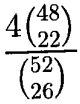 (C)
 (D)
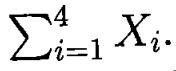 That is, X is a Binomial
random variable with parameters n = 4 and p = 0.1. Then,
(A)E[X1 | X=2]=0.1(B)E[X1 | X= 2]=0.5(C)[X1 | X=2]= 0.25
 . If X is the number of people who pick their own hats, then
E[X] is equal to
(A)
 (B)
 (C)
 (D)1
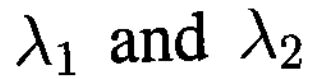 respectively, where X and Y are independent. Define
W = X + Y, then,
(A) W is Poisson with parameter
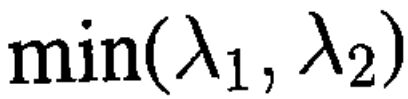 (B) W is Poisson with parameter
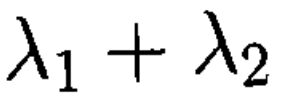 (C) W may not be Poisson but has mean equal to
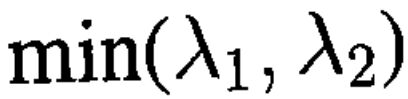 (D) W may not be Poisson but has mean equal to

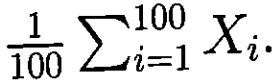 . Then P(S >3) is approximately equal to
(A)
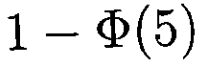 (B)
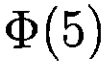 (C)
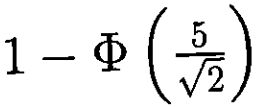 (D)
 (B)
 (C)
 (D)

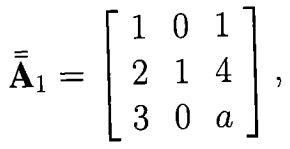
 and give the corresponding range of a.
 .
 , which is similar to the matrix
 in the Jordon form, i.e.,
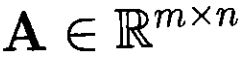 with r singular values
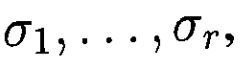 Ur= [u1,⋯,ur]
 and
 ;
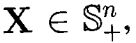
 (zero matrix)?