所屬科目:研究所、轉學考(插大)◆綜合化學
2.When the redox reaction in basic solution: is balanced using the smallest whole-number coefficients, the coefficient of H.0 is x and the sum of all coefficients is y. What are x and y? (A)x=2,y=9 (B)x= 1,y=8 (C)x=1,y=9 (D)x=2.y=8 (E)x =2,y= 10
7. Which sequence correctly ranks the following protons in order of increasing acidity? (A)1<2<3 (B)2<3<1(C)3<1<2(D)3<2<1 (E)2<1<3
10. What is the major end product of the following reaction series? (A) Ala (B) Gly (C) Leu (D) Ile (E) Val
13. Which of the following species is optically active? (A) NH2C1 (B) (C) (D) SiFCBrI (E) HCN
16. How many of the following ligands are capable of linkage isomerism? (A) 1 (B) 2 (C) 3 (D) 4 (E) 5
17. You analyze for pyridine () by dissolving 0.1000 g of the complex in 100 mL of H2O and titrating with a 0.01 M HCI solution. Which of the following indicators should be used to detect the endpoint? (Assume that the initial concentration of pyridine is approximately 0.01 M.) (A) thymol blue, pH range of color change = 8.0-9.6 (B) methyl red, pH range of color change = 4.8-6.0 (C) bromophenol blue, pH range of color change = 3.0-4.6 (D) bromothymol blue, pH range of color change = 6.0-7.6 (E) alizarin yellow, pH range of color change = 10.1-12.0
18. Which of the following is paramagnetic? (A) (B) (C)(D)(E
20. Arrange the following species from lowest to highest ionization energy: (A)(B) (C) (D) (E)
23. Metal X has a body-centered cubic structure. If the atomic radius of X is R, what is the edge length of the unit cell? (A)2R (B)√2R (C) (D) (E) √3 R
25. Consider the following gas samples:Which of the following statements is NOT TRUE?(A) Assuming identical intermolecular forces in the two samples, sample M should be morenearly ideal than sample N.(B) The root-mean-square velocity of molecules in sample M is twice as large as the root-mean-square velocity of molecules in sample N.(C) The average kinetic energy of the molecules in sample M is twice the average kineticenergy of the molecules in sample N.(D) The fraction of molecules in sample M having kinetic energies greater than some highfixed value is larger than the fraction of molecules in sample N having kinetic energiesgreater than that same high fixed value.(E) The volume of sample M is twice the volume of sample N.
26. A 0.100 g sample of the weak acid HA (molar mass = 100 g/mol) is dissolved in 500 g water. The freezing point of the resulting solution is -0.0056 *C. Calculate the value of Ka for this acid. Assume molarity equals molality in this solution. (The molal freezing point depression constant Kris 1.86 ℃) (A)(B)(C)(D)(E)
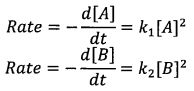
27. Two isomers (A and B) of a given compound dimerize as follows:Both processes are known to be second order in the reactant, and ki is known to be . In a particular experiment A, and B were placed in separate container at 25 ℃,where and . After each reaction had progressed for 3.00 min, [A] = 3.00 [B]. In this case the rate laws are define as follows:The concentration of A2 after 3.00 min is x M. The half-life for the experiment involving B isy s. What are the values of x and y?(A)(B)(C) (D)(E)
29. The observed solubility of the salt MX in 4.0 M strong acid is . The K, value for the acid HX is . Calculate the value of for the salt MX. (A) (B) (C) (D) (E)
30. A galvanic cell is constructed with copper electrodes and in each compartment. In one compartment, , and in the other compartment, . Calculate the potential for this cell at 25 ℃. The standard reduction potential for is +0.34 V. (A) 0.43 V (B) -0.43 V (C) 0.092 V (D) -0.092 V (E) 0.77 V
32. A 0.50 M solution of the BHA has a pH of 7.50 at 25 ℃, where B is a weak base and A- is the anion of the weak acid HA. Ifthe K, value for B is , what is the Ke value for HA? (A)(B)(C)(D) (E)
33. What is in a solution of Ca(OH)z at 25 ℃? (A) (B) (C) (D) (E)
34. The heat of vaporization of water at the normal boiling point, 373 K, is 40.7 kJ/mol. The specific heat capacity of liquid water is and of gaseous water is . Assume that these values are independent of temperature. What is the heat of vaporization of water at 288 K? (A) 44.0 kJ/mol (B) 50.2 kJ/mol (C) 37.4 kJ/mol (D) 31.2 kJ/mol (E) 40.7 kJ/mol
35. The atomic mass is 2.01410 u for . The masses are 0.000549 u for electron, 1.00728 u for proton, and 1.00866 u for neutron. What is the binding energy per nucleon for ? (A) 1.12 MeV(B) 1.42 MeV (C) 2.24 MeV (D) 2.83 MeV (E) 5.66 MeV
37. One mole of an ideal gas undergoes an isothermal reversible expansion at 300 K. During theprocess, the system absorbs 750 J of heat from the surroundings. When this gas iscompressed to the original state in one step isothermally, twice as much work is done on thesystem as was performed on the surroundings in the expansion. Which of the followingstatements are TRUE?(A) for the one-step isothermal compression is 2.5 J/K.(B) for the one-step isothermal compression is 5.0 J/K.(C) for the reversible isothermal expansion is zero.(D) for the overall process (expansion and compression) is zero.(E) for the overall process (expansion and compression) is -2.5 J/K.
38. Consider the standard galvanic cell at 25 ℃ based on the following half-reaction:
The electrodes in this cell are Ag(s) and Cu(s). Which of the following changes will make the cell potential decrease? (A) CuSO4(s) is added to the copper half-cell compartment (assume no volume change). (B) NH3(ag) is added to the copper half-cell compartment. (C) NaCl(s) is added to the silver half-cell compartment. (D) Water is added to both half-cell compartments until the volume of solution is doubled. (E) The silver electrode is replaced with a platinum electrode.
39. Which of the following statements about nuclear reaction and stability are TRUE? (A) A radioactive nuclide that decays from atoms to 2.5 x 10⁹ atoms in 10.0 mins has a half-life of 5.0 mins. (B) Nuclides with large Z values are often observed to be a-particle producers. (C) As Z increases, , nuclides need a greater proton-to-neutron ratio for stability. (D) Those "light" nuclides that have twice as many neutrons as protons are expected to be stable. (E) If more than one neutron from each fission event causes another fission event, the fission situation is described as supercritical.
42. The following results were obtained at 600 K for the decomposition of ethanol on alumina(Al2O3) surface,Which of the following statements are TRUE?(A) At t = 80 s, is 370 torr.(B) The rate constant is 90 torr/min.(C) This a first order reaction.(D) At t = 300 s, is 700 torr.(E) At t = 100 s, the partial pressure of ethanol is 100 torr.
43. Consider a buffered solution containing CH3NH:Cl and CH3NH2. Which of the followingstatements concerning this solution are TRUE? (A) A solution consisting of 0.10 M CH3NH3CI and 0.10 M CH3NH2 would have a higherbuffering capacity than one containing 1.0 M CH3NH3CI and 1.0 M CH3NH2.(B) If [CH3NH2] > [CH3NH3⁺], then the pH is larger than the pKa value of CH3NH3⁺ .(C) Adding more [CH3NH3Cl] to the initial buffer solution will increase the pH.(D) If [CH3NH2] > [CH3NH3⁺], then pH > 10.50.(E) IF [CH3NH2] = [CH3NH3⁺], then pH = 3.30.
44. Which of the following statements are TRUE? (A) Octahedral complexes are more appropriate than octahedral complexes to be used to determine whether a ligand is a strong-field or a weak-field ligand. (B) The fulminate ions (CNO⁻) can have three different Lewis structures in which all the N atoms have a same formal charge. (C) Cobalt is a component of vitamin B12, which is essential for the metabolism of carbohydrates, fats, and proteins. (D) are all NMR active nuclides. (E) Both Ir(NH3)3Cl3 and [Ni(H2O)+(NO2)2] exhibit geometric isomerism.
45. Consider 1.0 mole of a monatomic ideal gas in a container fitted with a piston. The initialconditions are V = 5.0 L and P = 4.0 atm at some constant T. These two processes areperformed isothermally:(a) The external pressure is suddenly changed to 2.0 atm to allow expansion of the gas.(b) Followed by process (a), the external pressure suddenly changes back to 4.0 atm tocompress the gas.Which of the following statements about these two processes are NOT TRUE?(A) In process (a), expansion of the gas is spontaneous.(B) In process (b), compression of the gas is nonspontaneous.(C) The sign of free energy change (△G) can be used to predict spontaneity of these twoprocesses.(D) In process (a), the change of internal energy (△E) is zero during the gas expansion.(E) In process (b), the sign of is negative during the gas compression.
 阿摩線上測驗
登入
 is balanced using the smallest whole-number coefficients, the coefficient of H.0 is x and the sum of all coefficients is y. What are x and y? (A)x=2,y=9 (B)x= 1,y=8 (C)x=1,y=9 (D)x=2.y=8 (E)x =2,y= 10

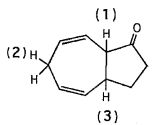 (A)1<2<3 (B)2<3<1(C)3<1<2(D)3<2<1 (E)2<1<3
 (A) Ala (B) Gly (C) Leu (D) Ile (E) Val
 (C)
 (D) SiFCBrI (E) HCN
 (A) 1 (B) 2 (C) 3 (D) 4 (E) 5
 ) by dissolving 0.1000 g of the complex in 100 mL of H2O and titrating with a 0.01 M HCI solution. Which of the following indicators should be used to detect the endpoint? (Assume that the initial concentration of pyridine is approximately 0.01 M.) (A) thymol blue, pH range of color change = 8.0-9.6 (B) methyl red, pH range of color change = 4.8-6.0 (C) bromophenol blue, pH range of color change = 3.0-4.6 (D) bromothymol blue, pH range of color change = 6.0-7.6 (E) alizarin yellow, pH range of color change = 10.1-12.0
 (B)
 (C)
 (D)
 (E

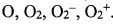 (A)
 (B)
 (C)
 (D)
 (E)

 (D)
 (E) √3 R
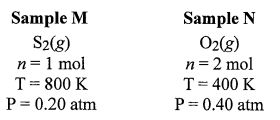
 (B)
 (C)
 (D)
 (E)


 . In a particular experiment A, and B were placed in separate container at 25 ℃,
 and
 . After each reaction had progressed for






 (A) -0.33 V (B)-0.036V (C)-0.11V (D)0.11V (E) 0.33 V
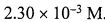 . The K, value for the acid HX is
 . Calculate the value of
 for the salt MX. (A)
 (B)
 (C)
 (D)
 (E)

 in each compartment. In one compartment,
 , and in the other compartment,
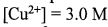 . Calculate the potential for this cell at 25 ℃. The standard reduction potential for
 is +0.34 V. (A) 0.43 V (B) -0.43 V (C) 0.092 V (D) -0.092 V (E) 0.77 V
 , what is the Ke value for HA? (A)
 (B)
 (C)
 (D)
 (E)

 in a
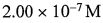 solution of Ca(OH)z at 25 ℃? (A)
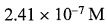 (B)
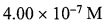 (C)
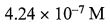 (D)
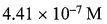 (E)
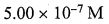
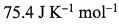 and of gaseous water is

 . Assume that these values are independent of temperature. What is the heat of vaporization of water at 288 K? (A) 44.0 kJ/mol (B) 50.2 kJ/mol (C) 37.4 kJ/mol (D) 31.2 kJ/mol (E) 40.7 kJ/mol
 . The masses are 0.000549 u for electron, 1.00728 u for proton, and 1.00866 u for neutron. What is the binding energy per nucleon for
 ? (A) 1.12 MeV(B) 1.42 MeV (C) 2.24 MeV (D) 2.83 MeV (E) 5.66 MeV
 for the one-step isothermal compression is 2.5 J/K.
 for the one-step isothermal compression is 5.0 J/K.
 for the reversible isothermal expansion is zero.
 for the overall process (expansion and compression) is zero.
 for the overall process (expansion and compression) is -2.5 J/K.


 atoms to 2.5 x 10⁹ atoms in 10.0 mins has a half-life of 5.0 mins. (B) Nuclides with large Z values are often observed to be a-particle producers. (C) As Z increases, , nuclides need a greater proton-to-neutron ratio for stability. (D) Those "light" nuclides that have twice as many neutrons as protons are expected to be stable. (E) If more than one neutron from each fission event causes another fission event, the fission situation is described as supercritical.
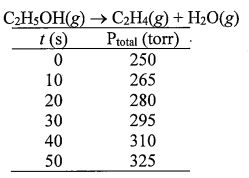
 is 370 torr.
 is 700 torr.

 complexes are more appropriate than octahedral
 complexes to be used to determine whether a ligand is a strong-field or a weak-field ligand. (B) The fulminate ions (CNO⁻) can have three different Lewis structures in which all the N atoms have a same formal charge. (C) Cobalt is a component of vitamin B12, which is essential for the metabolism of carbohydrates, fats, and proteins. (D)
 are all NMR active nuclides. (E) Both Ir(NH3)3Cl3 and [Ni(H2O)+(NO2)2] exhibit geometric isomerism.
 is negative during the gas compression.