所屬科目:研究所、轉學考(插大)◆生物化學
3. HELQ enzyme requires for catalysis. When the enzyme lacks , it would be referred to as the: (A) apoenzyme. (B) substrate. (C) coenzyme. (D) holoenzyme. (E) prosthetic group.
6. Which of the following is an advantage of using multiple steps in electron transport? (A) By using several steps, the net △G is higher (more energy is released). (B) More energy can be captured to synthesize ATP by using small steps. (C) More heat can be generated by using small steps. (D) Small steps allow for both more heat generation and more ATP synthesis. (E) All of these statements are advantages of using multiple steps.
16. In triacylglyceros, the glycerol and the fatty acid moieties is joined covalently in a: (A) phosphodieaster bond. (B) ester bond. (D) amide bond. (E) N-β-glycosyl bond. (C) ether bond.
19. During β oxidation of fatty acids,_______ , is produced in peroxisomes but not in mitochondria.(A)acety1-coA(B) FADH2 (C)H2O(D) H2O2 (E) NADH
22. Which of the following is not required in the synthesis of fatty acids?(A) Acetyl-CoA (B) Biotin (C) (D) Malonyl-CoA (E) NADH
25. Certain nucleotide bases in DNA molecules are enzymatically methylated. In all known DNA methylation reactions the methyl group donor is: (A) S-adenosylmethionine. (B) -methylenetetrahydrofolate. (C) N5-methyItetrahydrofolate. (D)(E) acetyl-CoA.
28. Which of the following statements is correct? (A) Nonpolar compounds force surrounding H2O molecules to become disordered. (B) Nonpolar compounds interfere with the hydrogen bonding among H2O molecules. (C) Nonpolar compounds increase entropy (△S) when dissolved in water. (D) Nonpolar compounds decrease enthalpy (△H) when dissolved in water. (E) None of the above
29. Compare the two reaction coordinate diagrams below and select the answer that correctly describes their relationship. In each case, the single intermediate is the ES complex. (A) (a) describes a strict "lock and key" model, whereas (b) describes a transition-state complementarity model. (B) The activation energy for the catalyzed reaction is #5 in (a) and is #7 in (b). (C) The activation energy for the uncatalyzed reaction is given by #5 + #6 in (a) and by #7 + #4 in (b). (D) The contribution of binding energy is given by #5 in (a) and by #7 in (b). (E) The ES complex is given by #2 in (a) and #3 in (b).
31. In the enzyme catalyzed reaction sequence below, can the intermediate be predicted and why? (A) Yes, the mechanism is a double-displacement reaction. (B) Yes, the reaction fits the ping-pong model. (C) No, the reaction is random single-displacement. (D) No, the reaction is double-displacement. (E) No, the reaction is 'order single-displacement.
37. Shown is the purine catabolism. What is the chemical structure of the compound ( A )?(A)① (B)② (C)③ (D) ④(E)⑤
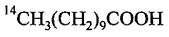
38. How many ATPs are produced by the complete metabolization of the saturated fatty acid shown below? (D) 50 (A) 32 (B) 36 (C) 38 (E) 52
39. ne pyrophosphate (TPP), derived from vitamin B1, is a coenzyme of pyruvate decarboxylase. Regar the functional role of TPp, which atom will be converted into a nucleophile? (A) No. 1. (B) No. 2. (C) No. 3. (D) No. 4. (E) No. 5.
40. Which of the following enzymes catalyzes the conversion shown below in the glycolysis pathway? (A) Hexokinase (B) Phosphofructokinase-1 (PFK-1) (C) Phosphohexose isomerase (D)Phosphoglucose mutase (E) Phosphohexose epimerase
43. In the citric acid cycle, succinate is dehydrogenated by succinate dehydrogenase, which yields fumarate. The dehydrogenation of two of the four hydrogens in succinate (labeled as H1~H4 in the figure shown below) is stereospecific, with the pro-S hydrogen removed from one carbon atom and the pro-R hydrogen removed from the other. Which of the following two hydrogens could be abstracted in the four hydrogens of the succinate molecule in the reaction catalyzed by succinate dehydrogenase? a. H1 and H2 b. H1 and H3 c. H1 and H4 d. H2 and H3 e. H2 and H4 f. H3 and H4 (A) b and e (B) c and d (C) a and f (D) Only c could occur. (E) Only d could occur.
45. Glucose, labeled with in different carbon atoms, is added to a crude extract of a tissue rich in the enzymes of the pentose phosphate pathway. The most rapid production of will occur when the glucose is labeled in: (A) C-1. (B) C-3. (C) C-4. (D) C-5. (E) C-6.
47. The following fatty acid, in which the indicated carbon is labeled with , is fed to an animal: After a period of time for fatty acid β oxidation, the label would most likely be recovered in: (A) acetyl-CoA. (B) beta-hydroxy butyryl-CoA. (C) both acetyl-CoA and propionyl-CoA. (D) palmitoyl-CoA. (E) propionyl-CoA.
49. The following molecular structure is the disaccharide maltose. Which position could be oxidized by the use of Fehling's reagent? (A) No. 1. (B) No. 2. (C) No. 3. (D) No. 4. (E) No. 5.
50. Oxaloacetate uniformly labeled with (i.e., with equal amounts of in each of its carbon atoms) is condensed with unlabeled acetyl-CoA. After a single pass through the citric acid cycle back to oxaloacetate, what fraction of the original radioactivity will be found in the oxaloacetate? (A) All (B) 1/2 (C) 1/3 (D) 1/4 (E) 3/4
 阿摩線上測驗
登入
 for catalysis. When the enzyme lacks
 M
(A) 1 and 2 (B) 2 only
(D) None of above is correct. (E) All of above are correct.
(C) 2 and 3
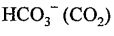 (D) Malonyl-CoA (E) NADH
 -methylenetetrahydrofolate.
(C) N5-methyItetrahydrofolate. (D)
 (E) acetyl-CoA.
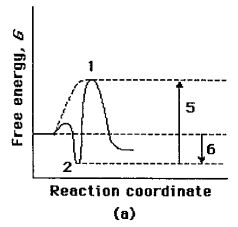
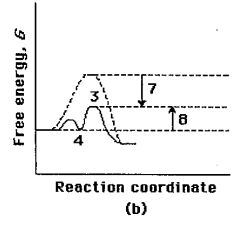 (A) (a) describes a strict "lock and key" model, whereas (b) describes a transition-state complementarity model. (B) The activation energy for the catalyzed reaction is #5 in (a) and is #7 in (b). (C) The activation energy for the uncatalyzed reaction is given by #5 + #6 in (a) and by #7 + #4 in (b). (D) The contribution of binding energy is given by #5 in (a) and by #7 in (b). (E) The ES complex is given by #2 in (a) and #3 in (b).
 intermediate be predicted and why?
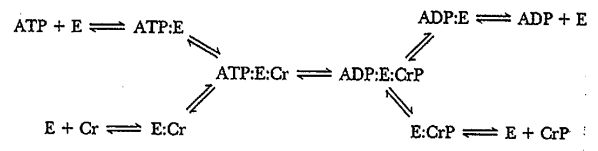 (A) Yes, the mechanism is a double-displacement reaction. (B) Yes, the reaction fits the ping-pong model. (C) No, the reaction is random single-displacement. (D) No, the reaction is double-displacement. (E) No, the reaction is 'order single-displacement.
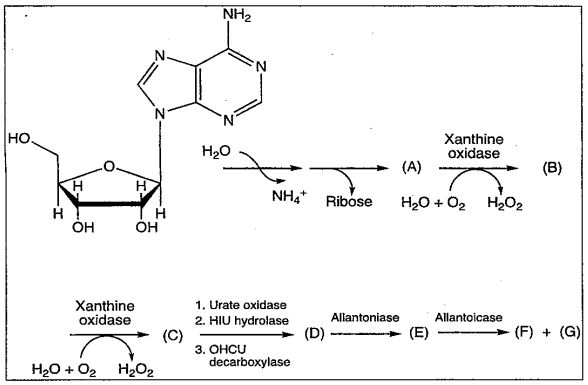
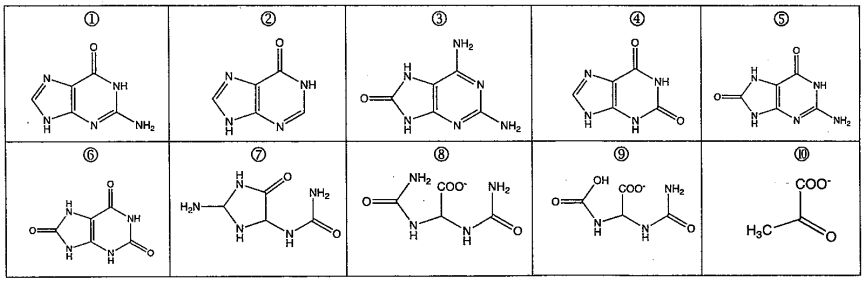 What is the chemical structure of the compound ( A )?(A)① (B)② (C)③ (D) ④(E)⑤
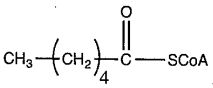 (D) 50 (A) 32 (B) 36 (C) 38 (E) 52
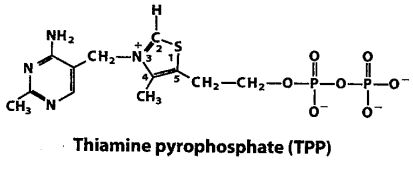 (A) No. 1. (B) No. 2. (C) No. 3. (D) No. 4. (E) No. 5.
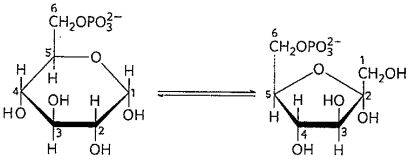 (A) Hexokinase (B) Phosphofructokinase-1 (PFK-1) (C) Phosphohexose isomerase (D)Phosphoglucose mutase (E) Phosphohexose epimerase
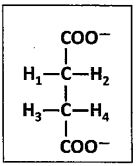 Which of the following two hydrogens could be abstracted in the four hydrogens of the succinate molecule in the reaction catalyzed by succinate dehydrogenase? a. H1 and H2 b. H1 and H3 c. H1 and H4 d. H2 and H3 e. H2 and H4 f. H3 and H4 (A) b and e (B) c and d (C) a and f (D) Only c could occur. (E) Only d could occur.
 in different carbon atoms, is added to a crude extract of a tissue rich in the enzymes of the pentose phosphate pathway. The most rapid production of
 will occur when the glucose is labeled in: (A) C-1. (B) C-3. (C) C-4. (D) C-5. (E) C-6.
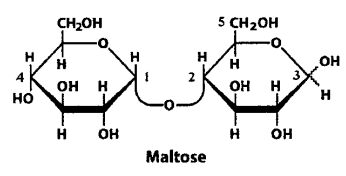 (A) No. 1. (B) No. 2. (C) No. 3. (D) No. 4. (E) No. 5.
 (i.e., with equal amounts of