所屬科目:研究所、轉學考(插大)◆普通物理學
1. A particle travels with constant speed v around a circle of radius R. For an interval in which it travels 5/6 of the way around the circle (i.e., through 300°), the ratio of the magnitude of its average acceleration to the magnitude of its instantaneous acceleration is: (A) 1/6 (B) 3√3/10π (C) 3/5π (D) √3/10 (E) 6/5π.
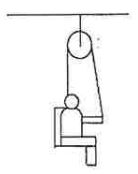
2. In the right figure, with about what steady force must the man pull on the rope to achieve an upward acceleration of 0.50 m/s2? The man has a mass of70 kg and the chair has a mass of 10 kg. (A) 370 N (B) 410 N (C) 820 N (D) 740 N (E) 390 N.
3. Two objects with masses, m1 and m2, have the same kinetic energy and are both moving to the right. The same constant force is applied to the left to both masses. If m1 = 4m2, the ratio of the stopping distance of m1 to that of m2 is: (A) 1:4 (B) 4:1 (C) 1:2 (D) 2:1 (E) 1:1.
4. The potential energy of a 0.20-kg particle moving along the x axis under a conservative force field is: U(x) =(8.0J/m²)x² - (2.0J/m²)x⁴ When the particle is at x = 1.0 m, its acceleration is: (A) 0 î (B) -8 m/s² î (C) 8 m/s² î (D) -40 m/s² î (E) 40 m/s² î.
5. Two boys with masses of 40 kg and 60 kg stand on a horizontal frictionless surface holding the ends of a light 10-m long rod. The boys pull themselves together along the rod. When they meet the 40-kg boy will have moved what distance? (A) 4 m (B) 5 m (C) 6 m (D) 10 m (E) none of above; need to know the forces they exert.
6. A solid uniform sphere of radius R and mass M has a rotational inertia about a diameter that is given by (2/5)MR². A light string of length 3R is attached to the surface and used to suspend the sphere from the ceiling. Its rotational inertia about the point of attachment at the ceiling is: (A) (2/5)MR² (B) 9MR² (C) 16MR² (D) 47/5MR² (E) (82/5)MR².
7. A playground merry-go-round has a radius R and a rotational inertia I. When the merry-go-round is at rest, a child with mass m runs with speed v along a line tangent to the rim and jumps on. The angular velocity of the merry-go-round is then: (A) mRv/(I-mR²) (B) mRv/(I+mR²) (C) mRv/I (D) 2mRv/I (E) v/R.
8. The amplitude of any oscillator can be doubled by: (A) doubling both the initial displacement and the initial speed (B) doubling only the initial speed (C) doubling only the initial displacement (D) doubling the initial displacement and halving the initial speed (E) doubling the initial speed and halving the initial displacement.
9. The displacement of a string carrying a traveling sinusoidal wave is given by y(x,t) = (kx – wt – φ). At time t = 0 the point at x = 0 has velocity v0 and displacement y0. The phase constant φ is given by tan (A) ν0/ωγ0 (B)ων0/γ0 (C) wy0/v0 (D) y0/ων0 (E) 0.
10. Consider the following processes: The temperature of two identical gases are increased from the same initial temperature to the same final temperature. Reversible processes are used. For gas A the process is carried out at constant volume while for gas B it is carried out at constant pressure. The change in entropy: (A) is greater for A only if the initial pressure of gas A is higher than gas B (B) is the same for A and B (C) is greater for A (D) is greater for B (E) can't be compared without more information.
11. Two identical conducting spheres, "1" and "2", carry equal charge. They are separated by a distance much larger than their diameters. A third identical conducting sphere, "3", is uncharged. Sphere "3" is first touched to "1", then to "2", and finally removed. As a result, the electrostatic force between "1" and "2", which was originally F, becomes: (A) F/2 (B) F/4 (C) F/18 (D) 3F/8 (E) 0.
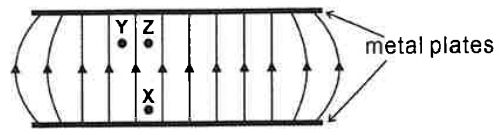
12. The diagram shows the electric field lines due to two charged parallel metal plates. Then:
(A) the upper plate is positive and the lower plate is negative (B) a positive charge placed at X would experience a greater force than if it were placed at Z (C) a positive charge placed at X would experience the same force if it were placed at Y (D) a positive charge placed at X would experience less force than if it were placed at Z (E) a negative charge at X could have its weight balanced by the electrical force.
13. Positive charge Q is distributed uniformly throughout an insulating sphere of radius R, centered at the origin. A positive point charge Q is place at x = 2R on the x axis. The magnitude of the electric field at x = R/2 on the x axis is: (A) Q/(4πε0R2) (B) Q/(8πε0R2) (C) 17Q/(72πε0R2) (D) Q/(72πε0R2) (E) none of these.
14. An electron has charge - e and mass m. A proton has charge e and mass 1840 m. A "proton volt” is equal to: (A) 1840 eV (B) 1 eV (C) (1/1840) eV (D) √1840 eV (E) (1/√1840) eV.
15. A certain x-ray tube requires a current of 7 mA at a voltage of 80 kV. The power (in watts) dissipated is: (A) 5600 (B) 560 (C) 26 (D) 11.4 (Ε) 87.5.
16. A charged capacitor is being discharged through a resistor. At the end of one time constant the charge has been reduced by (1 – 1/e) = 63% of its initial value. At the end of two-time constants the charge has been reduced by what percent of its initial value? (A) 82% (B) 100% (C) 86% (D) between 90% and 100% (E) 40%
17. A proton, traveling perpendicular to a magnetic field, follows a circular path with the same radius as an alpha particle which is also traveling perpendicular to the same field. The ratio of their speeds, v proton/v alpha is: (A) 0.5 (B) 4 (C) 1 (D) 2 (Ε) 8.
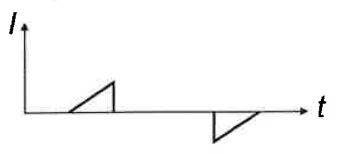
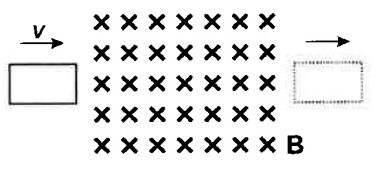
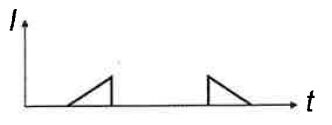
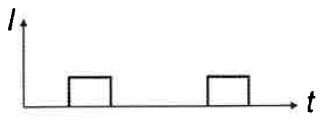
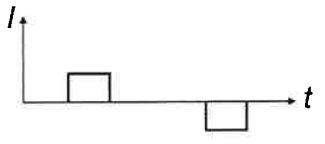
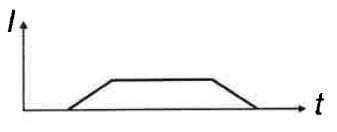
18. A square loop of wire moves with a constant speed v from a field – free region, through a region of uniform B field as shown. Which of the five graphs correctly shows the induced current I in the loop as a function of time t? (A)(B)(C)(D) g(E)
19. An unmagnetized steel bar is placed inside a solenoid. As the current in the solenoid is slowly increased from zero to some large value, the magnetization of the bar: (A) increases proportionally with the current (B) remains zero for a while and then increases linearly with any further increase in current (C) is unaffected by the current (D) increases with increasing current at first but later is much less affected by it (E) increases quadratically with the current.
20. A photoelectric cell is made using emitting material with a work function of 2.00 eV. A constant voltage difference V is maintained between the emitting surface and the collecting surface in a direction to push electrons back towards the emitting surface. When the wavelength of the radiation is changed, the longest wavelength which produces a photocurrent is 350 nm. Calculate the voltage difference V. Answer in volts. (A) 5.55 (B) 7.55 (C) 8.55 (D) 3.55 (E) 1.55
 阿摩線上測驗
登入
 (A) 370 N (B) 410 N (C) 820 N (D) 740 N (E) 390 N.
 is applied to the left to both masses. If m1 = 4m2, the ratio of the stopping distance of m1 to that of m2 is: (A) 1:4 (B) 4:1 (C) 1:2 (D) 2:1 (E) 1:1.
 (kx – wt – φ). At time t = 0 the point at x = 0 has velocity v0 and displacement y0. The phase constant φ is given by tan (A) ν0/ωγ0 (B)ων0/γ0 (C) wy0/v0 (D) y0/ων0 (E) 0.
 (A) the upper plate is positive and the lower plate is negative (B) a positive charge placed at X would experience a greater force than if it were placed at Z (C) a positive charge placed at X would experience the same force if it were placed at Y (D) a positive charge placed at X would experience less force than if it were placed at Z (E) a negative charge at X could have its weight balanced by the electrical force.
 (A)
 (B)
 (C)
 (D) g
 (E)