所屬科目:研究所、轉學考(插大)◆普通物理學
1. A boy wants to row across a river in the shortest possible time. He can row at 2 m/s in still water and the river is flowing at 1 m/s. At what angle θ should he point the bow (front) of his boat?
(A) 30° (B) 45° (C) 60° (D) 53° (E) 90°.
2. The diagram below represents a uniform ladder leaning safely against a real wall. Which of the following diagrams most correctly represents all the forces acting on the ladder? (A)(B) (C)(D)(E)
3. At time t = 0 a particle starts moving along the x axis. If its kinetic energy increases uniformly with t, the net force acting on it must be: (A) constant (B) proportional to (C) proportional to 1/ (D) proportional to t (E) proportional to 1/t.
4. A 0.20-kg particle moves along the x axis under the influence of a conservative force field. The potential energy is given byU(x) = (8.0J/m²)x² + (2.0J/m²)x⁴, where x is in coordinate of the particle. If the particle has a speed of 5.0 m/s when it is at the origin, what is its speed when it is at x =1.0 m? (A) 0 (B) 2.5 m/s (C) 7.9 m/s (D) 11 m/s (E) The particle can't reach the position x = 1.0 m.
5. A 3.0-kg and a 2.0-kg cart approach each other on a horizontal air track. They collide and stick together. After the collision, their total kinetic energy is 40 J. The speed of their center of mass is: (A) 2.8 m/s(B) 4.0 m/s(C) 5.2 m/s(D) 6.3 m/s(E) 0 m/s.
6. A 16 kg block is attached to a cord that is wrapped around the rim of a flywheel of diameter 0.40 m and hangs vertically. The rotational inertia of the flywheel I is 0.50 kg.m². When the block is released and the cord unwinds, the acceleration of the block is:(A) 0.15g (B) 0.56g (C) 0.84g (D) g (E) 1.3g.
7. A rigid and uniform rod of length L and mass M is free to rotate about the axis through its center and perpendicular to the rod (rotational inertia I=(1/12)ML²). A small particle also of mass M is moving perpendicular to the rod at a speed v, and it strikes the rod a distance (1/4)L from the center. If the particle sticks firmly to the rod, find the angular velocity (ω) of the system about the fixed axis after the collision. (A) 1.71 v/L (B) 2.16 v/L (C) 4.00 v/L (D) 4.22 v/L (E) 4.60 v/L.
8. The displacement of an object oscillating on a spring is given by x(t) = xmcos(wt +Φ). If the object is initially displaced in the negative x direction and given a negative initial velocity, then the phase constant Φ is between: (A) 3π/2 and 2π radians (B) π and 3π/2 radians (C) π/2 and π radians (D) 0 and π/2 radians (E) none of the above (Φ= π).
9. The pressure of an ideal gas is doubled in an isothermal process. The root-mean-square speed of the molecules: (A) does not change (B) change (increase) by a factor of (C) change (decrease) by a factor of 1/ (D) change by a factor of 2 (E) change by a factor of 1/2.
10. An heat engine operates between 200 K and 100 K. In each cycle, it takes 100 J from the hot reservoir, loses 25 J to the cold reservoir and does 75 J of work. This heat engine violates: (A) both the first and the second law of the thermodynamics; (B) neither the first nor the second law of the thermodynamics (C) the first law but not the second law of the thermodynamics (D) the second law but not the first law of the thermodynamics (E) can't not answer without knowing more information.
11. Two large parallel conducting plates are separated by a distance d, placed in a vacuum, and connected to a source of potential difference V. A "doubly charged" oxygen ion starts from rest on the surface of one plate and accelerates to the other. If e denotes the electron charge, the final kinetic energy of this ion is: (A) 2 eV (B) eV/d (C) eVd (D) Vd/e (E) eV/2.
12. A 7 µF and a 3 µF capacitor are each charged to a potential difference of 100 V. The positive terminal of the 3 µF capacitor is then connected to the negative terminal of the 7 µF capacitor and the negative terminal of the 3 µF capacitor is connected to the positive terminal of 7 µF capacitor. What total energy is now stored on the two-capacitor system? Answer in J. (A) 0 (B) 1.6 × 10⁻² (C) 8.0 × 10⁻³ (D) 4.0 × 10⁻² (E) 5.0 × 10⁻²
13. It is better to send V (A) t (B) t (C) t (D) t (E) t
14. In the capacitor discharge formulaq = qe-t/RC the symbol "t" means: (A) the time constant (B) the time it takes for C to lose the fraction 1/e of its initial charge (C) the time it takes for C to lose essentially all of its initial charge (D) the time it takes for C to lose the fraction (1 – 1/e) of its initial charge (E) none of the above.
15. Two long solenoids (radii 20 mm and 30 mm respectively) carry the same amount of current. The smaller solenoid is mounted inside the larger, along a common axis. It is observed that there is zero magnetic field within the inner solenoid. Therefore, the inner solenoid must have X times as many turns per length as the outer solenoid where X is: (A) 4/9 (B) 2/3 (C) 3/2 (D) 1 (E) 9/4.
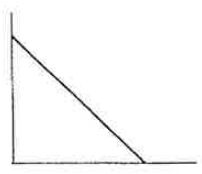
16. A copper penny slides on a horizontal frictionless table. There is a square region of uniform magnetic field perpendicular to the table as shown. Which graph correctly shows the speed v of the penny as a function of time t?
(A) (B) (C) (D) (E)
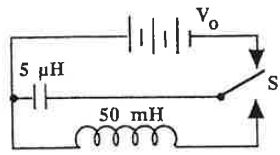
17. In the circuit shown, switch S is first pushed up to charge the capacitor. When S is then pushed down, the current in the circuit will oscillate at a frequency of:(A) 0.01 Hz (B) 318 Hz (C) 12.6 kHz (D) 2000 Hz (E) depends on Vo.
18. Consider: radio waves (r), visible light (v), infra-red (i), x-rays (x), ultraviolet (u). In order of increasing frequency, they are: (A) r, v, i, x, u (B) i, r, v, u, x (C) r, i, v, u, x (D) i, v, r, u, x (E) r, i, v, x, u.
19. A rocket ship of rest length 100 m is moving at speed 0.8 C past a timing device which records the time interval between the passage of the front and back ends of the ship. This time interval is: (A)0.20 με (B) 0.33 με (C) 0.25 με (D) 0.52 με(Ε) 0.69 μs.
20. Three different monochromatic light sources are used to liberate free electrons from the surface of an unknown material. Source 1 has wavelength 500 nm, and a stopping potential of 1.08 volts is observed. Source 2 has wavelength 650 nm and a stopping potential of 0.510 volts. If source 3 has wavelength 590 nm, what is the maximum energy of electrons that can be liberated from the surface by source 3? Answer in electron volts. (A) 0.50 (B) 0.70 (C) 0.20 (D) 0.90 (E) 0.10
 阿摩線上測驗
登入
阿摩線上測驗
登入
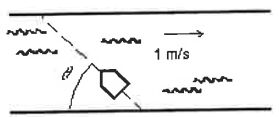 (A) 30° (B) 45° (C) 60° (D) 53° (E) 90°.
 (A)
(A)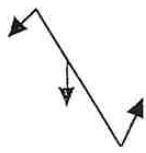 (B)
(B) 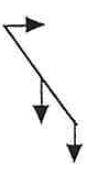 (C)
(C)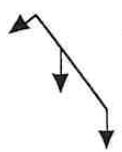 (D)
(D)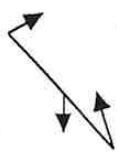 (E)
(E)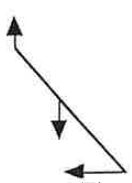
 (C) proportional to 1/
 (D) proportional to t (E) proportional to 1/t.
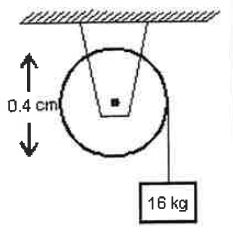 (A) 0.15g (B) 0.56g (C) 0.84g (D) g (E) 1.3g.
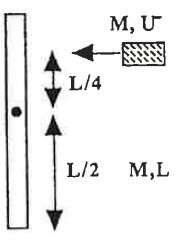 (A) 1.71 v/L (B) 2.16 v/L (C) 4.00 v/L (D) 4.22 v/L (E) 4.60 v/L.
 (C) change (decrease) by a factor of 1/
 (D) change by a factor of 2 (E) change by a factor of 1/2.
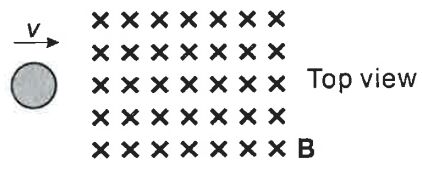 (A)
(A) 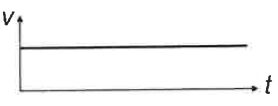 (B)
(B) 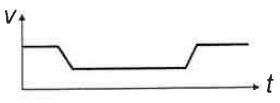 (C)
(C) 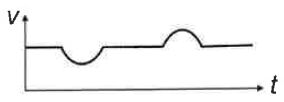 (D)
(D)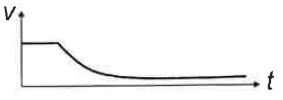 (E)
(E)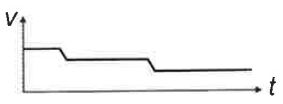
 (A) 0.01 Hz (B) 318 Hz (C) 12.6 kHz (D) 2000 Hz (E) depends on Vo.