所屬科目:研究所、轉學考(插大)◆物理化學及分析化學
1Given a free particle in a box, which of the following quantum mechanical conditions is not true?(A) Shifting the box in space will change the wavefunction.(B) The precise position of the particle is unpredictable.(C) If the size of the box is infinite, the energy of the particle is not quantized.(D) Shifting the box in space will change the energy of the particle.(E) The energy of the particle depends on the shape of the box.
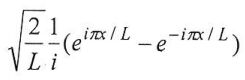
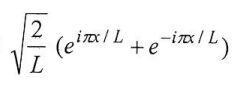
2Which one of the following is the correct form for the lowest-energy eigenfunction for a particle in a1D box with infinite barriers at x= -L/2 and L/2?(A)sin(x/L) (B)cos(πx/L) (C) (D)(E)None of the above.
3 Given a wave function φ(x) = x(x-1) in the region 0≤ x ≤ 1. Where N is the normalization constant to be determined. What is the possible value of N?(A)(B)(C)(D) (E) None of the above.
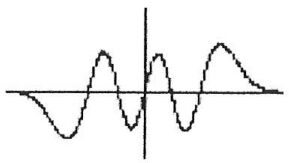
4The wavefunction on the right illustrates the quantum state of a harmonic oscillator with its vibrational quantum number v =
(A) 1 (B) 2 (C) 3 (D) 4(E)5.
5 Which of the following statements is true for a given set of harmonic oscillator wavefunctions corresponding to the same potential V(x)? (A) The ground-state energy is called zero-point energy and its value is zero. (B) The mean displacement from the equilibrium distance <x>≠0 for the first excited vibrational state v= 1.(C) The wavefunctions must have zero amplitude beyond the classical turning points.(D)(E) The wavefunctions involve Gaussian-type functions and thus are all even functions.
6Which of the following about the spherical harmonics is not true? m (A) The number of angular nodes in is l. m (B) The complex give non-zero eigenvalues of which represents the operator of the z-component of angular momentum. (C) is a constant everywhere in space. (D) serves as eigenfunctions for.(E) cosθ correlates with all p₂ orbitals.
7Which statement about H-atom is not true? (A) Spherical polar coordinates are the natural choice for H-atom Schrödinger equation because the potential term is spherically symmetric. (B) H-atom Schrödinger equation can be solved by separation of variables where the radial part Rni(r) and the angular partare linked through I(I+1) while Θ(θ) andΦ (Φ) are linked through m². (C) The operator for the z-component of angular momentum has the simplest form in spherical polar coordinates as opposed to the x and y-components. (D) The rules for allowed angular momentum magnitudes and orientations are shared by the rigid rotor and the H-atom. (E) By changing the variable sinθ into x, the Θ differential equation can be recognized as being the associated Legendre equation.
8In the above plot, the letters a, b, and c label three different radial distribution functions (RDF's) r²R² of H-atom from the same n level. Which of the following statements is true? (A) The maximum of curve a corresponds to the radii of maximum probability rmp = n²a0, (a0 is Bohr 2 radius). (B) Curve b corresponds to the RDF derived from a radial function R that is proportional to r² exp(-r/3a0). (C) Curve c corresponds to angular momentum quantum number I = 2. (D) Curve c shows two angular nodes. (E) The principal quantum number n = 2.
9The term "intersystem crossing" is used for(A) a transition from an excited singlet state to another excited singlet state.(B) a transition from the ground singlet state to an excited singlet state.(C) a transition from an excited singlet state to an excited triplet state.(D) a transition from an excited triplet state to another excited triplet state.(E) a transition from an excited triplet state to the ground singlet state.
10 Which of the following statements is not true for the experimental HCl rotational-vibrational spectrum below? (A) The splitting in each line is due the isotope effect. (B) In the middle of the spectrum a forbidden line is missing by the selection rules. (C) The bond length for HCl can be determined from the intervals between neighboring lines. (D) The separation between lines decreases in the R-branch and increases in the P-branch. (E) The lines connected to transitions with △J = +1 form the P-branch.
11For which of the following thermodynamic quantities can an absolute value be calculated?(A) internal energy U (B) enthalpy H (C) entropy S (D) Helmholtz energy A (E) Gibbs energy G
12 For which of the following substances the standard molar entropy is zero at 25°C ?(A) Na(S) (B) N2(g) (C) I2(S) (D) all of these (E) None of these.
13 For which of the following standard enthalpies of formation is not zero (25°C)?(A) Na(s) (B) N2(g) (C) I2(g) (D) C(s, graphite) (E) None of these.
14For a reversible adiabatic expansion of an ideal gas, which of the following is always true? (A) The work done by the gas is equal to the decrease in the internal energy of the gas. (B) The work done by the gas is equal to the heat absorbed by the gas. (C) The temperature of the gas will rise. (D) PV=C where C is a constant along the path. (E) No work is done by the gas to the surroundings.
15 For which statement about the Joule-Thomson (J-T) experiment is not true? (A) J-T expansion is an isenthalpic process (ΔΗ = 0). әт (B) is called the J-T coefficient µJT. (C) Any gas will be cooled by J-T expansion. (D) For ideal gases µJT = 0. (E) A positive J-T coefficient implies that the gas cools upon expansion.
16 For a gas whose equation of state is= RT (a simplified Van der Waals equation), the generalized (a and k represent thermal expansion coefficient and isothermal compressibility, respectively). The difference of these two heat capacities is equal to (A) nR (B) (C) R-b (D) 0 (E) nb
17Which of the following is true? (A) An increase of pressure always leads to a boiling point elevation for all substances. (B) An increase of pressure always leads to a melting point depression for all substances. (C) The slope of the solid-liquid coexistence curve in the P-T phase diagram is positive if the solid is less dense than the liquid. (D) In the P-V phase diagram, the solid-liquid coexistence region is broader than the gas-liquid coexistence region. (E) In the P-T phase diagram the Clausius-Clapeyron equation can be used to show that the slope of the solid-gas coexistence curve must be less than the slope of the liquid-gas coexistence curve near the triple point.
18Given that the molar enthalpy of vaporization is 42.7kJ/mole and is independent of temperature, what is the boiling point of water if the atmospheric pressure becomes 427 torr? (A) 85 °C (B) 77°C (C) 56°C (D) 42 °C (E) None of these.
19Which of the following about thermodynamic equilibria is not true? (A) At phase equilibrium, a substance that occurs in two phases will have the same concentration in both phases. (B) For a single component substance at a fixed value of pressure, the change of slopes in the plot of the chemical potential versus temperature across different phases represents the variation of the molar entropies of phases. (C)△rG is the net difference of chemical potentials between products and reactants for the reaction. (D) △rGº representing the change in standard Gibbs energy for the reaction between unmixed reactants to form unmixed products is a function of temperature only. (E)△rG = −RT In Kp+ RT InQ where Q represents the reaction quotient.
20Which of the following statements is not true? (A) The total partition function for a collection of N independent molecules or atoms can be expressed as the product of the molecular partition functions q for the individual species. (B) If these molecules or atoms are indistinguishable, the total partition function is divided by a factor of N!. (C) The existence of the 1/N! factor in the expression of Q for ideal gases is noticeable only in the entropy expression, but is not noticeable in the internal energy expression because the differential of the logarithm of 1/N! is zero. (D) The molecular partition function q for an ideal gas molecule can be decomposed into the sum of the partition functions for four types of degree-of-freedom: translational, vibrational, rotational, and electronic. (E) The vibrational partition function of a polyatomic molecule is a product of harmonic oscillator partition functions for each normal mode.
22The rate of formation of NH3, namely d[NH3]/dt, in the reaction N2 (g) + 3H2 (g) →2 NH3 (g) was reported as 1.2 mol L-¹ s-¹ (L is liter) under certain conditions. What is the rate of consumption of H2 gas, namely, d[H2]/dt=? (A) 1.2 mol L-¹ s-¹ (B) 1.4 mol L-¹ s-¹ (C) 1.8 mol L-¹ s-¹ (D) 2.4 mol L-¹ s-¹ (E) Not enough information.
23 The gaseous isomerization reaction, CH3NC → CH3CN, displays first-order kinetics, namely rate k[CH3NC]. Measurements at 500 K show that the concentration of the reactant has declined to 75% of its initial value after 440 s. How much time will be required for the concentration of CH3NC to drop to 25% of its initial value? (A) 640 s (B) 880s (C) 1320 s (D) 1680 s (E) 2120 s.
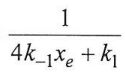
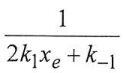
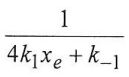
24For a reversible reaction , the rate constants k₁ (forward) and k-1 (reverse) can be obtained by the T-jump relaxation method. Suppose xe is the concentration of Y and Z at equilibrium. The relaxation time τ = (A)(B)(C)(D) (E)
25 In a consecutive first order reaction, A→B→C (where k₁ and k2 are the respective rate constants), species B has transient existence. Therefore, (A) k1~k2 (B) k1=2k2 (C) k1>>k2 (D) k₁<<k2 (E) None of these.
26 50 mL of 0.1 M diprotic acid (H2A; pKa1 = 10-4, pKa2 = 10-8) reacted with 50 mL of 0.1 M NaOH. What is the pH of the resulting solution? (A) 8.0 (B) 7.0 (C) 6.0 (D) 5.0(E)4.0
27What is the pH of 0.1 M NaCl solution? The activity coefficients of H3O+ and OH- at ionic strength 0.1 M are 0.83 and 0.76. (A) 7.00 (B) 7.01 (C) 7.02 (D) 6.99 (Ε) 6.98
28 What are the ionic strength and pH of the buffer solution consisting of 0.1 M CH3COOH (pKa = 4.76) and 0.1 M CH3COONa? (A) 0.1 M, pH 4.76 (B) 0.2 M, pH 5.76 (C) 0.3 M, pH 3.76 (D) 0.4 M, pH 2.76 (E) 0.6 M, pH 6.76
29The investigator developed the electrochemical biosensor for sensitive and selective detection of glucose. The obtained calibration curve for quantifying 1-100 mM glucose is y (signal) = 100 (slope, nA/mM) x x (glucose concentration, mM) + 2. The standard deviation for measuring a blank solution (i.e., without glucose) is 1.5 nA. What is the limit of quantification of glucose measured by the electrochemical biosensors? (A) 0.015 (B) 0.045 (C) 0.030 (D) 0.15 (E) 0.45.
30 Which of the following conditions is (are) favorable for the formation of crystalline precipitation?(i) the use of a homogeneous precipitating agent,(ii) the increase in solution temperature,(iii) the dilution of a precipitating agent,(iv) the rapid injection of a precipitating agent,(v) no stirring of the solution.(A)i(B)i,i(C)i,iiiii(D)i,ii,ili,iv(E)i,ii,ii,iv,v
31 What is the solubility of Al(OH)3 (Ksp = 2.7 x 10⁻³⁵) in water?(A)10-9 M (B) 10-8 M (C) 2.7 × 10⁻¹⁴ M (D) 2.7×10⁻¹⁵ M (E) 2.7 × 10⁻³⁵M
32Which of the following statements associated with titration is (are) CORRECT?(i) Titrations with NaOH are called argentometric titrations(ii) In the Vohhard method, Fe3+ serves as the indicator(iii) Zn2+ ions are titrated with EDTA in an ammonia/ammonium chloride buffer. The role of ammonia is to avoid the precipitation of Zn2+ ions.(iv) The bromate titration method is commonly performed in a basic solution.(A) i, ii, iii, iv (B) iii, iv (C) ii, iii, (D) ii, iii, iv (E) ii
33What is (are) the purpose of using high electrolyte solutions in electrochemical systems?(i) To avoid the migration of ions close to the electrode surface by electrostatic attraction under applied voltage, which can lead to adsorption on the electrode surface.(ii) To avoid too high resistance of the solution, which may cause IR drop.(iii) Avoid redox reactions in the solution.(iv) Effectively reduce the surface charge of the analyte, allowing the analyte to approach the electrode surface by diffusion and convection.(A) i, ii (B) i, ii, iii (C) i, ii, iv (D) i, iii, iv (E) i, ii, iii, iv
34What approaches can be used to determine the molecular weight of an unknown protein?(i) Matrix-assisted laser desorption ionization-time of flight mass spectrometry (MALDI-TOF MS).(ii) Size-exclusion chromatography coupled to UV absorption detector.(iii) Capillary gel electrophoresis with UV absorption detector.(iv) Gas chromatography-mass spectrometry (GC/MS).(v) Thermogravimetric analyzer (TGA)(A) i, ii, iii (B) i, ii, iii, iv (C) i, ii, iii, iv, v (D) i, ii, iv (E) i, ii, iii, v
35 Which of the following statements associated with atomic spectroscopy is (are) CORRECT?(i) Atomic absorption can be a thousand times more sensitive than atomic fluorescence.(ii) For Beer's law to apply, the source must have a narrower linewidth than the atomic vapor.(iii) In atomic absorption spectroscopy, nebulizers are used to introduce liquid samples.(iv) An electrically heated graphite furnace is less sensitive than a flame burner and requires more samples.(A) i, ii, iii, iv (B) i, ii, iii (C) ii, iii (D) iii, iv (E) i, iv
36 Which of the following statements associated with X-ray fluorescence (XRF) is (are) CORRECT?(i) XRF occurs when the material is excited by high-energy X-rays or gamma rays and emits characteristic secondary X-rays.(ii) Elements and chemicals can be analyzed with XRF.(iii) Planck's Law can be used to calculate the wavelength of the fluorescent radiation from an XRF- excited sample.(iv) An electron from one of an atom's inner orbital shells is dislodged when an X-ray of sufficient energy strikes an atom in the sample.(A) i (B) i, ii (C) i, ii, iii, (D) i, ii, iii, iv (E) i, iii, iv
37 Which of the following statements associated with the ion-selective electrode is (are) CORRECT?(i) In place of aqueous NaCl in the salt bridge, the junction potential can be reduced to 0.1 mV.(ii) A typical pH combination electrode includes a working electrode, a glass membrane, a reference electrode, and a counter electrode.(iii) The boundary potential is the difference between the potential at the internal and external surface of the glass membrane.(iv) The sodium error of the pH meter occurs at low pH conditions.(A) iii (B) iii, iv (C) i, iii (D) ii (E) i, ii, iii, iv
38 Which of the following statements associated with redox titration is (are) CORRECT?(i) The titration of Fe3+ with Ce4+ can be recorded potentiometrically with Pt and calomel electrodes.(ii) The standard reduction potential of analytes can be determined by recording the potential change during redox titration.(iii) For permanganate titration, KMnO4 serves as an indicator and an oxidant in a basic solution.(iv) To titrate a reducing analyte with excess triiodide, thiosulfate is often used as a titrant for the remaining triiodide in a back titration.(A) i, ii, iii, iv (B) ii, iii, iv (C) iii, iv (D) i, iv (E) ii, iii
39 An electrode's overpotential is the voltage required to overcome its activation energy. Which of the following electrodes has the smallest overpotential? (A) Pt (B) Hg (C) Pb (D) Cu (E) Au
40Coulometry is a chemical analysis based on counting the electrons used in a reaction. What is (are) the correct statement about coulometric titration?(i) The advantages of coulometry include precision, sensitivity, and generation of stable reagents in situ.(ii) Cyclohexane can be titrated with Br2 generated by electrolytic reduction of Br¯.(iii) Constant-current coulometry is performed using double Pt-wire electrodes.(iv) Controlled-potential coulometry in a three-electrode electrode cell is more selective than constant- current coulometry.(A) i, ii (B) iii, iv (C) i, ii, iii (D) i, iii, iv (E) i, ii, iii, iv
41Which electrochemical analysis method is most sensitive to Cd2+ detection?(A) Linear scan voltammetry(B) Cyclic voltammetry(C) Square wave voltammetry(D) Anodic stripping analysis(E) Differential pulse voltammetry
42Which of the following conditions can enhance the fluorescence of fluorescent molecules?(i) Enhancing fluorescent molecules' absorption at excitation wavelengths(ii) Utilizing an antireflective array to reduce fluorescent energy dissipation.(iii) Restricting the rotation of the fluorescent molecules in the viscous solution(iv) increasing the power of the excitation source(A) i, ii, iii, iv (B) i, ii, iii (C) ii, iii, iv (D) iii, iv (E) None of the above
43 Which of the following methods can enhance Raman signals?(i) The narrow linewidth of the laser is used in the Raman system.(ii) An analyte is absorbed on the roughened metal surface.(iii) Laser light is matched to the absorption maxima of the molecule.(iv) The charge-transfer process is conducted by adding semiconductor-based nanomaterials.(A) i, ii, iii, iv (B) i, ii, iii (C) ii, iii, iv (D) iii, iv (E) None of the above
44Which element has an odd number of m/z for its parent peak in any compound?(A) Nitrogen (B) Oxygen (C) Sulfur (D) Phosphorus (E) None of the above
45 In your sample, the difference in mass between the two analytes is only 0.1 m/z, which means 1140 and 1140.1. What is the minimum mass spectrometric resolution required? (A) 1140 (B) 11400 (C) 114000 (D) 114 (E) None of the above
46Fourier-transform infrared spectroscopy (FTIR) has several advantages over dispersive IR spectroscopy, including excellent spectral quality, high data collection speed, and high reproducibility. Explain why FT-IR has the above advantages
47 Compare the external calibration curve method with the method based on standard additions and explain which is more accurate.
 阿摩線上測驗
登入
阿摩線上測驗
登入
 sin(x/L) (B)
 cos(πx/L) (C)
 (D)
 (E)None of the above.
 (B)
 (C)
 (D)
 (E) None of the above.
 (A) 1 (B) 2 (C) 3 (D) 4(E)5.
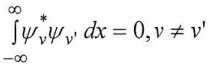 (E) The wavefunctions involve Gaussian-type functions and thus are all even functions.
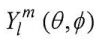 is not true? m (A) The number of angular nodes in
 is l. m (B) The complex
 give non-zero eigenvalues of
 which represents the operator of the z-component of angular momentum. (C)
 is a constant everywhere in space. (D)
 serves as eigenfunctions for
 .(E)
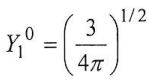 cosθ correlates with all p₂ orbitals.
 are linked through I(I+1) while Θ(θ) andΦ (Φ) are linked through m². (C) The operator for the z-component of angular momentum has the simplest form in spherical polar coordinates as opposed to the x and y-components. (D) The rules for allowed angular momentum magnitudes and orientations are shared by the rigid rotor and the H-atom. (E) By changing the variable sinθ into x, the Θ differential equation can be recognized as being the associated Legendre equation.
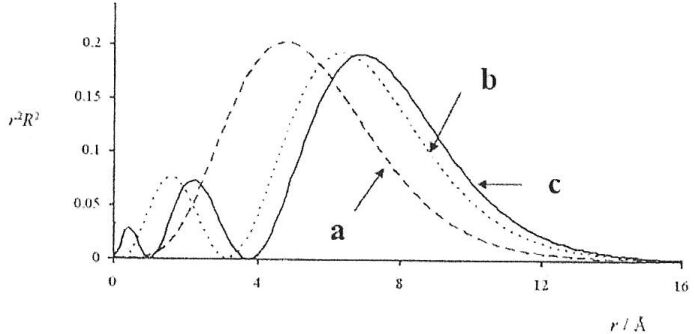 (A) The maximum of curve a corresponds to the radii of maximum probability rmp = n²a0, (a0 is Bohr 2 radius). (B) Curve b corresponds to the RDF derived from a radial function R that is proportional to r² exp(-r/3a0). (C) Curve c corresponds to angular momentum quantum number I = 2. (D) Curve c shows two angular nodes. (E) The principal quantum number n = 2.
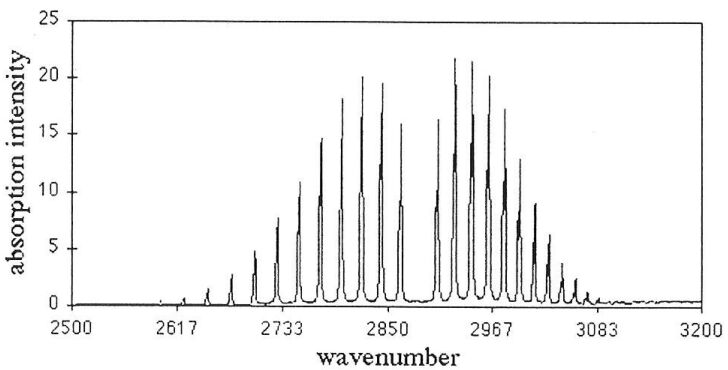 (A) The splitting in each line is due the isotope effect. (B) In the middle of the spectrum a forbidden line is missing by the selection rules. (C) The bond length for HCl can be determined from the intervals between neighboring lines. (D) The separation between lines decreases in the R-branch and increases in the P-branch. (E) The lines connected to transitions with △J = +1 form the P-branch.
 is
 (25°C)?
 is called the J-T coefficient µJT. (C) Any gas will be cooled by J-T expansion. (D) For ideal gases µJT = 0. (E) A positive J-T coefficient implies that the gas cools upon expansion.
 = RT (a simplified Van der Waals equation), the generalized
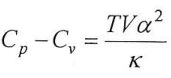 (a and k represent thermal expansion coefficient and isothermal compressibility, respectively). The difference of these two heat capacities is equal to (A) nR (B)
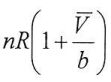 (C) R-b (D) 0 (E) nb
 . (D) If two different gases are at the same temperature, the probability distribution curve of ux for the lighter gas is broader than that for the heavier gas. (E) The root mean square of ux is equal to (kBT/m) 1/2.
 , the rate constants k₁ (forward) and k-1 (reverse) can be obtained by the T-jump relaxation method. Suppose xe is the concentration of Y and Z at equilibrium. The relaxation time τ = (A)
 (B)
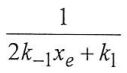 (C)
 (D)
 (E)