所屬科目:研究所、轉學考(插大)◆普通化學
1. A 0.4230-g sample of impure sodium nitrate was heated, converting all the sodium nitrate to 0.2864 g of sodium nitrite and oxygen gas. Which is the percent of sodium nitrate in the original sample? (A) 65% (B) 74% (C) 83% (D) 92%
2. Which of the following combination of solutions will NOT produce any precipitate? (A) K2CrO4(aq) + Ba(NO3)2(aq) (B) NaBr(aq) + RbCl(aq) (C) K2CO3(aq) + Mgl2(aq) (D) Na2CrO4(aq) + AlBr3(aq)
3. For the van der Waals gas, it shows the equation:
Which of the following gas has the largest value of b in standard state? (A) Cl2 (B) Ne (C) O2 (D) He
4. A 10.0 mL sample of an HCl solution has a pH of 2.000. What volume of water must be added to change the pH to 4.000? (A) 10 mL (B) 90 mL (C) 490 mL (D) 990 mL
5. Which of the following statements is true? (A) When a base is dissolved in water, the lowest possible pH of the solution is 7.0. (B) When an acid is dissolved in water, the lowest possible pH is 0. (C) A strong acid solution will have a lower pH than a weak acid solution. (D) A 0.0010 M Ba(OH)2 solution has a pOH that is twice the pOH value of a 0.0010 M KOH solution.
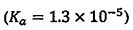
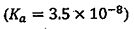
6. A chemist needs to prepare a solution buffered at pH 4.30 using the following acids and its sodium salt. Consider the ratio of [HA]/[A-] and pKa of each acid, which of the following acid can make the buffer system work best? (A) Chloroacetic acid (B) Propanoic acid (C) Benzoic acid (D) Hypochlorous acid
7. Use the Ksp to derive which of the following salts has the lowest solubility in pure water? (A) Copper(II) sulfide (B) Silver(I) sulfide (C) Mercury(II) sulfide (D) Bismuth(III) sulfide
8. At constant pressure and temperature, in which of the following systems is work done on the system by the surroundings? (A) CaCO3(s) → CaCO(s) + CO2(g) (C) Ca3P2(s) + 6H2O(l) → 3Ca(OH)2(s) + 2PH3(g) (B) CO(g) + H2O(g) → H2(g) + CO2(g) (D) 2CH3OH(l) +3O2(g) → 2CO2(g) + 4H2O(l)
9. What's the change in entropy that occur when a sample containing 2.00 moles of water is heated from 50°C to 150°C at 1 atm pressure? The molar heat capacities for H2O(1) and H2O(g) are 75.3 J/K-mol and 36.4 J/K-mol respectively, and the enthalpy of vaporization for water is 40.7 kJ/mol at 100°C. (A) 220 J/K (B) 250 J/K (C) 280 J/K (D) 310 J/K
10. Which of the following reaction is expected to have a positive value for AS°? (A) C2H4(g) + H2O(l) → C2H5OH(1) (C) CO(g) + Cl2(g) → COCl2(g) (B) SiF6(aq) + H2(g) → 2HF(g) + SiF4(g) (D) 4Al(s) + 3O2(g) → 2Al2O3(s)
11. A fuel cell designed to react grain alcohol with oxygen has the following net reaction: C2H5OH(1) +3O2(g) → 2CO2(g) + 3H2O(1)
The maximum work 1 mole of alcohol can yield by this process is 1320 kJ. What is the theoretical maximum voltage this cell can achieve? (A) 1.14 V (B) 1.20 V (C) 1.26 V (D) 1.32 V
12. Which of the following sets of quantum numbers are allowed? (A)(B) (C)(D)
13. Assume that a hydrogen atom's electron has been excited to the n = 5 level. How many different wavelengths of light can be emitted as this excited atom loses energy? (A) 8 (B) 9 (C) 10 (D) 11
14. Which of the following compounds or ion exhibit NO resonance? (A) AsI3 (B) CNO (C) O3 (D)
15. Which of the following statements concerning SO2 is NOT correct? (A) The central sulfur atom is sp² hybridized. (C) The resonance structures of SO2 exist. (B) The bond angles about the central sulfur atom are about 120 degrees. (D) One of the sulfur-oxygen bond is longer than the other one.
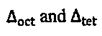
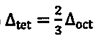
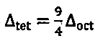
16. Concerning the energy split of orbital in octahedral and tetrahedral crystal field, which of the following relationship between is true? (A)(B) (C) (D)
17. Which of the following statement is true?. (A) The coordination number of a metal ion in an octahedral complex is 8. (B) All tetrahedral complex ions are low-spin. (C) The formula for triaquatriamminechromium(III) sulfate is [Cr(H2O)3(NH3)3]2(SO4)3. (D) Hemoglobin contains Fe3+.
18. The mass percent of carbon in a typical human is 18%, and the mass percent of in natural carbon is 1.6 × %. For an 80-kg person, how many decay events per second occur in this person due to the p-particle decay of ? (For , half-life for ẞ-decay is 5730 years.) (A) 2800 (B) 3800 (C) 4800 (D) 5800
a. Which reactant is limited?
b. What mass of DDT is formed, assuming 100% yield?
c. What mass of the excess reactant is left over?
d. If the actual yield of DDT is 284.36 g, what is the percent yield?
a. Explain why [B] is much greater than [A].
b. Derive the rate law and calculate value of rate constant for this reaction.
c. Which of the following mechanisms could be correct for this reaction? Justify your reason.
a. Use the appended standard reduction half potential, is zirconium metal capable of reducing water to form hydrogen gas at standard conditions?
2H2O+2e → H2 + = -0.83 V
b. Write down a balanced equation for the reduction of water by zirconium.
c. Calculate AG°, and equilibrium constant for the reduction of water by zirconium metal.
d. If 1.00 x 10³ kg of Zr (91.22 a.u.) reacts, what mass of H2 is produced? What volume of H2 at 1.0 atm and 1000°C is produced?
 阿摩線上測驗
登入

 (B) Propanoic acid
 (C) Benzoic acid
 (D) Hypochlorous acid
 (B) Silver(I) sulfide
 (C) Mercury(II) sulfide
 (D) Bismuth(III) sulfide

 (B)
 (C)
 (D)


 and tetrahedral
 crystal field, which of the following relationship between
 is true? (A)
 (B)
 (C)
 (D)
 in natural carbon is 1.6 ×
 %. For an 80-kg person, how many decay events per second occur in this person due to the p-particle decay of
 ? (For
 , half-life for ẞ-decay is 5730 years.) (A) 2800 (B) 3800 (C) 4800 (D) 5800

 = -0.83 V