所屬科目:研究所、轉學考(插大)◆統計學
1. A person buys a new toothbrush every quarter. Only two colors are available: blue and pink. If the person uses a blue toothbrush in a given quarter, the probabilities of buying a blue or pink toothbrush in the next quarter are 0.3 and 0.7, respectively. If the person uses a pink toothbrush in a given quarter, the probabilities of buying a blue or pink toothbrush in the next quarter are 0.5 and 0.5, respectively. Suppose the person buys a blue toothbrush in quarter 1. Given that the person buys a pink toothbrush in quarter 4, the probability that the toothbrush colors in quarters 2 and 3 are the same lies in which of the following ranges?(A) Between 0.35 and 0.39(B) Between 0.40 and 0.44(C) Between 0.45 and 0.49(D) Between 0.50 and 0.54
2. Suppose a random variable has a right-skewed (positively skewed) distribution. Which of the following is correct?(A) Mean \( < \) Median \( < \) Mode(B) Mean \( < \) Mode \( < \) Median(C) Median \( < \) Mode \( < \) Mean(D) Mode \( < \) Median \( < \) Mean
3. Let X and Y be random variables with the following joint probability density function. \( f(X, Y) = e^{-X} \), \( 0 < Y < X \) First derive \( E(Y | X) \), and then evaluate it at \( X = 2 \). What is the resulting expected value? (A) \( \frac{1}{2} \) (B) 1 (C) 2 (D) None of the above
4. A random variable X has the following probability density function \( f(X) = \frac{e^{-X}}{(1+e^{-X})^2} \), \( -\infty < X < \infty \) Let \( Y = (1 + e^{-X})^{-1} \). Which of the following distributions does the probability density function of Y, f(Y), belong to? (A) Uniform distribution (B) Normal distribution (C) Exponential distribution (D) Poisson distribution
5. Suppose x1, x2, ..., xn is a random sample from a normal distribution with mean μ and variance σ², where both μ and σ² are unknown. Assume x1 = 2, x2 = 4, x3 = 4, x4 = 6, x5 = 8, x6 = 8, and x7 = 10. What is the 90% confidence interval for σ²? Hint: χ²₀.₀₅.₆ = 1.635, χ²₀.₀₅.₇ = 2.167, χ²₀.₉₅.₆ = 12.592, and χ²₀.₉₅.₇ = 14.067.(A) (3.81, 29.36)(B) (4.45, 34.25)(C) (3.41, 22.15)(D) (3.98, 25.84)
6. Consider the hypothesis test for a normal distribution with mean μ at significance level α: H0: μ = μ0 versus H1: μ ≠ μ0. Which of the following is correct?(A) \( \Pr \) (critical region \( |\mathrm{H}_0\rangle = 1 - \alpha \)(B) \( \Pr \) (critical region \( |\mathrm{H}_1\rangle = \Pr \) (type II error)(C) \( \Pr \) (reject \( \mathrm{H}0\mid \mathrm{H}0 \) ) \( = \) p-value(D) \( \Pr \) (reject \( \mathrm{H}0\mid \mathrm{H}1 \) ) \( = \) power
7. Suppose \( x_1, x_2, \dots, x_n \) is a random sample of size n from the following double exponential distribution \( f(x | \beta) = \frac{1}{2\beta} e^{-\frac{|x|}{\beta}} \). Assume that \( x_1 = -3, x_2 = 2, x_3 = 4, x_4 = -1 \), and \( x_5 = 1 \). First derive the maximum likelihood estimator of \( \beta \), and then evaluate it at the given sample values. What is the resulting estimate? (A) 0.6 (B) 1.67 (C) 2.2 (D) 0.45
8. Suppose $x1, x2, \ldots, xn$ is a random sample of size $n$ from a Poisson distribution with mean $\lambda$, and assume $n = 2k$ for some integer $k$. Consider the following estimator. $\hat{\lambda} = \frac{1}{2k} \sum{i=1}^{k} (x{2i} - x{2i-1})^2$ Which of the following is correct?(A) \( \hat{\lambda} \) is a linear and an unbiased estimator.(B) \( \hat{\lambda} \) is a linear but biased estimator.(C) \( \hat{\lambda} \) is not a linear but an unbiased estimator.(D) \( \hat{\lambda} \) is neither a linear nor an unbiased estimator.
9. Suppose $x1, x2, \ldots, x_n$ is a random sample of size $n$ from a normal distribution with mean $\mu$ and variance $\sigma^2$. What is the Cramér-Rao lower bound for $\sigma^2$?(A) $\frac{\sigma^2}{n}$(B) $\frac{\sigma^2}{n-1}$(C) $\frac{2\sigma^4}{n}$(D) $\frac{2\sigma^4}{n-1}$
10. Let \( \{X_n\} \) be a sequence of random variables indexed by the sample size n. Suppose that \( X_n \) takes two values, 1 and n, with probabilities \( 1 - \frac{1}{n} \) and \( \frac{1}{n} \), respectively. Which of the following is correct? (A) \( X_n \) converges in probability. (B) \( X_n \) converges in mean square. (C) \( X_n \) converges in both probability and mean square. (D) \( X_n \) converges in neither probability nor mean square.
1. Consider the linear model $yi = \beta0 + \beta1 x{1i} + \beta2 x{2i} + ui$, where $E(ui \mid x{1i}, x{2i}) = 0$ and $Var(ui \mid x{1i}, x{2i}) = \sigma^2$ (homoskedasticity). Let $R1^2$ be the $R^2$ from the auxiliary regression of $x{1i}$ on $(1, x{2i})$. Suppose $\hat{\sigma}^2 = 4.00$, $\sum{i=1}^{n} (x{1i} - \bar{x}1)^2 = 200$, and $R1^2 = 0.75$. Using the standard homoskedastic OLS variance formula, what is the implied standard error of $\hat{\beta}_1$?(A) 0.071(B) 0.100(C) 0.283(D) 0.400
2. Consider $yi = \beta0 + \beta1 Di + \beta2 xi + \beta3 (Di xi) + ui$, where $Di \in \{0, 1\}$ and $xi \in \mathbb{R}$, with $E(ui \mid Di, xi) = 0$. Define the conditional mean $\mu(D, x) = E(yi \mid Di = D, xi = x)$. Which statement is correct?(A) \( \beta_{1} = \mu (1,x) - \mu (0,x) \) for all \( x \)(B) The marginal effect of \( x \) when \( D = 1 \) is \( \beta_{2} \)(C) \( \beta{3} = \frac{\partial\mu(1,x)}{\partial x}\Big|{x = 0} - \frac{\partial\mu(0,x)}{\partial x}\Big|_{x = 0} \)(D) \( \beta{2} + \beta{3} \) equals the intercept difference between \( D = 1 \) and \( D = 0 \)
3. The true model is $yi = \beta0 + \beta1 xi + \beta2 zi + ui$, $E(ui \mid xi, zi) = 0$, but you estimate the short regression $yi = \alpha0 + \alpha1 xi + ei$ (omitting $zi$). Assume the standard OVB formula:$$plim(\hat{\alpha}1) = \beta1 + \beta2 \frac{Cov(xi, zi)}{Var(xi)}.$$Suppose $\beta1 = 1.0$, $\beta2 = -2.0$, $Var(xi) = 4.0$, and $Cov(xi, zi) = 1.0$. Which is closest to $plim(\hat{\alpha}1)$?(A) 0.0(B) 0.5(C) 1.0(D)-0.5
4. Consider the simple regression $yi = \beta0 + \beta1 xi + u_i$. Which condition, if violated alone, implies OLS is generally not BLUE but can remain unbiased?(A) \( E(u{i}\mid x{i}) = 0 \)(B) \( \operatorname{Var}(ui \mid xi) = \sigma^2 \) (constant variance)(C) \( \operatorname{Var}(x_i) > 0 \)(D) Linear-in-parameters conditional mean: \( E(y{i} \mid x{i}) = \beta{0} + \beta{1}x_{i} \)
5. In the multiple regression $yi = \beta0 + \beta1 x{1i} + \beta2 x{2i} + ui$, you want to test $H0: \beta1 - \beta2 = 0$ (a single linear restriction).Suppose you have $\hat{\beta}1 = 0.80$, $\hat{\beta}2 = 0.50$, $\widehat{Var}(\hat{\beta}1) = 0.040$, $\widehat{Var}(\hat{\beta}2) = 0.010$, $\widehat{Cov}(\hat{\beta}1, \hat{\beta}2) = 0.005$.Compute the $t$-statistic $t = \frac{(\hat{\beta}1 - \hat{\beta}2) - 0}{\sqrt{\widehat{Var}(\hat{\beta}1 - \hat{\beta}2)}}$, $\widehat{Var}(\hat{\beta}1 - \hat{\beta}2) = \widehat{Var}(\hat{\beta}1) + \widehat{Var}(\hat{\beta}2) - 2\widehat{Cov}(\hat{\beta}1, \hat{\beta}2)$.Which is closest?(A) 1.50(B) 2.12(C) 3.00(D) 4.24
6. Consider the structural model $yi = \beta0 + \beta1 xi + ui$, where $Cov(xi, ui) \neq 0$. You have one instrument $zi$ satisfying $Cov(zi, xi) \neq 0$ (relevance), $Cov(zi, ui) = 0$ (exogeneity).Assume all variables are mean-zero for simplicity. The just-identified IV estimand is$$\beta1^{IV} = \frac{Cov(zi, yi)}{Cov(zi, x_i)}$$Suppose $Cov(zi, yi) = -0.18$ and $Cov(zi, xi) = 0.12$. What is $\beta_1^{IV}$?(A)-0.67(B)-0.5(C) 0.5(D)-1.50
7. In a just-identified IV setup with one endogenous regressor $xi$ and one instrument $zi$, the first stage (with an intercept) is $xi = \pi0 + \pi1 zi + vi$. You estimate $\hat{\pi}1$ with $t$-statistic $t{\pi1} = 1.9$ (two-sided). A common rule-of-thumb uses the first-stage $F$ statistic for $H0: \pi1 = 0$, which in this single-instrument case satisfies $F = t{\pi1}^2$. Which statement is most accurate?(A) \( F \approx 1.9 \), so the instrument is strong(B) \( F \approx 3.6 \), suggesting potential weak-instrument concerns and distorted 2SLS inference(C) \( F \approx 19 \), so 2SLS is more efficient than OLS(D) \( F \approx 0.5 \), so 2SLS is unbiased in finite samples
8. Let a categorical variable $Gi \in \{1,2,3,4\}$ and define dummies $D{ki} = \mathbf{1}\{Gi = k\}$, $k = 1,2,3,4$. Consider the regression with an intercept: $yi = \beta0 + \beta1 D{1i} + \beta2 D{2i} + \beta3 D{3i} + \beta4 D{4i} + ui$. Which statement is correct?(A) The model is identified because the dummies are mutually exclusive(B) The model is not identified because \( \sum{k=1}^{4} D{ki} = 1 \) for all \( i \); drop one dummy or drop the intercept(C) The model is identified if \( n \) is large enough(D) Identification fails only if one group has zero observations
9. Suppose you estimate a log-level model $\ln(yi) = \beta0 + \beta1 xi + ui, \quad yi > 0,$with $E(ui \mid xi) = 0$. Using the standard approximation for small changes, which interpretation of $\beta_1$ is correct?(A) A one-unit increase in \( x \) changes \( y \) by exactly \( \beta_{1} \) units(B) A one-percent increase in \( x \) changes \( y \) by approximately \( \beta_{1} \) percent(C) A one-unit increase in \( x \) changes \( E(y \mid x) \) by approximately \( 100\beta_{1} \) percent(D) \( \beta_{1} \) is the price elasticity of demand
10. Consider the wage equation $\ln(wagei) = \beta0 + \beta1 educi + ui$, where ui contains unobserved ability abilityi and local labor-market quality Li. Assume Cov(educi, abilityi) > 0and Li directly affects wages. A proposed instrument is distance to nearest college, zi. Suppose zi is strongly correlated with Li (e.g. urban areas have smaller distance and higher wages even holding education fixed), and $L_i$ is omitted from the regression. Which statement is most correct?(A) The exclusion restriction may fail because \( z{i} \) can affect \( \ln (wage{i}) \) through \( L{i} \), so \( Cov(z{i},u_{i}) \) may be nonzero.(B) If is always consistent regardless of \( L_i \)(C) Adding an intercept is sufficient to control for \( L_{i} \)(D) If OLS is biased, IV must be unbiased in finite samples
 阿摩線上測驗
登入
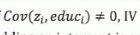 is always consistent regardless of