所屬科目:研究所、轉學考(插大)◆物理化學
1. Which of the following is NOT correct description about the Maxwell relation in thermodynamics? (A) $\left(\frac{\partial T}{\partial V}\right)_S = -\left(\frac{\partial P}{\partial S}\right)_V$ (B) $\left(\frac{\partial T}{\partial P}\right)_S = \left(\frac{\partial V}{\partial S}\right)_P$ (C) $-\left(\frac{\partial S}{\partial V}\right)_T = \left(\frac{\partial P}{\partial T}\right)_V$ (D) $-\left(\frac{\partial S}{\partial P}\right)_T = \left(\frac{\partial V}{\partial T}\right)_P$
2. At $298.15 \mathrm{~K}$, the reaction $\mathrm{SOCl}_{3(1)} + \mathrm{H}_{2} \mathrm{O}_{(1)} \rightarrow \mathrm{SO}_{2(g)} + 2 \mathrm{HCl}_{(g)}$ is endothermic and the equilibrium lies well on the right-hand side. Which of the following statement is correct? (A) $\Delta S_{\mathrm{rxn}} < 0$ at $298.15 \mathrm{~K}$ (B) $\Delta G_{\mathrm{rxn}} > 0$ at $298.15 \mathrm{~K}$ (C) $\Delta H_{\mathrm{rxn}} < 0$ at $298.15 \mathrm{~K}$ (D) $\Delta G_{\mathrm{rxn}}$ becomes more negative when the temperature is raised.
3. The reaction $\mathrm{A} \rightarrow 2\mathrm{B}$ is spontaneous when (A) $\mu_{\mathrm{A}} > 2\mu_{\mathrm{B}}$ (B) $\mu_{\mathrm{A}} = 2\mu_{\mathrm{B}}$ (C) $\mu_{\mathrm{A}} > \mu_{\mathrm{B}}$ (D) $\mu_{\mathrm{A}} < \mu_{\mathrm{B}}$ ($\mu$ is the chemical potential)
4. Einstein explained a series of experimental observations through his photoelectric effect theory. When light irradiates a metal surface, electrons are emitted. Classical physics could not account for why electron emission depends on the frequency of the incident light rather than its intensity. Which of the following statement correctly reflects Einstein's explanation? (A) Atoms in the cavity walls can emit or absorb energy only in discrete quanta. (B) Angular momentum is quantized. (C) The energy of light is not distributed uniformly throughout the wave; instead, it is carried in localized packets (photons). (D) The uncertainty principle applies.
5. Einstein's A and B coefficients describe how light interacts with atoms having discrete energy levels and explain how thermodynamic equilibrium between radiation and matter is established. Which of the following statement is correct? (A) During excitation, the probability that an atom absorbs a photon is not proportional to the photon density. (B) The corresponding de-excitation process is also not proportional to the photon density. (C) An electron must be able to spontaneously emit a photon at a rate that depends on the photon density. (D) The rate constants for excitation and stimulated de-excitation are the same.
6. Which set of the operators or physical quantities do NOT satisfy the Heisenberg uncertainty principle? (A) Angular momentum operators $\hat{\Gamma}_{\mathrm{y}} = -\mathrm{i}\hbar \left(\cos \phi \frac{\partial}{\partial\theta} -\cot \theta \sin \phi \frac{\partial}{\partial\phi}\right)$ and $\hat{L}_{z} = -\mathrm{i}\hbar \frac{\partial}{\partial\phi}$ (B) Frequency $(\nu)$ and time $(t)$ (C) Momentum $(P)$ and position $(x)$ (D) Operators $\hat{I} = 5$ and $\hat{J} = \int_{1}^{\infty} dx$
7. Which of the following quantum mechanical model does NOT have the zero-point energy? (A) Particle in a box with finite potential wells (B) Rigid rotor (C) Harmonic oscillator (D) Quantized electromagnetic field
8. Which of the following molecule may NOT show a rotational Raman spectrum? (A) $\mathrm{N}_2$ (B) $\mathrm{CO}_{2}$ (C) $\mathrm{H}_{2} \mathrm{O}$ (D) $\mathrm{CH}_{4}$
9. Scientists used ultrafast X-ray pulses to directly visualize the DNA photorepair process. The probability of bond-rearrangement events was observed to increase gradually over a timescale of approximately 500 ns. Which of the following statements is incorrect? (A) Molecular bond elongation occurs on a timescale of approximately 500 ns. (B) Molecular bond elongation occurs on a timescale of approximately 500 fs. (C) Although molecular bond vibrations occur on ultrafast timescales, the concentration of reaction products may require a much longer time to increase to a detectable level. (D) The presence of multiple reaction barriers allows reactant molecules that have crossed a barrier to return via reverse reactions.
10. In a consecutive reaction $A \rightarrow B \rightarrow C$ concentration of the intermediate will be small relative to the starting concentration of A if (A) the rate constant for the first step is larger than that for the second, (B) the rate constant for the second step is larger than that for the first, (C) very few products have formed, (D) nearly all the reactant has disappeared.
11. If a system at equilibrium is perturbed in the forward direction, the system will approach equilibrium with a rate determined by (A) the forward rate constant (B) the reverse rate constant (C) a combination of the two (D) neither
12. What is the physical meaning of $\Delta A$ in thermodynamics? (T: temperature; V: volume)(A) Maximum heat at constant T and V (B) Maximum non-expansion work at constant T and V(C) Maximum work at constant T and V (D) Maximum work at constant T
13. $\left(\frac{\partial \left(\frac{A}{T}\right)}{\partial \left(\frac{1}{T}\right)}\right)_V = ?$(A) $G$ (B) $H$ (C) $U$ (D) $S$
14. What is the expression of entropy change $(\Delta S)$ for the isothermal reversible expansion at temperature $T$ from $V_{1}$ to $V_{2}$ of $n$ moles of a van der Waals gas?(A) $nRT\ln \frac{V_1 - nb}{V_2 - nb} + an^2\left(\frac{1}{V_1} -\frac{1}{V_2}\right)$ (B) $-nR\ln \frac{V_1 - nb}{V_2 - nb} -\frac{an^2}{T}\left(\frac{1}{V_1} -\frac{1}{V_2}\right)$(C) $nR\ln \frac{V_1 - nb}{V_2 - nb} +\frac{an^2}{T}\left(\frac{1}{V_1} -\frac{1}{V_2}\right)$ (D) $-nRT\ln \frac{V_1 - nb}{V_2 - nb} -an^2\left(\frac{1}{V_1} -\frac{1}{V_2}\right)$
15. The equation of $C_{P,m} - C_{V,m}$ can be expressed in terms of $V_{m}, T,$ and the gas constants $R, a$ and $b$ as follows: $C_{P,m} - C_{V,m} = R / \left(\Gamma - \frac{\Theta a(V_m - b)^\Phi}{RTV_m^\Omega}\right)$ , where $\Gamma, \Theta, \Phi$ and $\Omega$ are real integers. Which of the description about $\Gamma, \Theta, \Phi$ and $\Omega$ is correct? (A) $\Gamma \neq \Omega$ (B) $\Theta \neq \Phi$ (C) $\Theta = \Phi = \Omega = 1$ (D) $\Omega = \Phi$
16. The rate equation of $A^{*}$ is (A) $[A^{*}] = [A]_{0}e^{-(k_{1} + k_{2})t}$ ; (B) $[A^{*}] = [A^{*}]_{0}e^{-(k_{3})t}$ ; (C) $[A^{*}] = [A^{*}]_{0}e^{-(k_{1} + k_{2} + k_{3})t}$ ; (D) $[A^{*}] = [A]_{0}e^{-(k_{1} + k_{2} + k_{3})t}$
17. The fluorescence lifetime of $A^{*}$ is (A) $\frac{1}{k_1}$ (B) $\frac{1}{k_1 + k_2}$ (C) $\frac{1}{k_1 + k_2 + k_3}$ (D) $\frac{1}{k_2}$
18. The branching percentage of $A_{hot}$ , is (A) $\frac{k_2}{k_1 + k_2}$ (B) $\frac{k_2}{k_1 + k_2 + k_3}$ (C) $\frac{k_1}{k_2}$ (D) $\frac{k_2}{k_1}$
19. The rate equation of species $A_{T}$ is (A) $[B] = \frac{k_3}{k_1 + k_2 + k_3} [A_T]_0 e^{-(k_1 + k_2 + k_3)t}$ (B) $[A_T] = [A_T]_0 e^{-(k_3)t}$ (C) $[A_T] = \frac{k_3}{k_1 + k_2 + k_3} [A_T]_0 [1 - e^{-(k_3)t}]$ (D) $[A_T] = \frac{k_3}{k_1 + k_2 + k_3} [A^*]_0 [1 - e^{-(k_1 + k_2 + k_3)t}]$
20. To increase the fluorescence quantum yield, the chemist may design a molecule with the following properties. Which of the following is incorrect?(A) A shorter fluorescence lifetime(B) Slower internal conversion rate(C) Slower intersystem crossing rate(D) Faster radiative decay
21. In ultrafast photochemical processes, molecules are often excited by femtosecond laser pulses to electronically excited states, followed by rapid nuclear motion and electronic relaxation. In such situations, the validity of the Born–Oppenheimer approximation (BOA) becomes a central issue. The BOA exploits the large mass difference between nuclei and electrons to simplify the molecular Schrödinger equation by separating electronic and nuclear motions. Which of the following statements regarding the Born–Oppenheimer approximation (BOA) are correct?(A) The BOA assumes that electrons respond instantaneously to nuclear motion due to their much smaller mass.(B) Within the BOA, the total molecular wavefunction is expressed as a product of an electronic wavefunction and a nuclear wavefunction.(C) Zero-point vibrational energy is neglected in the BOA.(D) Immediately after vertical photoexcitation, the BOA is typically valid because the nuclear geometry has not yet changed.(E) Within the BOA, ultrafast population transfer between different electronic states can be fully described without considering the interaction between nuclear motion and electronic states.
22. If we consider the three non-hybridized $p$ orbitals ($\psi_{1}, \psi_{2}$ and $\psi_{3}$) and their electrons using the molecular orbital (MO) theory, we can determine three $\pi$ MOs $\psi_{\pi}^{(1)}, \psi_{\pi}^{(2)}$ and $\psi_{\pi}^{(3)}$ with linear combination of $\psi_{1}, \psi_{2}$ and $\psi_{3}$ for that $\psi_{\pi}^{(1)} = C_A \psi_1 + C_B \psi_2 + C_A \psi_3$; $\psi_{\pi}^{(2)} = C_N (\psi_1 - \psi_3)$; $\psi_{\pi}^{(3)} = C_A \psi_1 - C_B \psi_2 + C_A \psi_3$, which obey orthonormal conditions ($\int \psi_{\pi}^{(i)*} \psi_{\pi}^{(i)} d\tau = 1$; $\int \psi_i' \psi_i d\tau = 1$; $\int \psi_i' \psi_j d\tau = 0$ for $i \neq j$). Which of the following statements regarding the linear combination coefficients $C_A$, $C_B$ and $C_N$ are correct?(A) $C_A > C_B$(B) $C_B = C_N$(C) $C_A < C_N$(D) $C_A = C_B < C_N$(E) $C_A > C_B = C_N$
23. The molar Gibbs free energy of a certain gas is given by $G_{m} = A_{1} + A_{2}P + RT\ln P$, where $A_{1}, A_{2}$ are constants, $T$ is temperature, and $P$ is pressure. One mole of this gas at temperature $T$ is expanded isothermally and reversibly from pressure $P_{1}$ to $P_{2}$. Which of the following statements regarding this process are correct?(A) The equation of state for the gas is $PV_{m} - A_{2} = RT$(B) The fugacity $(f)$ of the gas is $f = P \times e^{\frac{A_2P}{RT}}$(C) The internal energy change $\Delta U = 0$(D) The entropy change $\Delta S = R \ln \frac{P_2}{P_1}$(E) The enthalpy change $\Delta H = A_{2}(P_{2} - P_{1})$注意:背面有試題台灣聯合大學系統115學年度碩士班招生考試試題類組:化學類 科目:物理化學(1004)共 6 頁 第 5 頁
24. The following half-cells for which the reduction reaction and its corresponding standard electromotive force $(\mathrm{E}^{\circ})$ is given byHalf-cell (a): $\mathrm{Fe(OH)_{2(s)} + 2e^{-} \rightarrow Fe_{(s)} + 2OH^{-}(aq)}$ $\quad \mathrm{E}^{\circ} = -0.877\,\mathrm{V}$Half-cell (b): $\mathrm{Al}^{3+}(aq) + 3e^{-} \rightarrow \mathrm{Al}_{(s)}$ $\quad \mathrm{E}^{\circ} = -1.66\,\mathrm{V}$Half-cell (c): $\mathrm{AgBr}_{(s)} + \mathrm{e}^{-} \rightarrow \mathrm{Ag}_{(s)} + \mathrm{Br}^{-}_{(aq)}$ $\quad \mathrm{E}^{\circ} = +0.071\,\mathrm{V}$The electrochemical cell 1 $(\mathbf{E}_1)$ is constructed with the half-cell (a) and (b), whereas the electrochemical cell 2 $(\mathbf{E}_2)$ is constructed with the half-cell (a) and (c). The activity of all species is one for both cells. Which of the following statements are correct?(A) The electromotive force of the electrochemical cell is positive when the electrochemical reaction is spontaneous.(B) In $\mathrm{E}_1$, $\mathrm{Fe}_{(s)}$ is oxidized.(C) In $\mathrm{E}_2$, $\mathrm{Fe}_{(s)}$ is reduced.(D) If $\mathrm{E}_1$ is spontaneous, the overall reaction is $3\mathrm{Fe(OH)}_{2(s)} + 2\mathrm{Al}_{(s)} \rightleftharpoons 3\mathrm{Fe}_{(s)} + 6\mathrm{OH}^{-}_{(aq)} + \mathrm{Al}^{3+}_{(aq)}$.(E) If $\mathrm{E}_2$ is spontaneous, the overall reaction is $\mathrm{Fe(OH)}_{2(s)} + 2\mathrm{Ag}_{(s)} + 2\mathrm{Br}^{-}_{(aq)} \rightleftharpoons \mathrm{Fe}_{(s)} + 2\mathrm{OH}^{-}_{(aq)} + 2\mathrm{AgBr}_{(s)}$.
25. Experimental observations show that the fluorescence decay curves of anthracene measured at two different wavelengths do not exhibit simple exponential behavior. Instead, the decay curves display oscillatory features that are $180^{\circ}$ out of phase. Which of the following statements are correct?
(A) Multiple excited states in anthracene are excited non-coherently. (B) Interference between coherently excited states leads to periodic modulation of the excited-state population, producing oscillations in the fluorescence intensity, a phenomenon known as quantum beating. (C) In a simple two-level system with incoherent population decay, fluorescence follows a single exponential decay. When coherence is present, the fluorescence intensity contains both exponential decay and oscillatory components, resulting in non-exponential decay behavior. (D) Fluorescence detected at different wavelengths corresponds to emission from different vibronic transitions. Due to interference, population dynamics between these emitting states can be anticorrelated, leading to oscillations that are $180^{\circ}$ out of phase between the two detection wavelengths. (E) Fluorescence from the non-coherently excited states leads interference resulting the oscillations in the fluorescence intensity, a phenomenon known as quantum beating.
26. If the fluorescence quantum yield $(\varnothing_{f})$ of anthracene is $10\%$, and the fluorescence lifetime is $50\,\mathrm{ns}$, $k_{r}$ is the radiative rate constant, and $k_{nr}$ is the non-radiative rate constant. Which of the following are TRUE? (A) $k_{r} = 2 \times 10^{6}\,\mathrm{sec}^{-1}$ (B) $k_{r} = 2 \times 10^{7}\,\mathrm{sec}^{-1}$ (C) $k_{nr} = 2 \times 10^{6}\,\mathrm{sec}^{-1}$ (D) $k_{nr} = 1.8 \times 10^{7} \sec^{-1}$ (E) $k_{nr} = 9k_{r}$
28. The energy of a particle in a 3D cubic box is given by the formula:\(E_{n_x, n_y, n_z} = \frac{h^2}{8mL^2} \left(n_x^2 + n_y^2 + n_z^2\right)\)where h is Planck's constant, m is the mass of the particle, L is the dimensions of the box, and \(n_x\), \(n_y\), and \(n_z\) are the quantum numbers. Which of the following statements are correct? (A) The degeneracy of the ground state is one (B) The degeneracy of the first excited state is three (C) The energy of the first electronic absorption band is \(\frac{3h^2}{8mL^2}\) (D) The degeneracy of the excited state resulting the broad emission band (E) Without a zero-point energy
 阿摩線上測驗
登入
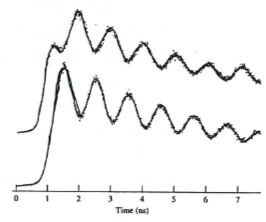 (A) Multiple excited states in anthracene are excited non-coherently. (B) Interference between coherently excited states leads to periodic modulation of the excited-state population, producing oscillations in the fluorescence intensity, a phenomenon known as quantum beating. (C) In a simple two-level system with incoherent population decay, fluorescence follows a single exponential decay. When coherence is present, the fluorescence intensity contains both exponential decay and oscillatory components, resulting in non-exponential decay behavior. (D) Fluorescence detected at different wavelengths corresponds to emission from different vibronic transitions. Due to interference, population dynamics between these emitting states can be anticorrelated, leading to oscillations that are $180^{\circ}$ out of phase between the two detection wavelengths. (E) Fluorescence from the non-coherently excited states leads interference resulting the oscillations in the fluorescence intensity, a phenomenon known as quantum beating.