 阿摩線上測驗
[2pt] 12. The figure shows a short-day condition (long night) and the effect of a night interruption with a brief red light pulse (R), followed by far-red light (FR) (row 3). Which option BEST predicts flowering outcomes for the long-day plant and short-day plant in row 3?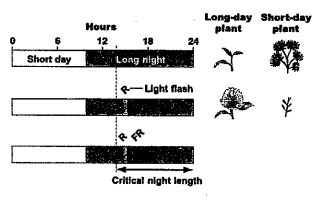
(A) Long-day plant does not flower; short-day plant flowers because FR pulse
reverses the effect of the R pulse.
(B) Short-day plant flowers in row 3 because the day length is still short, and shortday plants require short days to flower. Critical night length
(C) Long-day plant flowers; short-day plant does not flower because the red light night-break shortens the effective night length.
(D) Long-day plant does not flower; short-day plant flowers because the day length remains short.
(E) Long-day plant flowers; short-day plant flowers because both receive some light during the night
統計: A(0), B(0), C(1), D(0), E(1) #3828114