阿摩線上測驗
16. The allomorphs of the plural morpheme are determined by the last sound of the singular noun to which the morpheme is attached. The allomorphs of the past-tense morpheme are determined by the last sound of the verb to which the morpheme is attached. There is striking similarities in the processes required to generate the correct forms of these inflectional morphemes. Which of the following description is incorrect?
(A) There is a schwa insertion process as schwa is inserted before a word-final /z/ that follows a morpheme ending in a sibilant.
(B) There is an assimilation process as word-final /z/ is devoiced following a morpheme ending in a voiceless sound.
(C) There is a schwa insertion process as schwa is inserted preceding a word-final /d/ that follows a morpheme ending in a velar stop.
(D) There is an assimilation process as word-final /d/ is realized as [t] following a morpheme that ends in a voiceless sound.
答案:登入後查看
統計: A(43), B(75), C(174), D(48), E(0) #2925369
統計: A(43), B(75), C(174), D(48), E(0) #2925369
詳解 (共 4 筆)



HO Christinaichaho
#6079363
(a) 指非中央元音 schwa
發出沙沙的音 fricative /s/ -> 後有/z/, 中間就有一個 schwa
E X: gases
ㅤㅤ
(b) 前面是無聲子音結尾 原本/ Z /音 ->/ S /ex: buses
依字尾子音無聲配無聲的同化作用,就發無聲音voiceless .
ㅤㅤ
(c) 與(d) 正好相反
其中一個是對的~
ㅤㅤ
(D)原本應發成/d/ , ex worked 同化原則--
讓voiceless + voiceless /d / 變成/t/看, 以無聲配無聲, 就應發無聲。ex: cooked /t/
ㅤㅤ
ㅤㅤ
ㅤㅤ
0
0

Crabby C.
#7332079
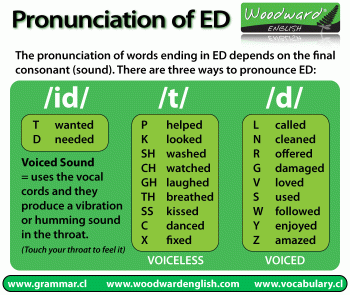
(C) Schwa insertion preceding word-final /d/ following a velar stop. 看第一欄
Velar needs to be corrected to alveolar.
(D)Assimilation where word-final /d/ is realized as [t] after a voiceless
sound.看第二欄
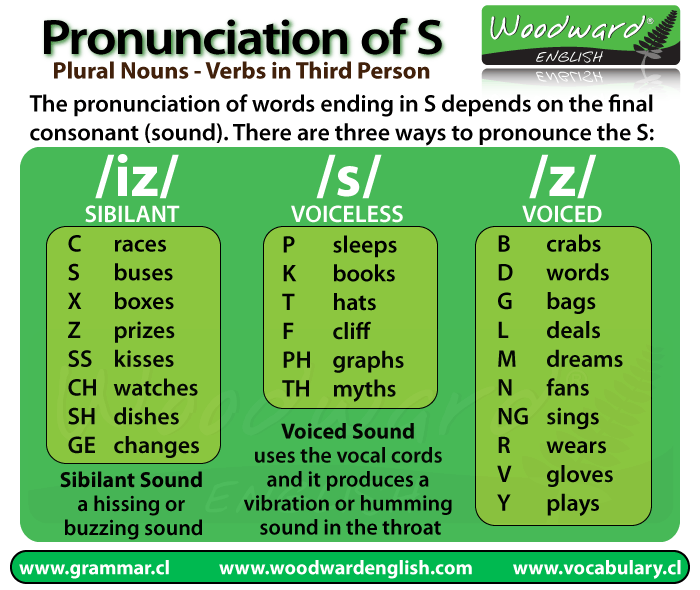
(A) Schwa insertion before word-final /z/ following a sibilant. 看第一欄
(B) Assimilation where word-final /z/ is devoiced after a voiceless sound. 第二欄
圖片來源:
https://www.woodwardenglish.com/how-to-pronounce-final-s/
https://www.literacymn.org/pronouncing-past-tense-ed-ending-sort-sounds
0
0