阿摩線上測驗
26 下列何者強調需求是人格的核心且奠基於生理相關機制?
(A) D. McClenlland
(B) H. Maslow
(C) D. Hebb
(D) H. Murray
統計: A(41), B(243), C(35), D(149), E(0) #1848396
詳解 (共 4 筆)

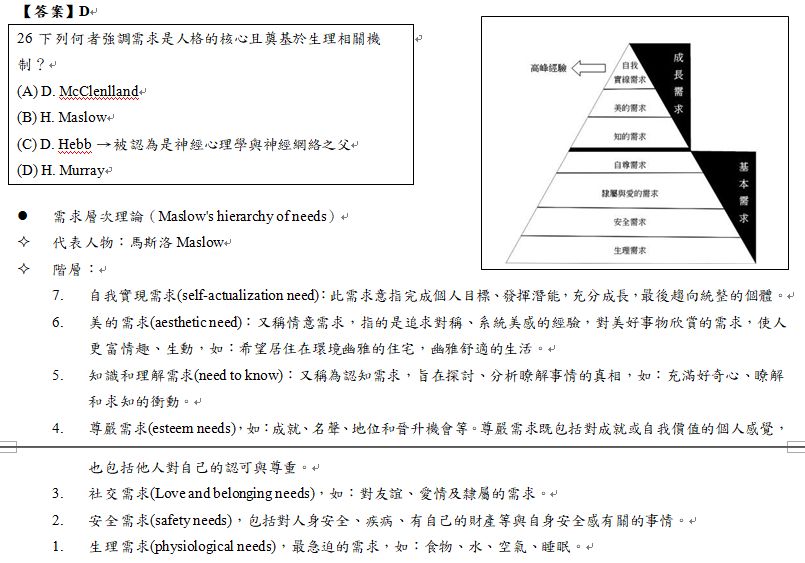
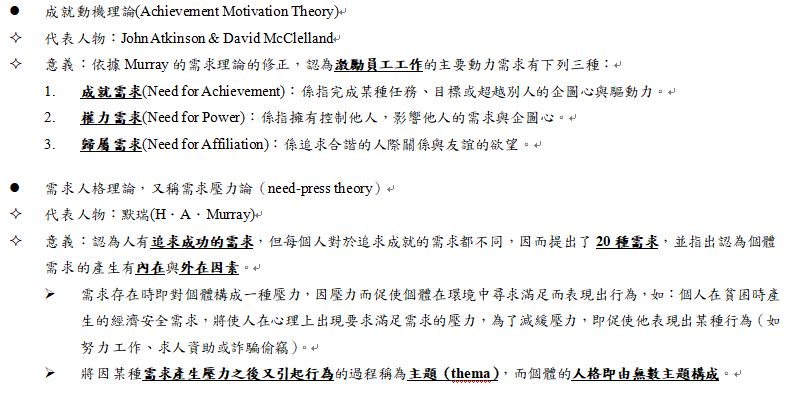

教科書多提到Henry Murray理論中的成就的需求(Needs for achievement),以及如何用TAT去測量,但這題問的是Murray提出人格的生理機轉,需要參考其1938年的原典。以下摘述維基百科部分對Henry Murray(與其理論)的介紹:
Murray developed a theory of personality called personology, based on "need" and "press".
In 1927, at the age of 33, Murray became assistant director of the Harvard Psychological Clinic.
He developed the concepts of latent needs (not openly displayed),manifest needs (observed in people's actions), "press" (external influences on motivation)and "thema"—"a pattern of press and need that
coalesces around particular interactions"
生理機轉在這裡 ☟☟
Murray divided personology into five principles: (1) Cerebral physiology, rooted in the brain, governs all aspects of personality. (2) People act to reduce physiological and psychological tension to gain
satisfaction, but do not strive to be tension-free, and rather cycle between seeking excitement, activity
and movement in their lives and then relaxing. (3) An individual's personality continues to develop over time and is influenced by all of the events that occur over a person's lifetime. (4) Personality is not fixed and it can change and progress, and (5) Each person has some unique characteristics and others which
are shared by everyone.
--------------------------
資料來源:維基百科與Murray, H. A. (1938). Explorations in Personality. New York: Oxford University Press.