 阿摩線上測驗
41. Which of the following is NOT what teachers implementing task-based language teaching do?
(A) Using whatever language is necessary to help students understand pre-task activities.
(B) Adopting a synthetic syllabus to help students learn language forms.
(C) Giving students feedback regarding the level of success in task completion.
(D) Providing learners with a natural context for authentic and meaningful interaction.
統計: A(85), B(405), C(49), D(38), E(0) #2307640
詳解 (共 5 筆)

Task-based Language Teaching (TBLT)
(p.192-208)
In 1976, Wilkins distinguished between two types of syllabi—synthetic syllabi and analytic syllabi.
Synthetic syllabi comprise linguistic units: grammar structures, vocabulary items, functions, etc.
The units are usually ordered logically, in a sequence from linguistic simplicity to linguistic complexity.
It is the learners’ responsibility to synthesize the linguistic units for the purpose of communication.
Analytic syllabi, on the other hand, ‘… are organised in terms of the purposes for which people are learning language and the kinds of language performance that are necessary to meet those purposes’ (Wilkins 1976: 13).
Content-based instruction, which we looked at in the previous chapter, employs an analytic syllabus.
Rather than learning language items one by one in a specific sequence, learners work on relevant content texts and the language of the texts.
Second language acquisition (SLA) research supports the use of analytic syllabi because such research shows that learners do not learn linguistic items one at a time. Instead, they induce linguistic information from the language samples they work on, and they acquire language items only when they are ready to do so.
A task-based syllabus, which we take up in this chapter, falls into the category of an analytic syllabus.
The syllabus is composed of tasks, not a sequence of linguistic items.
Source: Techniques & Principles in Language Teaching



Task代表學生有目標存在,絕不只是focus on language (have a outcome)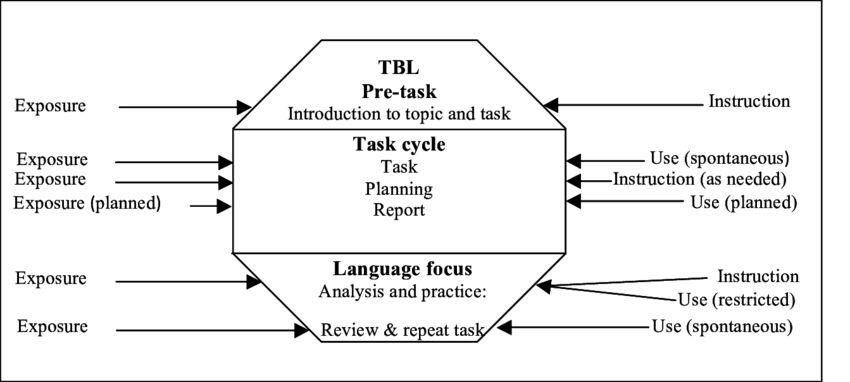
Willis 的教學過程框架
前任務(pre-task):介紹主題和任務,幫助學習者熟悉新詞和短語
任務環(task cycie)
任務(task):給予學習者表達機會
計畫(planning)思考語言的準確性,為匯報做準備
報告(report):使用正式語言匯報
語言焦點(language focus):探索語言,將新知系統化
練習(practice)
