 阿摩線上測驗
44. Based on Coyle’s language triptych, which of the following planning tools is related to language for learning?
(A) Adding
(B) Applying
(C) Adapting
(D) Analyzing
統計: A(256), B(193), C(91), D(79), E(0) #2307643
詳解 (共 4 筆)


補充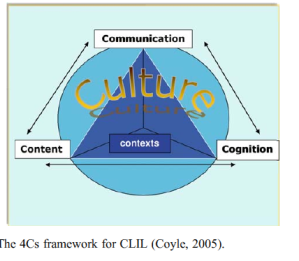
The 4Cs framework for CLIL starts withcontent
(such as subject matter, themes, cross-curricular approaches) and
focuses on the interrelationship between content (subject matter), communication
(language), cognition (thinking) and culture (awareness of
self and ‘otherness’) to build on the synergies of integrating learning
(content and cognition) and language learning (communication and cultures). It unites learning theories, language learning theories and
intercultural understanding:
1. Subject matter is not only about acquiring knowledge and skills,
it is about the learner constructing his/her own knowledge and
developing skills (Lantolf, 2000; Vygotsky, 1978);
2. Acquiring subject knowledge, skills and understanding is related
to learning and thinking (cognition). To enable the learner to construct
an understanding of the subject matter, the linguistic demands of its content must be analysed and made accessible (Met, 1998);
3. Thinking processes (cognition) need to be analysed for their linguistic demands (Bloom, 1984; McGuiness, 1999);
4. Language needs to be learned in context, learning through the language,
reconstructing the subject themes and their related cognitive processes e.g. language intake/output (Krashen, 1985; Swain, 2000);
5. Interaction in the learning context is fundamental to learning.
This has implications when the learning context operates through
L2 (Pica, 1991; van Lier, 1996);
6. The relationship between cultures and languages is complex.
Intercultural awareness and learning is fundamental to CLIL
(Byram, Nicols, and Stevens, 2001).
The 4Cs Framework holds that it is through progression in knowledge,
skills and understanding of the subject matter, engagement in associated
cognitive processing, interaction in a communicative context,
developing appropriate language knowledge and skills as well as
acquiring a deepening intercultural awareness through the positioning
of self and ‘otherness’, that effective CLIL takes place whatever the
model. From this perspective, CLIL involves learning to use language
appropriately whilst using language to learn effectively. The 4Cs
Framework is a tool for mapping out CLIL activities and for maximising
potential in any model, at any level and any age.
https://clilingmesoftly.wordpress.com/clil-models-3/the-4-cs-model-docoyle/


Language in CLIL & 3As Planning Tool
Main Branches:
1️⃣ Types of Language in CLIL
-
Language of Learning ?
-
Subject-specific vocabulary & academic terms
-
Essential for understanding subject concepts
-
-
Language for Learning ?️
-
Language for teacher-student communication
-
Includes classroom routines & discussion phrases
-
-
Language through Learning ?
-
Language acquired naturally during active learning
-
Not pre-planned by the teacher
-
2️⃣ 3As Planning Tool (Coyle, 2005)
-
Analyze ?
-
Identify key subject-related words, phrases, and grammar
-
Not direct translation but definition & analysis
-
-
Add ➕
-
Integrate subject and language learning
-
Use discussions, tasks, and metacognitive strategies
-
-
Apply/Assure ✅
-
Ensure students apply language in learning tasks
-
Monitor language progress
-