阿摩線上測驗
登入
首頁
>
研究所、轉學考(插大)◆工程力學
>
110年 - 110 國立臺灣科技大學_碩士班招生試題_營建工程系(丙組):工程力學#113276
> 申論題
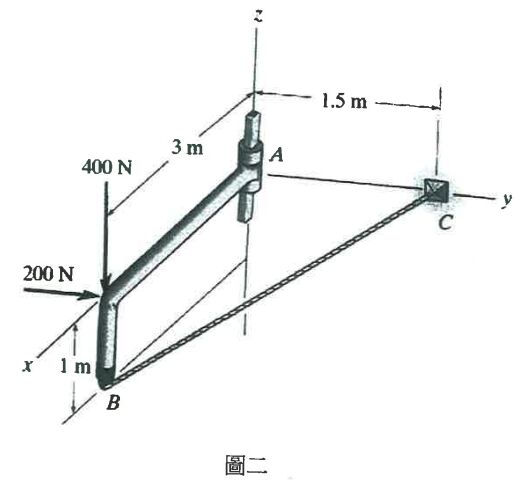
二、(25分) 圖二中,桿件AB之A處穿過一斷面為方形之桿件,因此桿件AB由A處之方形桿以及繩索Bc支撐,其中件AB與方形桿之無摩擦力。為了使得桿件 AB平衡,試求A之反力及繩索C之張力。
相關申論題
(a)試求鋼棒中的壓力P、最大壓應力σc以及B點的位移δB。(10分)
#484055
(b)若A點的固定端改為與一彈簧常數1,000MN/m的彈簧相接,如圖三(b)所示。試求鋼棒中的壓力P、最大壓力σc以及點的位移δB。(15分)
#484056
(a)劃出此之剪力圖與矩圖,以q及表示。(6分)
#484057
(b)試求複合對中性軸之斷面慣性矩。(10分)
#484058
(c)若L=6m,試求僅考慮最大正矩作用下此複合斷面可容許的最大均布載重q。(9分)
#484059
In the preamble to his 2009 book Vie de lettre, William Marx poses the guiding question of his study: "What is a lettre?" (the word is hard to translate from the French: certainly not simply someone who is literate, but not exactly a scholar or academic, much less a humanist - rather a member of the literati, someone whose life is devoted to books, maybe a 文人, but which would include a contemporary literature professor - ideally]: "Someone whose physical and intellectual existence is ordered around texts and books: living among them, living from them, employing his or her own life to make them live and, of course, to read them." You are attempting to enter this life, to become a lettre(e). This is a very strange thing to do! But what exactly does it mean? "Literati form at the same time the basis of a civilization (they guarantee its continuity) and a destructive instance, a support and a menace: they permit the constitution of an order but participate in its contestation.... Such is the true role of the practice and teaching of Jiterature today: to maintain active the double postulation of literature considered simultaneously as an expression of the real and as power of tearing away from this real; to allow oneself to be moved by these texts that have constructed our world, which are us, and at the same time are not us - or to demolish [that is, critique] them, which amounts to the same thing: we must leave open a door to negation - the difference between culture and entertainment precisely plays out here." Marx continues, "The lettre makes truth triumph against power. He Lor she] alone guarantees the exactitude of sources, the authenticity of texts, the pertinence of original context, the manner of holding closely to original intention. Other interpretations and commentaries are necessary too, but they come ofter, and if the lettre has not done his [or her] job first, these interpretations, however briliant, are meaningless..." But, he cautions, "Attention, however: scholarly reading (la lecture lettree) is also interpretation, because everything is interpretation; but it is an interpretation where the interpreter effaces him- [or her-] self as much as possible behind the text. In other words, scholarly reading is distinguished from other types of reading by a particular ethical dimension: the "I" of the interpreter is loathsome [haissable]. That there is not an ultimate truth of a given text is clear: but it is important to suppose a criterion of truth that renders certain interpretations more probable or more acceptable than others. In any case, the lettre thinks so." Or so William Marx thinks.What about you? What do you imagine the role of a literary scholar - teacher and critic - to be? Based on your exposure so far not only to the literary texts which have appealed to you (or you would not be taking this exam), but also the approaches to them by teachers and critics you have encountered, what do you consider the role of the scholar or lettre(e) to be? is it ideally neutral and self-effacing, the way Marx imagines? Or is this an old-fashioned approach we have fruitfully left behind? If you have any background so far in literary theory, how has this ideal been undermined since the "rise of theory" in the 60s and 70s? Why? If you have not had such exposure, still what do you envision being a lettre(e) will mean for you and your relation to literary texts? Is there an important difference between culture and entertainment? What is the nature of interpretation? What is the point of literary scholarship? Teaching? For that matter, what is the point of literature?
#484060
一、土壤工程性質相關問題(共25分) 1.已知某土壤之分類結果為SP-M。試簡述此土壤之屬性、粒徑分布及細料含量等基本性質。(8分)
#484061
2.試計算在此最佳夯實狀態下土壤之飽和度為何?並根據你的計算結果評述夯實結果是否合理。(10分)
#484062
3.承上題,如果工程需求是低滲透性夯實土層。請問乾側夯實或濕測夯實你會選哪一種?試用土壤組構觀念解釋之。(7分)
#484063
1.何謂hydraulic gradient?(5分)
#484064
相關試卷
110年 - 110 國立臺灣科技大學_碩士班招生試題_營建工程系(丙組):工程力學#113276
110年 · #113276
110年 - 110 國立中央大學_碩士班招生考試_土木工程學系/力學與結構工程組(一般生):工程力學#105314
110年 · #105314
110年 - 110 國立台北科技大學碩士班招生考試_自動化科技研究所:工程力學#103349
110年 · #103349
110年 - 110 國立臺北科技大學_碩士班招生考試_機械工程系機電整合碩士班(乙組):工程力學#103348
110年 · #103348
110年 - 110 國立臺灣大學_碩士班招生考試_工程科學及海洋工程學研究所乙組:工程力學(動力學及靜力學)#100701
110年 · #100701
91年 - 91 淡江大學 轉學考 工程力學(含靜力學、材料力學、動力學)#56023
91年 · #56023
87年 - 87 淡江大學 轉學考 工程力學(含靜力學、材料力學、動力學)#56402
87年 · #56402