所屬科目:研究所、轉學考(插大)◆普通物理學
1. If F = 4.0 N and m = 2.0 kg, what is the magnitude a of the acceleration for the block shown below?The surface is frictionless.(A) 5.3 m/s2 (B) 4.4 m/s2 (C) 3.5 m/s2 (D) 6.2 m/s2 (E) 8.4 m/s2
2. The horizontal surface on which the objects slide is frictionless. If F = 12 N, what is the tension instring 1?(A) 35 N (B) 30 N (C) 40 N (D) 45 N (E) 25 N
3. A 0.50-kg mass attached to the end of a string swings in a vertical circle (radius = 2.0 m). When themass is at the lowest point on the circle, the speed of the mass is 12 m/s. What is the magnitude of the forceof the string on the mass at this position?(A) 31 N (B) 36 N (C) 41 N (D) 46 N (E) 23 N
4. Equal amounts of work are performed on two bodies, A and B, initially at rest, and of masses M and 2Mrespectively. The relation between their speeds immediately after the work has been done on them is(A) vA =√2 vB (B) vA = 2vB (C) vA = vB (D) vB = √2vA (E) vB = 2vA
5. A 10-g bullet moving horizontally with a speed of 1.8 km/s strikes and passes through a 5.0-kg blockinitially at rest on a horizontal frictionless surface. The bullet emerges from the block with a speed of 1.0km/s. What is the kinetic energy of the block immediately after the bullet emerges?(A) 8.0 J (B) 6.4 J (C) 5.3 J (D) 9.4 J (E) 10 J
6. If M = 0.50 kg, L = 1.2 m, and the mass of each connecting rod shown is negligible, what is the momentof inertia about an axis perpendicular to the paper through the center of mass? Treat the mass as particles.(A) 3.7 kg⋅m2 (B) 2.8 kg⋅m2 (C) 3.2 kg⋅m2 (D) 2.3 kg⋅m2 (E) 3.9 kg⋅m2
7. A particle whose mass is 2.0 kg moves in the xy plane with a constant speed of 3.0 m/s along thedirection \( \mathbf{\hat{r}} = \mathbf{\hat{i}} + \mathbf{\hat{j}}. \). What is its angular momentum (in kg⋅m2/s) relative to the point (0, 5.0) meters?(A) \( 12\hat{\text{k}} \) (B) \( 11\mathbf{\hat{k}} \) (C)\( 13\hat{\mathbf{k}} \)(D)\( 14\hat{\text{k}} \) (E)\( 21\mathbf{\hat{k}} \)
8. The mass in the figure below slides on a frictionless surface. When the mass is pulled out, spring 1 isstretched a distance x1 from its equilibrium position and spring 2 is stretched a distance x2. The springconstants are k1 and k2 respectively. The force pulling back on the mass is:(A) −k2x1 (B) −k2x2 (C) −(k1x1 + k2x2)(D)\( -\frac{k_1 + k_2}{2} (x_1 + x_2) \) (E)\( -\frac{k_1 + k_2}{k_1 k_2} (x_1 + x_2) \)
9. Which of the following is a solution to the wave equation, \( \frac{\partial^2 y}{\partial x^2} = \frac{1}{v^2} \frac{\partial^2 y}{\partial t^2} \)(A)\( \frac{e^{-x}}{x} \sin x \) (B)\( (\cos kx) (\sin \omega t) \)(C)\( e^{-x} \sin \omega t \)(D)\( e^{-x} \sin (kx - \omega t) \) (E)\( e^{-x} \cos t \)
10. Two harmonic waves traveling in opposite directions interfere to produce a standing wave described byy = 2 sin (πx) cos (3πt) where x is in m and t is in s. What is the distance (in m) between the first twoantinodes?(A) 8 (B) 2 (C) 4 (D) 1 (E) 0.5
11. The work done in the expansion from an initial to a final state(A) is the area under the curve of a PV diagram.(B) depends only on the end point.(C) is independent of the path.(D) is the slope of a PV curve.(E) equals P(VF − Vi).
12. An 8 000-kg aluminum flagpole 100-m long is heated by the sun from a temperature of 10°C to 20°C.Find the heat transferred (in J) to the aluminum if the specific heat of aluminum is 0.215 cal/g⋅°C.(A) 7.2 × 10⁵ (B) 7.2 × 10⁷ (C) 7.2 × 10³ (D) 7.2 × 101 (E) 7.2 × 10²
13. The average molecular translational kinetic energy of a molecule in an ideal gas is(A) kBT (B) RT. (C) kBT (D) RT.(E) kBT, where n = number of internal degrees of freedom
14. The molar specific heat at constant pressure at 0°C of an ideal monatomic gas is(A) (B) R. (C) (D) 2R (E)
15. An ideal gas is allowed to undergo a free expansion. If its initial volume is V1 and its final volume is V2,the change in entropy is(A) nR ln (V2/V1) (B) nRT ln (V2/V1) (C) nk ln (V2/V1) (D) 0 (E) nR V2/V1
16. If a = 3.0 mm, b = 4.0 mm, Q1 = 60 nC, Q2 = −80 nC, and q = 36 nC in the figure, what is themagnitude of the electric force on q?(A) 5.0 N (B) 4.4 N (C) 3.8 N (D) 5.7 N (E) 0.60 N
17. An electron (m = 9.1 × 10⁻³¹ kg, q = −1.6 × 10⁻¹⁹ C) starts from rest at point A and has a speed of 5.0 ×10⁶ m/s at point B. Only electric forces act on it during this motion. Determine the electric potentialdifference VA − VB. (A) −71 V (B) +71V (C) -26 V (D) +26 V (E) -140 V
18. How many electrons pass through a 20-Ω resistor in 10 min if there is a potential drop of 30 voltsacross it?(A) 5.6 × 10²¹ (B) 7.5 × 10²¹ (C) 9.4 × 10²¹ (D) 1.1 × 10²¹ (E) 3.8 × 10²¹
19. The light intensity incident on a metallic surface with a work function of 3 eV produces photoelectronswith a maximum kinetic energy of 2 eV. The frequency of the light is doubled. Determine the maximumkinetic energy (in eV).(A) 3 (B) 2 (C) (D) 4 (E) 7
20. Find the uncertainty in the momentum (in kg ⋅ m/s) of an electron if the uncertainty in its position isequal to 3.4 × 10⁻¹⁰ m, the circumference of the first Bohr orbit.(A) 6.2 × 10⁻²⁵ (B) 1.6 × 10⁻²⁵ (C) 15.5 × 10⁻²⁵ (D) 19.4 × 10⁻²⁵ (E) 2.0 × 10⁻²⁴
21. Assume a diatomic molecule can be considered to be two point masses separated by a distance r. Thecenter of mass of the system is located a distance x from m1, equal to(A) m1r/(m1 + m2) (B) m2r/(m1 + m2) (C) (m1 + m2) r/m1(D) (m1 + m2) r/m2 (E) r(m2/m1)22
22. The rotational kinetic energy of a diatomic molecule can take the form(A) (1/2)mω2 (B) (1/2)Iω2 (C) [m1m2/(m1 +m2)]r2ω2(D) (1/2)mv2 (E) 1/2 μω2
23. The energy released when an atom takes an electron is called(A)internal energy (B) dissociation energy (C) binding energy(D) electron affinity (E) ionization energy
24. Light behaves like(A) a wave at times, and a particle at other times. (B) a wave (C) a particle (D) unknown7
25. Two isotopes of uranium have the same(A) mass number (B) neutron number (C) atomic number(D) Nucleon number (E) nucleon and neutron number
 阿摩線上測驗
登入
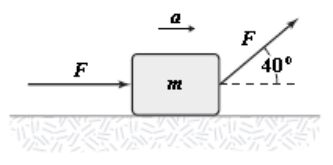 (A) 5.3 m/s2 (B) 4.4 m/s2 (C) 3.5 m/s2 (D) 6.2 m/s2 (E) 8.4 m/s2
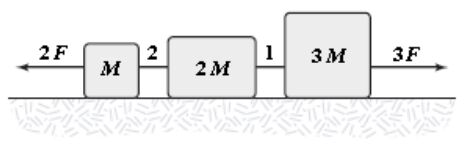 (A) 35 N (B) 30 N (C) 40 N (D) 45 N (E) 25 N
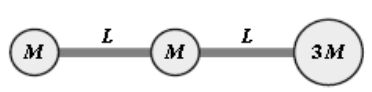 (A) 3.7 kg⋅m2 (B) 2.8 kg⋅m2 (C) 3.2 kg⋅m2 (D) 2.3 kg⋅m2 (E) 3.9 kg⋅m2
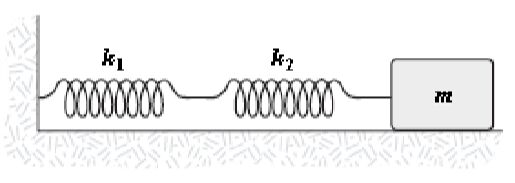 (A) −k2x1 (B) −k2x2 (C) −(k1x1 + k2x2)(D)