所屬科目:研究所、轉學考(插大)◆普通物理學
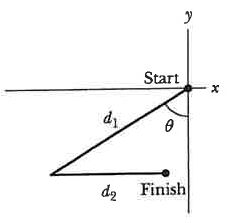
1. The figure shows an overhead view of two straight segments of the run by a mouse: d₁ = 14.0 m, d2 = 9.00 m, 0 = 60.0°. The figure is not drawn to scale. What is the angle (deg) of that displacement vector (relative to the +x direction). [Note: The figure is not to scale.]
(A) 10.7 (B) 4.53 (C) 7.67 (D) 9.16 (E) 1.94
2. In projectile motion (such as with a thrown baseball), which is true about velocity and acceleration ? (A) is always tangent to the path and is always downward. (B) is always perpendicular to the path and is always horizontal. (C) is always perpendicular to the path and is always downward. (D) is always tangent to the path and is always horizontal. (E) is always downward and is always tangent to the path.
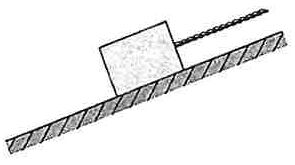
3. The figure shows a block on a frictionless ramp; a cord attached to the block can pull on the block with a force parallel to the ramp. Here are three situations:
1. The block moves up the ramp with speed increasing at the rate of 2 m/s².
2. The block moves down the ramp with speed decreasing at the rate of 2 m/s².
3. The block moves down the ramp with speed increasing at the rate of 2 m/s². Rank the three situations according to the tension in the cord, greatest first. () indicates a tie.
(A) 1, 2, 3 (B) 2, 1, 3 (C) (1,2), 3 (D) 1, (2,3) (E) (2,3), 1
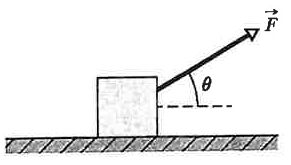
4. The figure shows a 2.00 kg block on a floor. We apply a 10.0 N force Fat an upward angle of = 30.0°. What is the magnitude (N) of the frictional force on the block? (You need to determine if the block is sliding or not.) The coefficient of static friction is 0.800 and the coefficient of kinetic friction is 0.200.
(A) 6.93 (B) 12.5 (C) 10.0 (D) 8.66 (E) 2.01
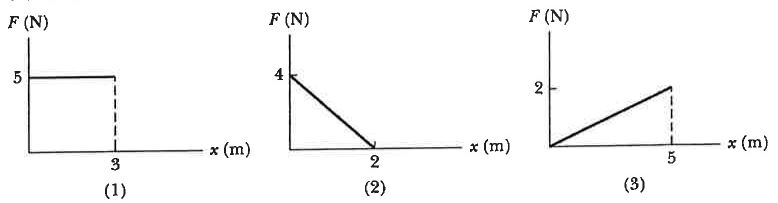
5. The figure shows three graphs of a force that acts on a block as the block slides across a frictionless floor over the indicated distance. Rank the three graphs according to the work done on the block by the force, most positive first, most negative last. () indicates a tie.
(A) 2, 3, 1 (B) (1,2), 3 (C) 2, (1,3) (D) 3, 2, 1 (E) 1, 3, 2
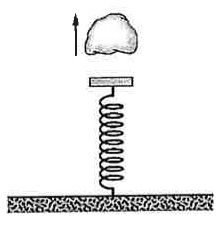
6. In the figure, we have placed a rock on a vertical spring, pressed downward on the spring to compress it, and then released the spring so that the rock flies vertically upward. At one instant, the rock is 2.50 m above its launch point (the release point) and has a speed of 5.00 m/s. The mass of the rock is 3.00 kg and the spring constant is 4000 N/m. How far (m) was the spring compressed just before the launch?
(A) 0.236 (B) 0.039 (C) 0.456 (D) 0.578 (E) 0.102
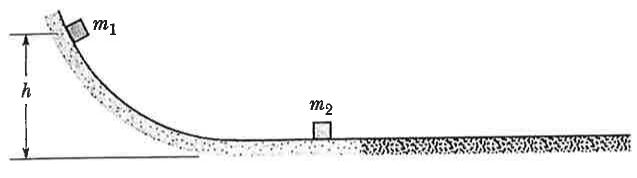
7. In the figure, block 1 with mass m₁ starts from rest at height h = 2.00 m on a frictionless ramp and then slides down and has an elastic collision with block 2 with mass m2. The masses are related by m₁ = 2.00 m2. What is the speed (m/s) of block 2 just after the collision?
(A) 0.45 (B)8.35(C)11.2 (D) 2.34 (E) 4.01
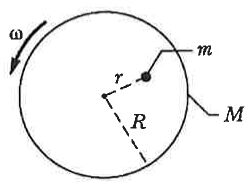
8. The figure is an overhead view of a disk (mass M = 5.00 kg and radius R = 4.00 m) rotating like a merry-go-round. A particle (mass m = 3.00 kg) lies on the disk at radius r = 2.00 m. The angular speed is 6.00 rad/s. What is the kinetic energy (J) of the disk-particle system?
(A) 648 (B) 1660 (C) 2180 (D) 936 (E) 279
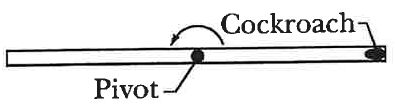
9. The figure shows an overhead view of a narrow meter stick (length = 1 m) that rotates about its center at an initial angular speed of 2.00 rad/s. A cockroach rides at one end. The cockroach then crawls to the center of the stick. What is the new angular speed (rad/s)? Stick mass = 2.00 (cockroach mass). For a thin rod rotating around its center, I = (1/12) mL²
(A) 3.68 (B) 10.6 (C) 6.62 (D) 7.80 (E) 5.00
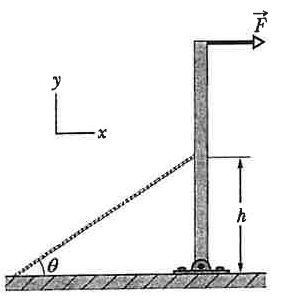
10. In the figure, a uniform beam with a length of 3.00 m is hinged at its lower end, and a horizontal force of magnitude 45.0 N acts at its upper end. The beam is held vertical by a cable that makes an angle 0 = 20.0° with the ground and is attached to the beam at height h = 1.50 m. What is the tension (N) in the cable?
(A) 117 (B) 131 (C) 77.8 (D) 95.8 (E) 67.7
11. We start with 2.00 kg sample of ice at T = -25.0 °C. How much energy (J) is required to bring the sample to a temperature of T = 35.0 °C T = 35.0°C? Specific heat of ice = 2.22 × 10³ J/kg·K, specific heat of liquid water = 4.18 × 10³ J/kg·K, heat of fusion = 3.33 × 10⁵ J/K. (A) 8.53 × 10⁵ (B) 1.22 × 10⁷ (C) 1.07 × 10⁶ (D) 8.62 × 10⁷ (E) 3.82 × 10⁸
12. A sample of air initially occupies 0.280 m³ at a pressure of 202 kPa. It is next expanded isothermally to a pressure of 101 kPa and then cooled at constant pressure until it returns to its initial volume. How much work (J) has been done by the sample? (A) 2.38 × 10⁵ (B) 8.32 × 10³ (C) 4.76 × 10⁶ (D) 6.17 x 10² (E) 1.05 × 10⁴
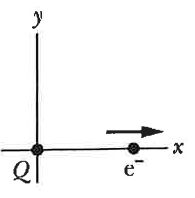
13. The figure shows a particle of charge Q = -3e that is fixed at the origin and an electron that is moving along the x axis. At the instant when the separation is 2.00 m, what is the magnitude (m/s²) of the electron's acceleration? An electron has mass =9.11× kg.
(A) 9.62 × 10² (B) 3.17 × 10³ (C) 7.82 × 10³ (D) 1.90 × 10² (E) 1.28 × 10⁴
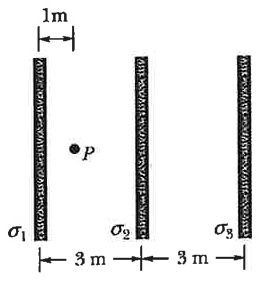
14. The figure shows three parallel, infinite, nonconducting sheets of charge and their surface charge densities. (You see the cross section of the sheets.) What is the magnitude (N/C) of the net electric field at the point indicated? σ₁ = -2.00 µC/m² σ2 = +2.00 µC/m² σ3 = +2.00 µC/m²
(A) 3.39 × 10⁵(B)8.26 × 10⁶(C)9.18 × 10³(D)2.64 × 10⁴(E)1.31 × 10⁶
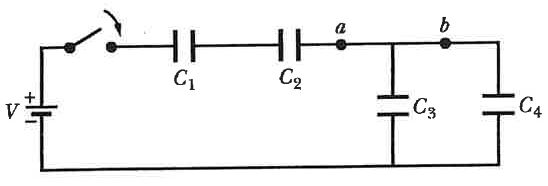
15. In the figure, we have V= 9.0 V, C2 = 3.0 µF, and C4 = 4.0 µF, and all the capacitors are initially uncharged. When switch S is closed, a total charge of 20 µC passes through point a and a total charge of 8.0 µC passes through point b. What is capacitance C3 (uF)?
(A) 11.0 (B) 6.0 (C) 2.0 (D) 13.0 (E) 1.0
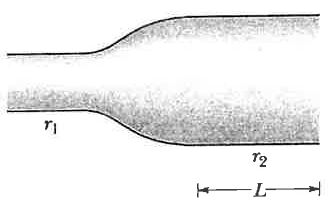
16. The figure shows a wire that changes in width, with radii r2 = 2.00 r1. The drift speed in region 1 at the left is 2.00 × m/s. The resistivity is 1.69 x ohm-m. The density of conduction electrons is 8.49 x 3. On the right, length L is 3.00 cm. What is the potential change AV (volts) along that length?
(A) 9.15 × (B) 1.37 × (C) 3.44 × (D) 5.62 × (E) 6.83 x
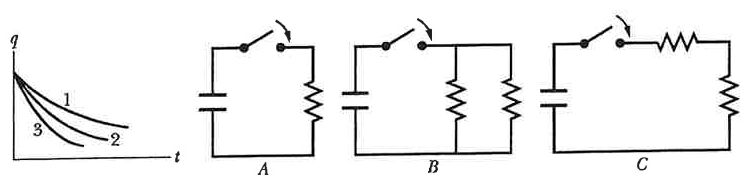
17. The figure shows three circuits in which a charged capacitor is discharged when the switch is closed. The resistors are identical; the capacitors are identical. The graph shows how the charge q on the capacitor decays with time t. Which plot corresponds to which circuit?
(A) A3, B2, C↔1 (B) A↔1, B↔3, C↔2 (C) A↔2, B↔1, C↔3 (D) A↔3, B↔1, C↔2 (E) A2, B3, C↔1
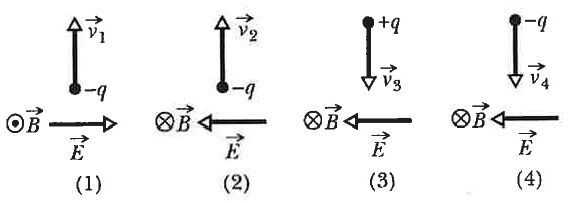
18. The figure shows four snapshots (photos) in different situations in which a charged particle travels through a uniform magnetic (B = 4.0 T) and a uniform electric field (E = 200 V/m). In which will the particle veer to our left just after the snapshot? (The encircled dot indicates a field directly out of the figure. An encircled x indicates a field directly into the figure.) v₁ = 40 m/s, v2 = 60 m/s, v3 = 30 m/s, v4 = 45 m/s,
(A) 3 only (B) 1 and 2 (C) 2 and 4 (D) 1 and 3 (E) none
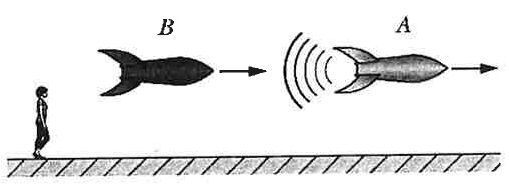
19. The figure shows two spaceships moving directly away from us. Ship A (in front) emits a light signal at wavelength 500 nm (as measured by the ship occupants). Ship B (in pursuit) detects that signal at wavelength 600 nm. Ship B is moving at speed 0.200c relative to us. What is the wavelength (nm) of the signal as we detect it?
(A) 1235 (B) 735 (C) 1100 (D) 312 (E) 276
20. A certain photon has the same momentum as a proton moving at speed 5.00 × 10⁶ m/s. (This is slow enough that you do not need relativity for the proton.) The proton mass is 1.67 × kg. What is the energy (in MeV) of the photon that has the same momentum as the proton? (A) 15.6 (B) 1.40 (C) 0.654 (D) 0.112 (E) 8.63
1. The figure shows an overhead view of two straight segments of the run by a mouse: d₁ = 14.0 m, d2 = 9.00 m, 0 = 60.0°. The figure is not drawn to scale. What is the angle (deg) of that displacement vector (relative to the +x direction). [Note: The figure is not to scale.] (A) 10.7 (B) 4.53 (C) 7.67 (D) 9.16 (Ε) 1.94
2. In projectile motion (such as with a thrown baseball), which is true about velocity and acceleration ā? (A) is always tangent to the path and a is always downward. (B) is always perpendicular to the path and a is always horizontal. (C) is always perpendicular to the path and a is always downward. (D) is always tangent to the path and a is always horizontal. (E) is always downward and āis always tangent to the path.
3. The block moves down the ramp with speed increasing at the rate of 2 m/s². Rank the three situations according to the tension in the cord, greatest first. () indicates a tie. (A) 1, 2, 3 (B) 2, 1, 3 (C) (1,2), 3 (D) 1, (2,3) (E) (2,3), 1
4. The figure shows a 2.00 kg block on a floor. We apply a 10.0 N force Fat an upward angle of = 30.0°. What is the magnitude (N) of the frictional force on the block? (You need to determine if the block is sliding or not.) The coefficient of static friction is 0.800 and the coefficient of kinetic friction is 0.200. (A) 6.93 (B) 12.5 (C) 10.0 (D) 8.66 (E) 2.01
5. The figure shows three graphs of a force that acts on a block as the block slides across a frictionless floor over the indicated distance. Rank the three graphs according to the work done on the block by the force, most positive first, most negative last. () indicates a tie. (A) 2, 3, 1 (B) (1,2), 3 (C) 2, (1,3) (D) 3, 2, 1 (E) 1, 3, 2
6. In the figure, we have placed a rock on a vertical spring, pressed downward on the spring to compress it, and then released the spring so that the rock flies vertically upward. At one instant, the rock is 2.50 m above its launch point (the release point) and has a speed of 5.00 m/s. The mass of the rock is 3.00 kg and the spring constant is 4000 N/m. How far (m) was the spring compressed just before the launch? (A) 0.236 (B) 0.039 (C) 0.456 (D) 0.578 (E) 0.102
7. In the figure, block 1 with mass m₁ starts from rest at height h = 2.00 m on a frictionless ramp and then slides down and has an elastic collision with block 2 with mass m2. The masses are related by m₁ = 2.00 m2. What is the speed (m/s) of block 2 just after the collision? (A) 0.45 (B)11.2 (D) 2.34 (E) 4.01
8. The figure is an overhead view of a disk (mass M = 5.00 kg and radius R = 4.00 m) rotating like a merry-go-round. A particle (mass m = 3.00 kg) lies on the disk at radius r = 2.00 m. The angular speed is 6.00 rad/s. What is the kinetic energy (J) of the disk-particle system? (A) 648 (B) 1660 (C) 2180 (D) 936 (E) 279
9. The figure shows an overhead view of a narrow meter stick (length = 1 m) that rotates about its center at an initial angular speed of 2.00 rad/s. A cockroach rides at one end. The cockroach then crawls to the center of the stick. What is the new angular speed (rad/s)? Stick mass = 2.00 (cockroach mass). For a thin rod rotating around its center, I = (1/12) mL² (A) 3.68 (B) 10.6 (C) 6.62 (D) 7.80 (Ε) 5.00
10. In the figure, a uniform beam with a length of 3.00 m is hinged at its lower end, and a horizontal force F of magnitude 45.0 N acts at its upper end. The beam is held vertical by a cable that makes an angle 0 = 20.0° with the ground and is attached to the beam at height h = 1.50 m. What is the tension (N) in the cable? (A) 117 (B) 131 (C) 77.8 (D) 95.8 (E) 67.7
13. The figure shows a particle of charge Q = -3e that is fixed at the origin and an electron that is moving along the x axis. At the instant when the separation is 2.00 m, what is the magnitude (m/s²) of the electron's acceleration? An electron has mass =9.11×10⁻³¹ kg. (A) 9.62 × 10² (B) 3.17 × 10³ (C) 7.82 × 10³ (D) 1.90 × 10² (E) 1.28 × 10⁴
14. The figure shows three parallel, infinite, nonconducting sheets of charge and their surface charge densities. (You see the cross section of the sheets.) What is the magnitude (N/C) of the net electric field at the point indicated? σ₁ = -2.00 µC/m² σ2 = +2.00 µC/m² σ3 = +2.00 µC/m² (A) 3.39 × 10⁵
15. In the figure, we have V= 9.0 V, C2 = 3.0 µF, and C4 = 4.0 µF, and all the capacitors are initially uncharged. When switch S is closed, a total charge of 20 µC passes through point a and a total charge of 8.0 µC passes through point b. What is capacitance C3 (uF)? (A) 11.0 (B) 6.0 (C) 2.0 (D) 13.0 (Ε) 1.0
16. The figure shows a wire that changes in width, with radii r2 = 2.00 r1. The drift speed in region 1 at the left is 2.00 × 10⁻⁸ m/s. The resistivity is 1.69 x 10⁻⁸ ohm-m. The density of conduction electrons is 8.49 x 1028 m-3. On the right, length L is 3.00 cm. What is the potential change AV (volts) along that length? (A) 9.15 × 10⁻⁵ (B) 1.37 × 10⁻⁶ (C) 3.44 × 10⁻⁸ (D) 5.62 × 10⁻⁹ (E) 6.83 x 10⁻⁷
17. The figure shows three circuits in which a charged capacitor is discharged when the switch is closed. The resistors are identical; the capacitors are identical. The graph shows how the charge q on the capacitor decays with time t. Which plot corresponds to which circuit? (A) A3, B2, C↔1 (B) A↔1, B↔3, C↔2 (C) A↔2, B↔1, C↔3 (D) A↔3, B↔1, C↔2 (E) A2, B3, C↔1
18. The figure shows four snapshots (photos) in different situations in which a charged particle travels through a uniform magnetic (B = 4.0 T) and a uniform electric field (E = 200 V/m). In which will the particle veer to our left just after the snapshot? (The encircled dot indicates a field directly out of the figure. An encircled x indicates a field directly into the figure.) v₁ = 40 m/s, v2 = 60 m/s, v3 = 30 m/s, v4 = 45 m/s, (A) 3 only (B) 1 and 2 (C) 2 and 4 (D) 1 and 3 (E) none
19. The figure shows two spaceships moving directly away from us. Ship A (in front) emits a light signal at wavelength 500 nm (as measured by the ship occupants). Ship B (in pursuit) detects that signal at wavelength 600 nm. Ship B is moving at speed 0.200c relative to us. What is the wavelength (nm) of the signal as we detect it? (A) 1235 (B) 735 (C) 1100 (D) 312 (E) 276
20. A certain photon has the same momentum as a proton moving at speed 5.00 × 10⁶ m/s. (This is slow enough that you do not need relativity for the proton.) The proton mass is 1.67 × 10⁻²⁷ kg. What is the energy (in MeV) of the photon that has the same momentum as the proton? (A) 15.6 (B) 1.40 (C) 0.654 (D) 0.112 (E) 8.63
 阿摩線上測驗
登入
 (A) 10.7 (B) 4.53 (C) 7.67 (D) 9.16 (E) 1.94
 and acceleration
 ? (A)
 is always tangent to the path and
 is always downward. (B)
 is always perpendicular to the path and
 is always horizontal. (C)
 is always perpendicular to the path and
 is always downward. (D)
 is always tangent to the path and
 is always horizontal. (E)
 is always downward and
 is always tangent to the path.
 (A) 1, 2, 3 (B) 2, 1, 3 (C) (1,2), 3 (D) 1, (2,3) (E) (2,3), 1
 (A) 6.93 (B) 12.5 (C) 10.0 (D) 8.66 (E) 2.01
 (A) 2, 3, 1 (B) (1,2), 3 (C) 2, (1,3) (D) 3, 2, 1 (E) 1, 3, 2
 (A) 0.236 (B) 0.039 (C) 0.456 (D) 0.578 (E) 0.102
 (A) 0.45 (B)8.35(C)11.2 (D) 2.34 (E) 4.01
 (A) 648 (B) 1660 (C) 2180 (D) 936 (E) 279
 (A) 3.68 (B) 10.6 (C) 6.62 (D) 7.80 (E) 5.00
 of magnitude 45.0 N acts at its upper end. The beam is held vertical by a cable that makes an angle 0 = 20.0° with the ground and is attached to the beam at height h = 1.50 m. What is the tension (N) in the cable?
 (A) 117 (B) 131 (C) 77.8 (D) 95.8 (E) 67.7
 kg.
 (A) 9.62 × 10² (B) 3.17 × 10³ (C) 7.82 × 10³ (D) 1.90 × 10² (E) 1.28 × 10⁴
 (A) 3.39 × 10⁵(B)8.26 × 10⁶(C)9.18 × 10³(D)2.64 × 10⁴(E)1.31 × 10⁶
 (A) 11.0 (B) 6.0 (C) 2.0 (D) 13.0 (E) 1.0
 m/s. The resistivity is 1.69 x
 ohm-m. The density of conduction electrons is 8.49 x
 3. On the right, length L is 3.00 cm. What is the potential change AV (volts) along that length?
 (A) 9.15 ×
 (B) 1.37 ×
 (C) 3.44 ×
 (D) 5.62 ×
 (E) 6.83 x

 (A) A3, B2, C↔1 (B) A↔1, B↔3, C↔2 (C) A↔2, B↔1, C↔3 (D) A↔3, B↔1, C↔2 (E) A2, B3, C↔1
 (A) 3 only (B) 1 and 2 (C) 2 and 4 (D) 1 and 3 (E) none
 (A) 1235 (B) 735 (C) 1100 (D) 312 (E) 276
 kg. What is the energy (in MeV) of the photon that has the same momentum as the proton? (A) 15.6 (B) 1.40 (C) 0.654 (D) 0.112 (E) 8.63