所屬科目:研究所、轉學考(插大)◆普通物理學
1. Which of the following has the correct dimensions of inductance (in SI units)? (A) V·s²/A (B) V·s/C (C) V·s/A (D) J·s/C² (E) none of the above.
2. Which of the following has the correct dimensions of bulk modulus (in SI units)? (A) Pa (B) Pa·m/s (C) N/m (D) N·m (E) none of the above.
3. Which of the following has the correct dimensions of the permeability constant μ₀ (in SI units)? (A) T·m/A² (B) N·m²/C² (C) N/A² (D) J/A (E) none of the above.
4. Which of the following has the correct dimensions of the Boltzmann's constant k (in SI units)? (A) J·mol/K (B) J/(K·mol) (C) N/K (D) J/K (E) none of the above.
5. Which of the following has the correct dimensions of the Planck's constant h (in SI units)? (A) J·m (B) J·s² (C) kg·m/s² (D) kg·m²/s (E) none of the above.
6. A pinhole camera has a hole of diameter 1 mm. The film is placed 10 cm from the hole. Consider two point objects located 10 m from the hole. Assuming the light has a wavelength of 500nm, what is the minimum separation between the source objects for them to be resolved? (A) 32 cm (B) 0.32 mm (C) 6.1 cm (D) 6.1 mm (E) 6.1 m
7. Suppose the intensity of sunlight (solar radiation) at the surface of the earth is 3000 W/m². What force does it exert on a mirror of area 2 m², assuming normal incidence and total reflection of light? (A) 2 × 10⁻⁵ N (B) 4 × 10⁻⁵ N (C) 4 × 10⁻⁴ N (D) 10⁻⁴ N (E) 10⁻² N
8. Consider a cube of density ρ and horizontal cross-sectional area L² with vertical height L. The cube is floating in a liquid with density ρ_L. At equilibrium a fraction L₀/L of the cube is immersed in the liquid. Now let's push down the cube a little bit and release it. What is the period of the subsequent oscillation? (A) (B)(C)(D)(E) none of the above.
9. What is the linear acceleration of the CM (center of mass)? (A) g sin φ (B) g sin φ (C) g sin φ (D) g sin φ (E) none of the above.
10. What is the minimum (static) coefficient of friction required for the hollow sphere to roll without slipping? (A) (B) tan φ (C) (D) tan φ (E) none of the above.
11. The Deflection angle δ of a plumb line from the true vertical (radial line) at latitude λ is approximately (all angles are represented in radians) (A) ω²R_E(sin λ)/g (B) ω²R_E(cos λ)/g (C) ω²R_E(sin 2λ)/2g (D) ω²R_E(cos 3λ)/2g (E) none of the above.
12. At which latitude (in radians) does one observe the largest deflection? (A) 0 (B) π/6 (C) π/4 (D) π/2 (E) none of the above.
13. The wavelength of the scattered photon λ' is equal to (A) λ - 2h/(mc) (B) λ + 2h/(mc) (C) λ/(1 + mcλ/h) (D) λ/(1 - mc²λ/h) (E) none of the above.
14. What is the momentum of the scattered particle? (A) -hc(1/λ + 1/λ') (B) hc(1/λ - 1/λ') (C) h(1/λ + 1/λ') (D) h(1/λ - 1/λ') (E) none of the above.
15. How much heat is transported from the right volume to the left during this process? (A) PV (B)PV (C) PV (D)PV (E) none of the above.
16. What is the change in total entropy of the system? (A)(B)(C) nR (D) 0 (E) none of the above.
17. What is the magnitude of the change in the left volume ΔV when mechanical equilibrium is achieved (where the net force on the partition is zero)? (A) (25/3-1)/(25/3+1)V (B) (23/5-1)/(23/5+1)V (C) (1/3)V (D) 23/5/(23/5+1)V (E) none of the above.
18. What is the ratio of temperatures T'R/T'L at mechanical equilibrium? ('R': right side; 'L': left side.) (A) 2 (B) 1 (C) 23/5 (D) 25/3 (E) none of the above.
19.What is the maximal current I_max in this circuit? (A) Q₀/C (B) Q₀R/C (C) Q₀/√(RC) (D) Q₀/RC (E) none of the above.
20. What is the behavior of the current I(t) in this circuit? (A) Imax exp(-t/RC) (B) Imax(1 - exp(-t/RC)) (C) Imax exp(-t/√(RC)) (D) Imax RC/(t + RC) (E) Imax cos(2πt/RC).
21. What is the maximal current I_max in this circuit? (A) Q₀/LC (B) Q₀/√(LC) (C) Q₀L/C (D) Q₀C/L (E) none of the above.
22. What is the behavior of the current I(t) in this circuit? (A) Imax exp(-t/√LC) (B) Imax exp(-t/LC) (C) Imax sin(t/√LC) (D) Imax, a constant (E) Imax cos(2πt/√LC).
23. What is the magnitude of magnetic field at the center of the orbit due to the electron's motion? (A) (B) (C) (D)(E) none of the above.
24. What is the magnitude of magnetic (dipole) moment μ⃗ associated with this motion? (A) evr/2 (B) evr (C) evr² (D) eπr² (E) none of the above.
●Now suppose a weak (in the sense that eB ≪ 2mω) magnetic field = Bẑ is turned on normal to the plane of this orbit. The original angular frequency ω becomes ω' = ω + Δω.
25.Suppose the orbital radius is unchanged. What is Δω? (A) eB/2me (B)(C) evB/(me rB) (D) v/rB (E) none of the above.
 阿摩線上測驗
登入
阿摩線上測驗
登入
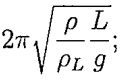 (B)
(B)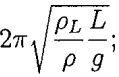 (C)
(C)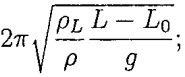 (D)
(D) (E) none of the above.
 g sin φ (B) g sin φ (C)
  g sin φ (D)
  g sin φ (E) none of the above.
 (B)
(B)  tan φ (C)
  (D)
(D)  tan φ (E) none of the above.
 PV (C)
  PV (D)
 PV (E) none of the above.
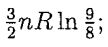 (B)
(B)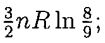 (C)
(C)  nR (D) 0 (E) none of the above.
 (B)
(B) (C)
(C)  (D)
(D) (E) none of the above.
 = Bẑ is turned on normal to the plane of this orbit. The original angular frequency ω becomes ω' = ω + Δω.
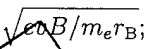 (C) evB/(me rB) (D) v/rB (E) none of the above.