所屬科目:研究所、轉學考(插大)-普通生物學
2. A covalent chemical bond is one in which (A) electrons are removed from one atom and transferred to another atom so that the two atoms become oppositely charged. (B) protons and neutrons are shared by two atoms so as to satisfy the requirements of both atoms. (C) outer-shell electrons of two atoms are shared so as to satisfactorily fill the outer electron shells of both atoms. (D) outer-shell electrons of one atom are transferred to the inner electron shells of another atom. (E) inner-shell electrons of one atom are transferred to the outer electron shell of another atom.
3. Which of the following is possible due to the high surface tension of water? (A) Lakes don't freeze solid in winter, despite low temperatures. (B) A water strider can walk across the surface of a small pond. (C) Organisms resist temperature changes, although they give off heat due to chemical reactions. (D) Water can act as a solvent. (E) The pll of water remains exactly neutral.
4. Which of the following type of microscopy would be most effective in visualizing the fine structure of viruses and cytoskeletal filaments? (A) standard light microscopy (B) phase-contrast light microscopy (C) transmission electron microscopy (D) darkfield light microscopy (E) differential-interference microscopy
5. Cell membrane molecules are labeled with a fluorescent tag and then a portion of then are bleached with a laser beam. What would one observe after the cell is incubated for a few minutes? (A) The bleached molecules would disappear into the cell. (B) The bleached molecules would diffuse laterally through the membrane and intermix with unbleached molecules. (C) The bleached molecules would remain in the spot where bleaching occurred. (D) All the bleached molecules would flip-flop across the cell membrane. (E) A11 of the choices are correct.
6. Sports physiologists at an Olympic training center wanted to monitor athletes to determine at what point their muscles were functioning anaerobically. They could do this by checking for the buildup of which molecule? (A) ΑΤΡ(B) lactate(C) carbon dioxide (D) pyruvic acid(E) oxygen
7. The binding (or fusion) of vesicles to target membranes requires which of the following? (A) signal recognition particle (B) proteasome (C) v-snare and t-snare interactions (D) dynamin (E) vesicle peptidase
8. Autophage provides a way for cells to (A) degrade entire organelles and recycle their components. (B) automatically control the level of ATP. (C) engulf bacterial cells. (D) export unwanted organelles out of the cell. (E) degrade unwanted proteins.
9. Which of the following reactions would require the hydrolysis of at least two ATP molecules for it to occur? (A) A reaction that has a G = -8 kCal. (B) A reaction that has a G = +9 kCal. (C) A reaction that has a G = -16 kCal. (D) A reaction that has a G = +18 kCal. (E) A reaction that has a G = -14.6 kCal.
10. Which of the following statements about steroid receptors is FALSE? (A) The receptors undergo a conformational change after binding the steroid. (B) The receptors are localized to the plasma membrane. (C) Once the steroid binds the receptor, the steroid/receptor complexes dimerize. (D) Steroid receptors act as transcriptional factors, regulating the expression of certain genes and the subsequent production of proteins. (E) Steroid receptors are localized to either the cytoplasm or nucleus.
11. The grass lands do not flourish if there is no animal feed on grass. Most of monocot plants are taken over by dicots. Which of the following statements is the most likely reason? (A) Monocot roots have weaker adsorption of nutrients. (B) Without animal, monocot roots expand too quickly and cause depletion of nutrients. Then, whole population will be extinct. (C) Monocot will grow too tall, and will be destroyed by typhoon. (D) Monocots are light sensitive, and need animals to protect them avoid UV irradiations. (E) Dicots have fibrous roots to compete more nutrients.
12. A plant cell with solute potential -0.65Mpa maintains a constant volume when bathed with solution that has -0.30MPa, and is in an open container. The cells has pressure potential of (A) -0.30MPa (B) 0.35MPa (C) +0.30MPa (D) +0.35MPa (E) 0MPa
13. Movement of xylem sap from roots to leaves (A) occurs through the symplast of xylem (B) results mainly from diffusion within symplast. (C) depends on active transport. (D) usually depends on tension or negative pressure potential. (E) is accomplished by aquaporins.
14. A seed develops from (A) an ovum. (B) a pollen grain. (C) an ovule. (D) an ovary. (E) an embryo.
15. Genetic variations are important for evolution. Which of following statements is true? (A) Mutations are the only way to make more genetic variations. (B) Sexual recombination increases genetic variations for all organisms. (C) Heterozygote advantage is one of mechanisms to preserve genetic variations in diploid organisms. (D) Directional natural selections increase diversity of organisms in one population. (E) Darwin applied genetic principles to explain importance of genetic variation in evolution.
16. What is the trait used to group the organisms in to a clad? (A) Derived trait (B) Homologous traits (C) Ileterologous traits (D) Sex traits (E) Unique traits
17. Two potential devices that eukaryotic cells use to regulate transcription are DNA _ and _ histone (A) methylation; amplification (B) amplification; methylation (C) acetylation; methylation (D) methylation; acetylation (E) amplification; acetylation
18. What is the effect of a frame-shifting mutation in a gene? (A) It changes an amino acid in the encoded protein. (B) It has no effect on the amino acid sequence of the encoded protein. (C) It introduces a stop codon into the mRN( A ) (D) It alters the reading frame of the mRN( A ) (E) It prevents introns from being expressed.
19. Absence of bicoid gene mRNA from a Drosophila egg leads to the absence of anterior larval body parts and mirror-image duplication of posterior parts. This is evidence that the product of the bicoid gene (A) is transcribed in the early embryo. (B) normally leads to formation of tail structures. (C) normally leads to formation of head structures. (D) is a protein present in all head structures. (E) leads to programmed cell death
20. Which of the following is (are) the characteristics of microRNAs? (A) The microRNAs precursors form hair-pin (stem-loop) structure (B) Dicer enzyme cuts into shorter fragments (C) microRNAs prevent gene expression either by degrading the target mRNA or by blocking its translation (D) B and C only (E) A, B, and C
21. What is the function of reverse transcriptase in retroviruses? (A) It hydrolyzes the host cell's DN( A ) (B) It uses viral RNA as a template for DNA synthesis. (C) It converts host cell RNA into viral DN( A ) (D) It translates viral RNA into proteins. (E) It uses viral RNA as a template for making complementary RNA strands.
22. Which of the following helps to stabilize mRNA by inhibiting its degradation? (A) TATA box (B) Spliceosomes (C) 5' cap (D) poly-A tail (E) both C and D
23. If the recombination frequency between gene A and B is 10 out of 100 offspring, gene A and C is 30 out of 100 offspring, and gene B and C is 40 out of 100 offspring. What is the genetic map of these genes on a chromosome? (A) ABC (B) BCA (C) BAC (D) CAB (E) either C or D
24. The inheritance pattern where two or more genes do not assort independently because they are close together on the same chromosome is called (A) epistasis (B) linkage (C) genomic imprinting (D) dominance (E) Mendelian inheritance
25. A cell that has 2n + 1 chromosomes is (A) trisomic (B) polyploid (C) aneuploid (D) monosomic (E) both A and C
26. Bacteria are grown in 15N (heavy) medium and then transferred to 14N (light) medium and allowed to replicate for 1 generation. The DNA is subsequently isolated and centrifuged in a CsC12 gradient to yield what type of gradient band(s)? (A) one heavy band (B) one light band (C) one half-heavy (intermediate to heavy and light) band (D) one heavy and one half-heavy band (E) one heavy and one light band
27. Bacteria are grown in 15N (heavy) medium and then transferred to 14N (light) medium and allowed to replicate for 2 generations. The DNA is subsequently isolated and centrifuged in a CsC12 gradient to yield what type of gradient band(s)? (A) one heavy band (B) one light band (C) one half-heavy (intermediate to heavy and light) band (D) one heavy and one half-heavy band (E) one light and one half-heavy band
28. The mechanism of DNA replication is (A) conservative. (B) intermediate. (C) semiconservative. (D) dispersive. (E) complementary.
29. __ enables a single gene to encode two or more polypeptides that are different in their amino acid sequence. (A) Reverse transcription (B) Self-splicing (C) Capping (D) Alternative splicing (E) Regulatory splicing
30. Which one of the following structures belongs to connective tissues? (A) Sweat gland (B) Cardiac muscle (C) Blood (D) Trachea (E) Neuron
31. Which of the following statements regarding the lipid digestion and absorption is not correct? (A) The rate of digestion is increased by the process of emulsification. (B) The digested triglyceride will be resynthesized in the small intestine epithelial cells. (C) Before they are actively absorbed into epithelial cells, the fatty acids and monoglyceride will form micelles along with bile salt and vitamins. (D) The major digestive enzyme is pancreatic lipase. (E) The chylomicrons are too large to diffuse into blood capillaries, but can diffuse into lacteals.
32. There are several mechanisms to maintain the blood glucose concentration during the postabsorptive state. Which one is not correct? (A) Glycogenolysis (B) Gluconeogenesis (C) Glucose sparing (D) Cells use fatty acid as an alternate energy source. (E) The liver will convert glycerol into ketones, which are released into the blood during prolonged fasting.
33. What causes the animal heart to beat so steadily? (A) Heart center of the brain (B) Sinoatrial node (C) Atrioventricular node (D) Purkinje fiber (E) Hypothalamus
34. CO2 is transported from inner tissues to lung mainly by which of the following ways? (A) Dissolved in the plasma (B) Attached to the hemoglobin (C) As carbonic acid (D) As bicarbonate ions (E) As carbon dioxide
35. Which of the following statements regarding the functions of your kidney is not correct? (A) Filtration of blood (B) Water reabsorption (C) Excretion of nitrogenous waste (D) Production of urea as a waste product of protein (E) Regulation of salt balance
36. The main target site of ADH (antidiuretic hormone) is __ (A) Proximal convoluted tubule of the kidney (B) Collecting duct of the kidney (C) The Henle loop of the kidney (D) Posterior pituitary gland (E) Adrenal gland
37. Which of the following statements about protein and steroid hormones is wrong? (A) Most of protein hormones bind to receptors located on the cytoplasm. (B) Steroid hormones are lipophilic. (C) Protein hormones bind noncovalently to receptors. (D) Steroid hormones usually stimulate gene transcription directly. (E) Protein hormone will stimulate second messenger pathway.
38. The luteinizing hormone (LH) will stimulate __ and follicle-stimulating hormone (FSH) stimulates __ That controls male spermatogenesis. (A) Corpus luteum, follicle cell (B) Sertoli cells, follicle cells (C) Sertoli cells, Leydig cells (D) Leydig cells, Sertoli cells (E) Follicle cells, Sertoli cells
39. Which of the following statements regarding fertilization in sea urchins is not correct? (A) The sperm will proceed acrosomal reaction. (B) The egg will proceed cortical reaction (C) The fast block to polyspermy is due to depolarization after sperm and egg fusion. (D) The slow block to polyspermy is due to the release of Ca2+. (E) The increase in cytosolic Ca2+ begins in the opposite site of sperm entry and propagates throughout the egg.
40. What stageis the three germ layers formation in the embryo? (A) Blastula formation (B) Gastrulation (C) Organ formation (D) Pattern formation (E) Neurulation
41. What kind of molecule should all antigen-presenting cells express to hold the antigen? (A) T cell receptor (B) Antibody (C) Class I MIHC proteins (D) Class II MIIC proteins (E) CD4
42. What kind of immunoglobulin involves in allergy? (A) Ig A (B) Ig G (C) Ig M (D) Ig D (E) Ig E
43. Which of the following structureis not a mechanoreceptor? (A) Meissner' s corpuscles (B) Ruffini corpuscles (C) Ilair cells (D) Stretch receptor (E) Nociceptor
44. In nerve cells, an action potential is actively propagated along axon (A) to the cell body. (B) to the axon terminal. (C) to the cell body or the axon terminal dependent on animal needs. (D) to the dendrites. E away from synapse
45. Which of the statements of population conservation is true? (A) Larger population is more eagerly conserved than smaller population. (B) It is not necessary to conserve population with low genetic diversity. (C) Extinction vortex is a downward population spiral. Unless reversed the process, populations will be extinct. (D) Effective size of population is always larger than that of total population.
46. What is the sustainable biosphere initiative? (A) A plan to convert all natural ecosystems in the biosphere to carefully engineered ones. (B) A program that uses adaptive management to experiment and learn while working with disturbed ecosystem. (C) A conservation practice that sets up zoned reserves surrounded the buffer zones. (D) A research agenda to study biodiversity and support sustainable development. (E) The declining population approach to conservation that seeks to identify and remedy causes of species' declines.
47. According to climograph for biomes in North America, annual mean temperature and precipitation of Area A are 10 degree C and 2500mm. The type of biome for this area is (A) Coniferous forest (B) Desert (C) Tropical forest (D) Temperate grassland (E) Temperate broadleaf forest
48. If all species existed now, which one of the following species have nucleotide polymorphism? (A) H. erectus (B) A.anamensis (C) P. boisei (D) H. sapiens (E) H. floresiensis
49. If there was no geographic isolation and H. neanderthalensis and H. sapiens could have offsprings but hybrids did not survive, which of the following statements is true? (A) The mechanism of speciation is allopatric speciation. (B) Such speciation may be due to polyploidy. (C) This speciation process is a type of anagenesis. (D) Speciation occurs at steps of prezygotic isolation. (E) There is mechanic isolation between these species.
50. According to the following tables, which of countries needs resources from other countries most? (A) India (B) China (C) USA (D) Japan (E) Sweden
 阿摩線上測驗
登入
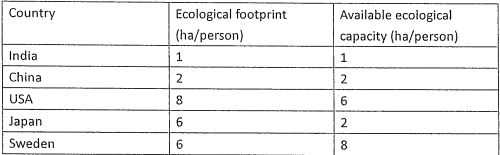 (A) India (B) China (C) USA (D) Japan (E) Sweden