所屬科目:研究所、轉學考(插大)◆普通物理學
1. Two forces, \( F_1 \) and \( F_2 \), act on a particle with a mass of 1 kg and make it accelerate at 4i-6j+k (m/s²). If \( F_1 = -2i+ j + 5k (N), find \( F_2 \).
(A)2i-7j-3k (N) (B)2i-5j+5k(N) (C)\( F_2 = 6i-5j+5k(N) (D)\( F_2 = 6i-7j-3k (N) (E)\( F_2 = 2i-5j(N)
2. A particle moves along the x-axis according to the equation \( 5t = 3x^2 + 4x + 6 \), where x is the position in meter and t is the time in second. Find its speed when \( x = 1.0 \) m. _________(m/s)(A)2.0 (B)1.5 (C)1 (D)0.5 (E)0.1
3. Which of the following does not represent the dimension of force? (m: mass, x: position, v: speed, a: acceleration, k: force constant, q: charge, E: electric field, B: magnetic induction) (A)ma (B)kx (C)qE (D)qB (E)\( mv^2/x \)
4. A solid wheel with mass M, radius R, rolls without sliding on a horizontal surface and its rotational inertia is \( MR^2/2 \). If the center of mass is accelerating at a. Find the applied force F acting on the axle and the frictional force f on the wheel surface. (F, f) = (A)(Ma, 0) (B)(Ma, Ma/2) (C)(2Ma, Ma) (D)(2Ma, Ma/2) (E)(3Ma/2, Ma/2)
5. A wheel takes 3.00 s to rotate 36.0 rounds. Its angular speed at the end of the 3.00-s interval is 27.0 rad/s. What is the constant angular acceleration of the wheel? (rad·s⁻²)(A)2.0 (B)1.0 (C)3.0 (D)0.5 (E)4.0
6. A charge of 10 C is first put on a spherical conducting shell and then another point charge of -3 C is put at the center. Find the net charge on the outer surface of the shell: (A)-7 C (B)-3 C (C)0 C (D)+3 C (E)+7 C
7. A capacitor of capacitance C and an inductor of inductance L are connected on both ends, the resonance angular frequency is: (A)LC (B)\( (LC)^{1/2} \) (C)\( (LC)^2 \) (D)\( (1/LC)^{1/2} \) (E)L/C
8. A magnetic field B passing in perpendicular through a square wire loop of area A. The magnetic flux through the loop is: (A)0 (B)BA/2 (C)BA (D)2BA (E)3BA
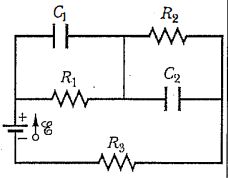
9. In the right figure, \( R_1 = 5\Omega \), \( R_2 = 10\Omega \), \( R_3 = 15\Omega \), \( C_1 = 5\mu F \), \( C_2 = 10\mu F \), and the ideal battery has an emf \( \varepsilon = 20V \). In steady state, the total energy stored in the two capacitors is:
(A)\( 2.78\times10^{-5} \) J (B)\( 1.12\times10^{-4} \) J (C)\( 2.22\times10^{-4} \) J (D)\( 2.50\times10^{-4} \) J (E)\( 4.72\times10^{-4} \) J
10. A monochromatic light (\( \lambda = 560 \) nm) is incident on a thin film with refractive index n = 1.40. How thick must the film be in order for destructive interference to occur when reflected? (A)100 nm (B)200 nm (C)150 nm (D)250 nm (E)50 nm
11. Assume the pupil diameter is 0.50 cm and n = 1.22 for the naked eye. What is the maximal distance if one is to distinguish between two blue lights (\( \lambda = 500 \) nm) separated by 1.5 m? (A)6.0 km (B)12 km (C)9.0 km (D)3.0 km (E)15 km
12. For diffraction of waves by a single slit of width a at a distance D from the screen, which is right? (A)the first maximum occurs at \( a\sin\theta = \lambda \) (B)smaller a will result in larger separations between minima (C)the intensity of each maximum is the same (D)the diffraction is more easily observed for lights of shorter wavelength than those of longer wavelength (E)the first maximum occurs at \( a\sin\theta = 3\lambda/2 \)
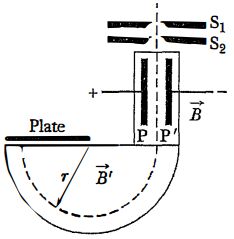
13. Two charged particles of the same charge q but different masses \( m_1 \) and \( m_2 \) are accelerated by a potential difference V. They then enter a uniform field B' following a circular path. Select the correct answers:
(A)The kinetic energy is qVB' for both particles(B)the speed of \( m_1 \) is \( (2qV/m_1)^{1/2} \)(C)the radius of the path in B' for \( m_2 \) is \( (m_2 V/qB'^i2)^{1/2} \)(D)\( r_1/r_2 = (m_2/m_1)^{1/2} \) (E)\( r_1/r_2 = (m_1/m_2)^{1/2} \)
14. A solid sphere of radius R has a volume charge density \( \rho = ar/R \), where r is radial distance from the sphere's center. (A)The Gaussian law cannot be applied in this case (B)the sphere's total charge is \( a\pi R^3 \)
(C)the magnitude of the electric field at r = 0 is zero
(D)the magnitude of the electric field at r = R/2 is 1/16 αR/ε0,(E)the magnitude of the electric field at r = R is αR/ε0
15. Which of the following are correct? (A)There can be no electric field inside a solid conducting sphere (B)the Gauss's Theorem of magnetism suggests that no magnetic monopole exists (C)electric current flowing in a wire will produce a magnetic field (D)a static magnetic field threaded through a loop will cause an emf (E)alternately changing electric and magnetic fields will generate an electromagnetic wave
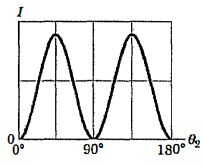
16. An unpolarized light is sent into three polarizing sheets (angles: \( \theta_1 \), \( \theta_2 \), \( \theta_3 \) from positive y-axis). Angles \( \theta_1 \) and \( \theta_3 \) are fixed, but angle \( \theta_2 \) is varied. The transmission intensity of the light as a function of \( \theta_2 \) is shown in the right figure.
(A)Both \( \theta_1 \) or \( \theta_3 \) are located at 90° (B)transmission rate of the unpolarized light after sheet 1 is 1/2 (C)two sheets 1 and 3 are perpendicular to each other (D)transmission intensity is 0 if one takes out the sheet 2 (E)transmission rate is 1/8 if \( \theta_2 = 30° \)
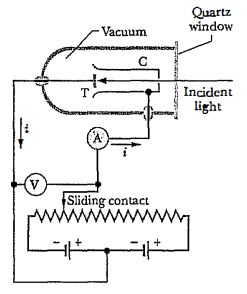
17. A setup of photoelectric effect is illustrated in the right figure.
(A)The kinetic energy \( K_{max} \) is proportional to the stopping potential (B)for a light of given frequency, \( K_{max} \) does not depend on the intensity of the light source (C)increasing the intensity of the light source should cause larger \( K_{max} \) (D)the slope of a "stopping potential vs. incident light frequency" plot depends on the metals (E)the work function of the target metal can be derived (T is the target, C is the cathode in the diagram)
(A) speed
(B) angular frequency
(C) wavelength of the electromagnetic wave emitted by the antenna assuming L = 0.6 μH and C = 15.0 pF
 阿摩線上測驗
登入
 (A)\( 2.78\times10^{-5} \) J (B)\( 1.12\times10^{-4} \) J (C)\( 2.22\times10^{-4} \) J (D)\( 2.50\times10^{-4} \) J (E)\( 4.72\times10^{-4} \) J
 (A)The kinetic energy is qVB' for both particles(B)the speed of \( m_1 \) is \( (2qV/m_1)^{1/2} \)(C)the radius of the path in B' for \( m_2 \) is \( (m_2 V/qB'^i2)^{1/2} \)(D)\( r_1/r_2 = (m_2/m_1)^{1/2} \) (E)\( r_1/r_2 = (m_1/m_2)^{1/2} \)
 (A)Both \( \theta_1 \) or \( \theta_3 \) are located at 90° (B)transmission rate of the unpolarized light after sheet 1 is 1/2 (C)two sheets 1 and 3 are perpendicular to each other (D)transmission intensity is 0 if one takes out the sheet 2 (E)transmission rate is 1/8 if \( \theta_2 = 30° \)
 (A)The kinetic energy \( K_{max} \) is proportional to the stopping potential (B)for a light of given frequency, \( K_{max} \) does not depend on the intensity of the light source (C)increasing the intensity of the light source should cause larger \( K_{max} \) (D)the slope of a "stopping potential vs. incident light frequency" plot depends on the metals (E)the work function of the target metal can be derived (T is the target, C is the cathode in the diagram)