所屬科目:研究所、轉學考(插大)◆普通物理學
1. Which of the following has the dimension of time? (R: resistance; L: inductance; C: capacitance) (A) LC (B) LR (C) RC (D) R/L (E) None of the above.
2. The electron spin was first discovered in the Stern-Gerlach experiment. To let electrons of distinct spin angular momenta deflect into different trajectories, one has to apply (A) a uniform DC electric field (B) a uniform DC magnetic field (C) a non-uniform DC electric field (D) a non-uniform DC magnetic field (E) a uniform AC magnetic field.
3. Consider the Lennard-Jones potential energy U(r) = 4ε[(σ/r)¹² − (σ/r)⁶], where σ and ε are constants and r is the distance between two particles. At which distance r is the attractive force largest? (A) r = σ (B) r = 21/6σ (C) r = 0 (D) r = (26/7)1/6σ (E) r = (26/7)1/6ε/σ.
4. If we superimpose two sound waves with frequencies 400Hz and 402Hz, respectively, what is the resulting beat frequency? (A) 2Hz (B) 4Hz (C) 401Hz (D) 160800Hz (E) 401/(2π)Hz.
5. A uniform string of linear mass density μ and length L hangs vertically under gravity. How long does it take a wave to propagate from the bottom to the top of the string? (A) L/√(μg) (B) L√(μ/g) (C) 2π√(L/g) (D) √(L/g) (E) 2√(L/g).
6. Consider a point particle of mass m lying at a distance d above some infinitely large sheet, whose mass per unit area is σ. What is the magnitude of gravitational attractive force between these two objects? (G is the gravitational constant.) (A) 4πGmσ (B) 2πGmσ (C) Gmσ/2 (D) Gmσ/d² (E) Gm²/(4d²).
7. Consider an electron inside a square quantum well of depth 10eV, and the width of the well is 1nm. What is the ground-state energy? (The zero potential is designated at the bottom of the well. Hint: You can get an estimate from the infinite-well problem.) (A) 0.003eV (B) 0.03eV (C) 0.3eV (D) 3eV (E) 0eV.
8. A simple way to produce X-rays is to bombard some heavy metal target with high-speed electrons. If the shortest wavelength of the resulting X-rays is approximately 1Å, what is the bias voltage applied on the accelerating electrons? (A) 12.4mV (B) 12.4V (C) 12.4kV (D) 12.4MV (E) 12.4GV.
9. Consider the quantum state l = 3, m_l = 3. What is the angle (in radians) between the angular momentum and the +z direction? (A) (B) (C) π/6 (D) π/2 (E) 0
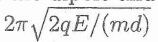
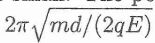
10. An electric dipole consists of two opposite charges, each with mass m and charge ±q (respectively), and the two charges are separated by a distance d. Under a uniform external electric field E, the electric dipole performs simple harmonic oscillation if the angle between the dipole and E is small. The period of this oscillation is (A) (B) (C) (D)(E) none of the above.
11. Continued from the last question, if initially the dipole is at rest and perpendicular to the external electric field, what is its angular speed (in terms of rotation instead of oscillation) when it becomes parallel to E? (A) 2md/(qE) (B) qE/(2md) (C) 2qE/(md) (D) md/(2qE) (E) none of the above.
12. The wavelength of the scattered photon λ' is equal to (A) λ − 2h/(mc) (B) λ + 2h/(mc) (C) λ/(1 + mcλ/h) (D) λ/(1 − mc²λ/h) (E) none of the above.
13. What is the momentum of the scattered particle? (A) h(1/λ − 1/λ') (B) h(1/λ + 1/λ') (C) −hc(1/λ + 1/λ') (D) hc(1/λ − 1/λ') (E) none of the above.
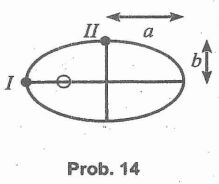
14. A planet is rotating about the sun in an elliptic orbit. If its speed at the perihelion (point I) is v, what is its speed at point II?
(A) (B) (C) [(a − b)/b]v (D) [(a + b)/b]v (E)
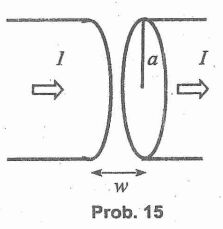
15. A fat wire of radius a carries a constant current I, which is uniformly distributed over its cross section. A narrow gap in the wire (of width w ≪ a) forms a parallel-plate capacitor. Inside this gap, the magnetic field at a distance s < a from the central axis is
(A) μ₀sI/(2πa²) (B) μ₀sI/a² (C) μ₀I/(2πs) (D) μ₀I/(2πa) (E) none of the above.
16.The process the air undergoes as it descends is approximately (A) isothermal (B) isobaric (C) adiabatic (D) constant-volume (E) free expansion.
17. During this process, (A) the internal energy of the air considered decreases (B) the internal energy of the air increases (C) the air volume expands (D) the air pressure drops down (E) none of the above happens.
18. The constant-volume specific heat CV (heat capacity per mole) for a diatomic ideal gas is shown in the following figure. Which of the following statements is correct?
(A) Electronic excitations can be largely triggered at 2000K (B) Vibrational motion ceases at 50K (C) Vibrational excitations can be largely triggered at 300K (D) Rotational motion can be rarely found at 50K (E) All of the above statements are correct.
19. Consider two Carnot engines connected in series. The efficiency for the first engine is ε₁ while the efficiency for the second engine is ε₂. What is the overall efficiency of the combined system?
(A) ε₁ + ε₂ (B) ε₁ε₂ (C) (ε₁ + ε₂)/2 (D) (E) ε₁ + ε₂ − ε₁ε₂
20. What is the bulk modulus (i.e., inverse compressibility) for a diatomic ideal gas measured from adiabatic compression/expansion? (γ = 1.4 for a diatomic ideal gas; P: pressure; ρ: density; T: temperature) (A) γT/P (B) γP/ρ (C) γP (D) P (E) none of the above.
 阿摩線上測驗
登入
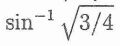 (B)
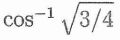 (C) π/6 (D) π/2 (E) 0
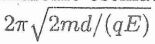 (B)
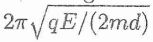 (C)
 (D)
 (E) none of the above.
 (A)
 (B)
 (C) [(a − b)/b]v (D) [(a + b)/b]v (E)

 (A) μ₀sI/(2πa²) (B) μ₀sI/a² (C) μ₀I/(2πs) (D) μ₀I/(2πa) (E) none of the above.
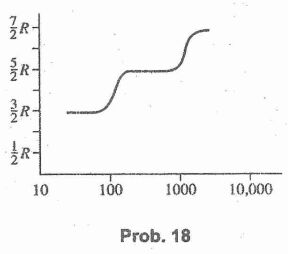 (A) Electronic excitations can be largely triggered at 2000K (B) Vibrational motion ceases at 50K (C) Vibrational excitations can be largely triggered at 300K (D) Rotational motion can be rarely found at 50K (E) All of the above statements are correct.
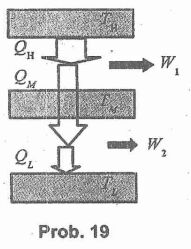 (A) ε₁ + ε₂ (B) ε₁ε₂ (C) (ε₁ + ε₂)/2 (D)
 (E) ε₁ + ε₂ − ε₁ε₂