阿摩線上測驗
登入
首頁
>
學士後西醫-生物學
> 104年 - 104 學士後西醫:普通生物學#27035
104年 - 104 學士後西醫:普通生物學#27035
科目:
學士後西醫-生物學 |
年份:
104年 |
選擇題數:
80 |
申論題數:
0
試卷資訊
所屬科目:
學士後西醫-生物學
選擇題 (80)
1. Tay-Sachs disease is a human genetic abnormality that results in cells accumulating and becoming clogged with very large, complex, undigested lipids. Which cellular organelle must be involved in this condition? (A) mitochondrion (B) lysosome (C) endoplasmic reticulum (D) Golgi apparatus (E) ribosome
2. Several of the different globin genes are expressed in humans, but at different times in development. What mechanism could allow this? (A) pseudogene activation (B) exon shuffling (C) differential translation of mRNAs (D) differential gene regulation over time (E) natural selection
3. Most causes of speciation are relatively slow, in that they may take many generations to see changes, with the exception of ______. (A) colonization (B) sexual selection (C) reinforcement (D) natural selection (E) polyploidy
4. Leaf thickness represents a trade-off between ______. (A) water retention and carbon dioxide absorption (B) light collection and carbon dioxide absorption (C) water retention and oxygen absorption (D) light collection and oxygen absorption (E) light collection and water retention
5. What is the only type of chemical signal that does not alter the physiology of the animal producing that signal? (A) paracrine (B) pheromones (C) neuroendocrine (D) neural (E) none of above
6. Which of the following causes populations to shift most quickly from an exponential to a logistic population growth? (A) competition for resources (B) favorable climatic conditions (C) decreased death rate (D) removal of predators (E) increased birth rate
7. Matter is gained or lost in ecosystems. How does this occur? (A) Heterotrophs convert heat to energy. (B) Photosynthetic organisms convert solar energy to sugars. (C) Chemoautotrophic organisms can convert matter to energy. (D) Matter can be moved from one ecosystem to another. (E) Detrivores convert matter to energy.
8. Which of the following provides the best evidence of a biodiversity crisis? (A) the incursion of a non-native species (B) climate change (C) increasing pollution levels (D) decrease in regional productivity (E) high rate of extinction
9. An earthquake decimates a ground-squirrel population, killing 98% of the squirrels. The surviving population happens to have broader stripes, on average, than the initial population. If broadness of stripes is genetically determined, what effect has the ground-squirrel population experienced during the earthquake? (A) disruptive selection (B) a genetic bottleneck (C) directional selection (D) a founder event (E) stabilizing selection
10. If a cell has completed meiosis I and is just beginning meiosis II, which of the following is an appropriate description of its contents? (A) It has double the amount of DNA as the cell that began meiosis. (B) It has one-fourth the DNA and one-half the chromosomes as the originating cell. (C) It has half the amount of DNA as the cell that began meiosis. (D) It is identical in content to another cell formed from the same meiosis I event. (E) It has half the chromosomes but twice the DNA of the originating cell.
11. Jams, jellies, preserves, honey, and other foods with high sugar content hardly ever become contaminated by bacteria, even when the food containers are left open at room temperature. This is because bacteria that encounter such an environment ______. (A) are unable to swim through these thick and viscous materials (B) undergo death as a result of water loss from the cell (C) are unable to metabolize the glucose or fructose, and thus starve to death (D) are obligate anaerobes (E) are unable to reproduce then die eventually
12. Sympatric species ______. (A) are more likely than allopatric species to display character displacement (B) always show character displacement (C) are less likely than allopatric species to display character displacement (D) are unlikely to be competing (E) are more likely than allopatric species to display character displacement and likely to be competing
13. The veins of leaves are ______. I) composed of xylem and phloem II) continuous with vascular bundles in the stem and roots III) finely branched to be in close contact with photosynthesizing cell (A) only I (B) only II (C) only III (D) I and II (E) I, II, and III
14. To be useful to plants soil nitrogen must usually occur as: (A) N2 and NH3 (B) NH3 and NO3 - (C) NO3 - and N2 (D) N2 and NO2 (E) NO2 and NO3 -
15. What major benefits do plants and mycorrhizal fungi receive from their symbiotic relationship? (A) Fungi receive photosynthetic products in exchange for living in plant root nodules. (B) Plants receive nitrogen and phosphorus, and fungi receive photosynthetic products. (C) Plants receive enzymes, and fungi receive nitrogen and phosphorus. (D) Plants receive increased root surface area, and fungi receive digestive enzymes. (E) All of the above are false.
16. Which of the following statements about vitamins is FALSE? (A) Thiamine is a coenzyme in removing CO2 and relates to Beriberi. (B) Folic acid is a component of coenzyme A and relates to birth defect. (C) Ascorbic acid is a coenzyme in collagen synthesis and relates to scurvy. (D) Retinol is a component of visual pigments and relates to blindness. (E) Tocopherol is an antioxidant and relates to nervous system degeneration.
17. Pollen from a plant with the S1S2 genotype is recognized and allowed to germinate on the stigma of the same plant with the S1S2 genotype. According to the S-system hypothesis, this indicates that the plant is ______. (A) self-incompatible and must cross-pollinate (B) self-incompatible and can self-pollinate (C) self-compatible and must cross-pollinate (D) self-compatible and can self-pollinate (E) self-compatible and can self-pollinate or cross-pollinate
18. DNA methylation and histone acetylation are examples of ______. (A) genetic mutation (B) epigenetic phenomena (C) translocation (D) chromosomal rearrangements (E) gene degradation
19. Which of the following is in the correct order for one cycle of polymerase chain reaction (PCR)? (A) Denature DNA; add fresh enzyme; anneal primers; add dNTPs; extend primers. (B) Anneal primers; denature DNA; extend primers. (C) Denature DNA; anneal primers; extend primers. (D) Extend primers; anneal primers; denature DNA. (E) Add dNTPs; add fresh enzyme; denature DNA.
20. Which of the following definition is WRONG for molecular clock? (A) Paralogous genes are used. (B) Constant mutation rate is supposed. (C) Fossil record can be used to correct dating. (D) Based on Neutral theory. (E) The rate of molecular change should be regular like a clock.
21. If organisms a, b, and c belong to the same class but to different orders and if organisms c, d, and e belong to the same order but to different families, which of the following pairs of organisms would be expected to show the greatest degree of structural homology? (A) a and d (B) b and c (C) b and d (D) d and e (E) a and e
22. Which of the following plants has a dominant sporophyte generation and a seed, but no fruit? (A) fern (B) pine tree (C) tulip (D) lycophyte (E) moss
23. Which of the following statements about renin-angiotensin-aldosterone system (RAAS) is FALSE? (A) Sensors in juxtaglomerular apparatus (JAG) detect decrease in pressure. (B) JAG releases renin with decreased pressure. (C) Renin cleaves angiotensinogen to produce angiotensin I. (D) Angiotensin II stimulates the kidney to release aldosterone. (E) Aldosterone increases blood volume by Na+ and water reabsorption.
24. A biologist doing a long-term study on a wild spider population observes increased variation in silk thickness. Which of the following could the spider population be experiencing? (A) directional selection (B) genetic drift (C) disruptive selection (D) stabilizing selection (E) founder effect
25. Two species of frogs belonging to the same genus occasionally mate, but the embryos stop developing after a day and then die. These two frog species separate by ______. (A) gametic isolation (B) reduced hybrid fertility (C) hybrid breakdown (D) mechanical isolation (E) reduced hybrid viability
26. Which of the following characteristics tends to limit bryophytes and seedless vascular plants to habitats that are relatively moist? (A) absence of cuticle (B) presence of flagellated sperm (C) presence of free-living, independent zygotes and early embryos (D) presence of lignified vascular tissues (E) presence of seeds and pollen
27. There are several stages about alternation of generations of ferns. Which order is TRUE? (1) gametophyte, (2) sporophyte, (3) spores, (4) archegonia, (5) gametes. (A) 32541 (B) 23145 (C) 32451 (D) 23541 (E) 32145
28. Compare with Monocots and Eudicots, which of the following statements is FALSE? (A) A seed of Monocots has one cotyledon; that of Eudicots has two. (B) Leaf vein of Monocots is usually parallel, but that of Eudicots is usually netlike. (C) Vascular tissue of stems in Monocots is scattered, but that of Eudicots is usually arranged in ring. (D) Pollen grain of Monocots has one opening; that of Eudicots has three openings. (E) Floral organs usually in multiple of four in Monocots, but three in Eudicots.
29. Which structure is found in angiosperms but NOT gymnosperms? (A) fruit (B) spores (C) seeds (D) ovule (E) a tube that grows from the pollen to deliver sperm
30. The heterokaryotic phase of a fungal life cycle is ______. (A) a stage in which the hyphae contain only one type of haploid nucleus (B) a stage in which hyphae contain two, genetically different, haploid nuclei (C) a stage in which hyphae contain two, genetically different, diploid nuclei (D) a stage that is diploid but functions as a gametophyte (like the body of an animal) (E) a triploid stage formed by the fusion of a diploid nucleus with the haploid nucleus of a compatible hypha
31. Exercise and emergency reactions include ______. (A) decreased activity in the sympathetic, and increased activity in the parasympathetic divisions (B) increased activity in all parts of the peripheral nervous system (C) increased activity in the sympathetic, and decreased activity in the parasympathetic divisions (D) increased activity in the enteric nervous system (E) reduced heart rate and blood pressure
32. Which of the following is an example of a commensalism? (A) fungi residing in plant roots, such as endomycorrhizae (B) rancher ants that protect aphids in exchange for sugar-rich honeydew (C) bacteria fixing nitrogen in plants (D) insects pollinate flowers (E) cattle egrets eating insects stirred up by grazing bison
33. Which of the following is a greenhouse gas? (A) water vapor (B) molecular oxygen (C) molecular nitrogen (D) argon (E) carbon monoxide
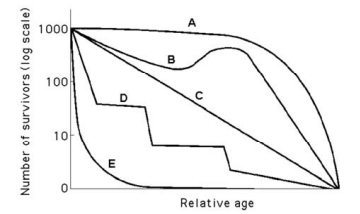
34. In the figure below, which of the following survivorship curves most applies to humans living in developed countries?
(A) curve A (B) curve B (C) curve C (D) curve D (E) curve E
35. _____ is formed in ______ during embryonic development. Which of the following statements is FALSE? (A) Dorsal lip, frog (B) Primitive streak, sea urchin (C) Primitive streak, chick (D) Epiblast, chick (E) Epiblast, human
36. Which of the following statements about fruit fly is FALSE? (A) Spermatheca can be used to store sperm in male fly. (B) Defective expression of Hox genes suppresses the embryonic development. (C) The courtship behaviors include orienting, tapping and singing. (D) Toll receptor leads to synthesis of antimicrobial peptides against fungi. (E) Drosophila melanogaster has a diploid number of 8.
37. Which insect is classified incorrectly? (A) mosquitoes - Diptera (B) butterflies - Lepidoptera (C) bees - Lepidoptera (D) flies - Diptera (E) grasshoppers - Orthoptera
38. Which of the following statements about the reproductive cycles of human female is FALSE? (A) Low level of estradiol inhibits the secretion of pituitary gonadotropins. (B) High level of estradiol stimulates the secretion of pituitary gonadotropins. (C) High level of estradiol and progesterone stimulates the secretion of pituitary gonadotropins. (D) High level of LH (luteinizing hormone) stimulates ovulation. (E) High level of estradiol and progesterone stimulates the maintenance of endometrium.
39. Which of the following statements about the extracellular matrix (ECM) is FALSE? (A) Collagens are assembled into triple helix in the ER lumen. (B) Glycosaminoglycans (GAGs) contain positively charged carbohydrates. (C) Chondroitin sulfate is a GAG to be part of proteoglycan. (D) Elastin is a protein capable of changing conformation. (E) Fibronectin can directly bind with integrin.
40. Which of the following statements about the RNA processing is FALSE? (A) Not all of the nucleotides in the mature mRNA can be translated into proteins. (B) Spliceosomes are composed of proteins and snRNAs. (C) Modified guanosine is required for the capping of pre-mRNA. (D) Methylation is required for the capping of pre-mRNA. (E) PolyA polymerase adds 50-200 more adenines at the stop codon.
41. Which of the following statements about cell junctions is FALSE? (A) Actin filaments anchor desmosomes in the cytoplasm. (B) Hemidesmosomes connect cells to extracellular matrix (ECM) via integrins. (C) Integrin is a transmembrane protein with two nonidentical subunits. (D) Cadherins are Ca2+-dependent molecules to create cell-to-cell junctions. (E) The connexons of gap junctions allow the passage of ions.
42. Which of the following statements about blood tissue is FALSE? (A) The mature red blood cells contain nucleus in frog but not in human. (B) Eosinophils with bilobed-nucleus can kill parasites. (C) Lymphocytes with multilobed-nucleus are the most abundant leukocytes. (D) Monocytes are phagocytes and develop into macrophages. (E) Basophiles secret anticlotting factor called heparin at the site of injury.
43. Which of the following statements about gene cloning is FALSE? (A) DNA with specific palindromic sequence can be cut by restriction enzymes. (B) EcoRI, a restriction enzyme from E. coli, cut DNA into sticky ends. (C) Gene of interest can be linked into plasmid with DNA polymerase. (D) The plasmids are transformed into competent cells. (E) Ions such as CaCl2 affect whether or not a bacterium will be competent cells.
44. Which of the following statements about neurotransmitter is FALSE? (A) Dopamine is derived from tyrosine and released by ventral tegmental area (VTA) neuron. (B) Epinephrine derived from tryptophan is important for fight-or-flight reactions. (C) Serotonin derived from tryptophan affect sleep and mood. (D) Endorphin is a neuropeptide to mediate pain perception. (E) Substance P is a neuropeptide to mediate pain perception.
45. Which of the following statements about drugs is FALSE? (A) Taxol inhibits cancer cells by preventing microtubule depolymerization. (B) Tamoxifen inhibits cancer cells by blocking the function of estrogen receptor. (C) RU486 induces abortion by blocking the function of estrogen receptor. (D) Erythromycin inhibits the growth of bacteria by blocking their ribosomes. (E) Chloramphenicol inhibits the growth of bacteria by blocking their ribosomes.
46. Which of the following sugars contain ketone group? (A) glyceraldehyde (B) ribose (C) glucose (D) fructose (E) galactose
47. Which of the following proteins have quaternary structure? I. Methionine II. Lysozyme III. Collagen IV. Hemoglobin (A) I and II (B) III and IV (C) I, II, and IV (D) II, III, and IV (E) II and III
48. Endomembrane system includes following organelles, except ______. (A) nuclear envelope (B) endoplasmic reticulum (ER) (C) Golgi apparatus (D) mitochondria (E) lysosome
49. Which of following is NOT a second messenger in signal transduction? (A) proton (B) cAMP (C) Ca2+ (D) inositol triphosphate (IP3) (E) diacylglycerol (DAG)
50. All of the enzymes catalyze reactions to produce NADH , FADH2 or ATP in citric acid cycle, except ______. (A) isocitrate dehydrogenase (B) α-ketoglutarate dehydrogenase (C) succinyl-CoA synthetase (D) succinate dehydrogenase (E) citrate synthetase
51. Which of the following molecule does NOT participate in oxidative phosphorylation? (A) proton (B) Ca2+ (C) ubiquinone (Q) (D) cytochrome c (cyt c) (E) ADP
52. Which of the following statements about cell cycle is FALSE? (A) Cyclin is degraded during G1. (B) Synthesis of cyclin begins in S phase. (C) Cyclin combines with Cdk to produce maturation-promoting factor (MPF). (D) MPF promotes mitosis by phosphorylating various proteins. (E) MPF’s activity peaks during prophase of M phase.
53. Which of the following statements about inherited disorders is FALSE? (A) Cystic fibrosis, a recessive disease, is caused by the defect of Cl- transporter. (B) Tay-Sachs disease, a dominate disease, is caused by the defect in mitochondria. (C) Phenylketonuria, a recessive disease, is caused by inability to metabolized phenylalanine. (D) Huntingon’s disease, a dominate disease, is a neuron degenerative disease. (E) Sickle-cell disease caused by T to A substitution results in defect of hemoglobin.
複選題
54. Which of the following statements about bacterial replication fork is FALSE? (A) Helicase breaks and unwinds parental DNA. (B) Primase synthesizes DNA primers. (C) DNA polymerase III synthesizes leading strand. (D) DNA polymerase I removes the primers. (E) DNA ligase joins the Okazaki fragments.
55. Which of the following statements about the molecules of appetite regulation is FALSE? (A) Hormone ghrelin is secreted by stomach to trigger feelings of hunger. (B) Hormone insulin is secreted by pancreas to suppress appetite by brain. (C) Hormone leptin is secreted by adipose to suppress appetite. (D) Hormone PYY is secreted by small intestine to suppress appetite. (E) Hormone syndecan is secreted by hypothalamus to trigger appetite.
56. What is the order of the control of heart rhythm? 1. Signals are delayed at AV node. 2. Bundle branches pass signals to heart apex. 3. Signals from SA node spread. 4. Signals spread throughout ventricles. (A) 3 → 4 → 2 → 1 (B) 4 → 1 → 3 → 2 (C) 3 → 1 → 2 → 4 (D) 2 → 1 → 4 → 3 (E) 2 → 3 → 4 → 1
57. What is the order of the nephron? 1. Thick segment of ascending limb. 2. Distal tubule. 3. Descending limb. 4. Glomerulus. 5. Thin segment of ascending limb. 6. Collecting duct. 7. Proximal tubule. (A) 4 → 2 → 3 → 5 → 1 → 7 → 6 (B) 4 → 7 → 3 → 5 → 1 → 2 → 6 (C) 4 → 2 → 3 → 1 → 5 → 7 → 6 (D) 4 → 7 → 5 → 1 → 3 → 2 → 6 (E) 4 → 2 → 7 → 1 → 5 → 3 → 6
58. Which of the following statements about the regulation of skeletal muscle contraction is FALSE? (A) Acetylcholine releases and triggers an action potential in muscle fiber. (B) Action potential is propagated along plasma membrane and down T tubules. (C) Action potential triggers Ca2+ release from sarcoplasmic reticulum (SR). (D) Ca2+ bind to tropomyosin and release myosin-binding sites to initiate muscle contraction. (E) Amyotrophic lateral sclerosis (ALS) is a disease of muscle fibers atrophy caused by motor neuron degeneration.
59. Which of the following statements about skeleton is FALSE? (A) Nematodes use hydrostatic skeleton to move. (B) The exoskeletons of insect contain chitin. (C) The osteoblasts are bone-building cells. (D) The osteoclasts are bone-resorbing cells. (E) The joint between the head of ulna and the humerus is a pivot joint.
60. Which of the following statements about plant hormones is FALSE? (A) Auxin (IAA) is produced by shoot apical meristems to stimulate stem elongation. (B) Cytokinins are synthesized in roots to regulate cell division. (C) Gibberellins (GA) are produced by meristems of apical buds to stimulate pollen development. (D) Ethylene can be produced by most parts of the plant to promote ripening of fruits. (E) Jasmonates are derived from cartenoid regulate floral development. Ⅱ.
複選題
61. Which of the following statements about eukaryotic transcription is FALSE? (A) Transcription factors bind on the TATA box of promoters. (B) RNA polymerase II unwinds the double strand DNA and synthesis mRNAs. (C) MyoD is a transcription factor committing cells into skeletal muscle. (D) The direct binding of enhancer with the promoter increases the rate of gene expression. (E) The start point is the nucleotide where RNA synthesis actually begins. .
62. Which of the following statements about protist is FALSE? (A) Entamoeba histolytica moves by pseudopodia and causes intestinal illness. (B) Trypanosoma moves by flagella and causes sleeping sickness. (C) Plasmodium moves by cilia and causes malaria. (D) Paramecium moves by cilia and the genetic variation results from conjugation. (E) Trichomonas moves by flagella and causes sexually transmitted disease.
63. Which of the following statements is FALSE? (A) The hilum was observed in the starch grains of potato under microscope. (B) The liver cells of pig may contain more than one nucleus. (C) The shape of pigment cells in the fish scale is irregular. (D) The fat cells stained by Sudan dye turned into blue color. (E) The composition of crystals in the plants can be CaCO3 or Calcium oxalate.
64. Which of the following statements about RNA interference (RNAi) is FALSE? (A) MicroRNAs (miRNAs) or short-interfering RNAs (siRNAs) interfere with the proper expression of mRNAs. (B) Single-stranded pre-siRNA is cut by dicer and release typically 22bp RNA. (C) Single-stranded siRNA associates with RISC protein and bind to target mRNA. (D) High complementarity of siRNA and target mRNA result in mRNA degradation or translation inhibition. (E) Low complementarity of siRNA and target mRNA result in mRNA degradation or translation inhibition.
65. Which of the following coding region of a mRNA can encode a peptide and end at stop codon? (A) 5’ ACGAUAAACUGAUCUAUUAG 3’ (B) 5’ CACAUAUGAAAGACACCCUAA 3’ (C) 5’ AAUAGCCAGUAGGCCGCUAG 3’ (D) 5’ ACUUAGCGAACUCCACAAUG 3’ (E) 5’ GGGACAUGCCCAGAUGACAC 3’
66. A farmer uses triazine herbicide to control pigweed in his field. For the first few years, the triazine works well and almost all the pigweed dies; but after several years, the farmer sees more and more pigweed. Which of these explanations best explains what happened? (A) The herbicide company lost its triazine formula and started selling poor-quality triazine. (B) Triazine-resistant pigweed has less-efficient photosynthesis metabolism. (C) Natural selection caused the pigweed to mutate, creating a new triazine-resistant species. (D) Triazine-resistant weeds were more likely to survive and reproduce. (E) Disruptive selection caused the pigweed to produce a new triazine-resistant species.
67. You enjoy learning about history by traveling throughout North America studying gravestones. You notice that gravestones from 1900 and earlier usually host many types of lichens. But in one cemetery, lichens are entirely absent, even from old gravestones. Given what is known about lichens, the cemetery without lichens probably ______. (A) has an unusually dry climate (B) is subject to extremely cold winter temperatures (C) gets a great deal of rain, which favors the growth of competing bacteria (D) has a high population of fungi that parasitize lichens (E) is close to a source of air pollution
68. The most immediate potential benefits of introducing genetically modified crops include ______. I. creating crops that can grow on land previously unsuitable for agriculture II. creating crops with better potential for biofuel production III. creating crops with better nutritional attributes IV. increasing crop yield V. decreasing the mutation rate of certain genes (A) III, IV, and V (B) II, III, and IV (C) I, II, and III (D) I, II, III, and IV (E) I, II, III, IV, and V
69. Radish flowers may be red, purple, or white. A cross between a red-flowered plant and a white-flowered plant yields all-purple offspring. The part of the radish we eat may be oval or long, with long being the dominant trait. If true-breeding red long radishes are crossed with true-breeding white oval radishes, the F1 will be expected to be which of the following? (A) purple and long (B) purple and oval (C) red and long (D) white and long (E) red and oval
70. What is the most logical sequence of steps for splicing foreign DNA into a plasmid and inserting the plasmid into a bacterium? I. Transform bacteria with a recombinant DNA molecule. II. Cut the plasmid DNA using restriction enzymes (endonucleases). III. Extract plasmid DNA from bacterial cells. IV. Hydrogen-bond the plasmid DNA to nonplasmid DNA fragments. V. Use ligase to seal plasmid DNA to nonplasmid DNA. (A) III, II, IV, V, I (B) IV, V, I, II, III (C) II, III, V, IV, I (D) III, IV, V, I, II (E) III, I, IV, V, II
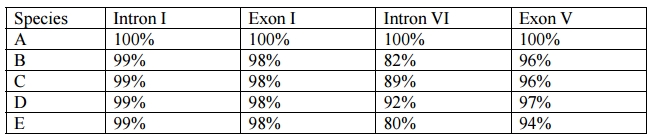
71. The following table compares the % sequence homology of four different parts (two introns and two exons) of a gene that is found in five different eukaryotic species. The data reported for species A were obtained by comparing DNA from one member of species A to another member of species A.
Which of these four gene parts should allow the construction of the most accurate phylogenetic tree, assuming that this is the only part of the gene that has acted as a reliable molecular clock? (A) Exon I (B) Exon V (C) Intron I (D) Intron VI (E) Both Exon I and V
72. The tails of UCSD campus male dark-eyed juncos were, on average, 36% white, whereas the tails of male juncos from the original colonizing population averaged 40-45% white. If this observed trait difference were due to a difference in the original colonizing population, it would most likely be due to ______. (A) a genetic bottleneck (B) a founder effect (C) gene flow between populations (D) mutations in the UCSD population (E) stabilizing selection
73. The phenomenon of fusion is likely to occur when, after a period of geographic isolation, two populations meet again and ______. (A) an increasing number of viable, fertile hybrids is produced over the course of the next one hundred generations (B) an increasing number of infertile hybrids is produced over the course of the next one hundred generations (C) no reproduction occurs in the hybrid zone (D) a decreasing number of viable, fertile hybrids is produced over the course of the next one hundred generations (E) fewer and fewer hybridization occurs
74. If two species are close competitors, and one species is experimentally removed from the community, the remaining species would be expected to ______. (A) become the target of specialized parasites (B) expand its realized niche (C) change its fundamental niche (D) decline in abundance (E) unchange
75. Which of the following statements about bacterial gene regulation is FALSE? (A) Tryptophan binds to activate repressor of trp operon. (B) Allolactose is an inducer of lac operon. (C) The product of lac I is the repressor of lac operon. (D) Inactive repressor turns the repressible operon off. (E) Catabolite activator protein (CAP) is activated by cAMP in lac operon.
76. Some molecular data place the giant panda in the bear family (Ursidae) but place the lesser panda in the raccoon family (Procyonidae). The morphological similarities of these two species must therefore be due to ______. (A) inheritance of acquired characteristics (B) sexual selection (C) inheritance of shared derived characters (D) convergent evolution (E) punctuated equilibrium
複選題
77. Which of the following statements about the scientists and their contributions to the discovery of DNA as a genetic material as well as DNA's structure and function is NOT CORRECT? (A) Frederick Griffith's study on two strains of Streptococus pneumonia led to the discovery that DNA is a genetic material. (B) Alfred Hershey and Martha Chase's studies of the virus that infects bacteria provided experimental evidence that DNA, but not protein, is the genetic material of virus. (C) Erwin Chargaff reported that the base composition of DNA varies between species, providing additional evidence that DNA is a genetic material. (D) Rosalind Franklin produced the first X-ray diffraction image of DNA. (E) James Watson and Francis Crick built the first double-helix model of DNA.(本題送分)
78. Which description about “innate immunity” is NOT CORRECT? (A) Innate immunity is found in all animals. (B) The great success of insects in habitats teeming with diverse microbes highlights the effectiveness of invertebrate innate immunity. (C) Innate immune responses are distinct for different classes of pathogens. (D) Recognition and response in innate immunity of mammalian occur with tremendous specificity. (E) Each mammalian Toll-like receptor binds to fragments of molecules characteristic of a set of pathogens.
79. Which peptide can form disulfide bond and has high absorbance at 280 nm? (A) APYNIK (B) KCMHYS (C) QWLTFS (D) RVAGEF (E) CTHGPH
80. Which of the following statements about virus is FALSE? (A) Papillomavirus is double-stranded DNA (dsDNA) virus that causes warts. (B) Poxvirus is dsDNA virus that causes smallpox. (C) Coronavirus is single-stranded RNA (ssRNA) virus that causes SARS. (D) Filovirus is ssRNA virus that causes Ebola. (E) Paramyxovirus is ssRNA virus that causes hepatitis C.
申論題 (0)
相關試卷
108年 - 108 學士後西醫:生物學#79182
108年 · #79182
105年 - 105 高雄醫學大學_學士後西醫:普通生物學#78613
105年 · #78613
103年 - 103 學士後西醫:普通生物學#27047
103年 · #27047
102年 - 102 學士後西醫:普通生物學#27058
102年 · #27058
101年 - 101 高雄醫學大學_學士後西醫學系招生考試試題:普通生物學#27447
101年 · #27447
100年 - 100 學士後西醫:生物學#27448
100年 · #27448
99年 - 學士後西醫生物學99生物#39211
99年 · #39211
98年 - 學士後西醫普通生物學98普通生物學#39361
98年 · #39361
97年 - 97 高雄醫學大學_學士後西醫:普通生物學#78694
97年 · #78694
96年 - 96學士後西醫生物#39066
96年 · #39066
 阿摩線上測驗
登入
阿摩線上測驗
登入
 (A) curve A (B) curve B (C) curve C
(D) curve D (E) curve E
(A) curve A (B) curve B (C) curve C
(D) curve D (E) curve E
 Which of these four gene parts should allow the construction of the most accurate phylogenetic tree, assuming that this is
the only part of the gene that has acted as a reliable molecular clock?
(A) Exon I (B) Exon V (C) Intron I
(D) Intron VI (E) Both Exon I and V
Which of these four gene parts should allow the construction of the most accurate phylogenetic tree, assuming that this is
the only part of the gene that has acted as a reliable molecular clock?
(A) Exon I (B) Exon V (C) Intron I
(D) Intron VI (E) Both Exon I and V