所屬科目:研究所、轉學考(插大)◆普通物理學
1. The fine structure constant is defined as α ≡ . The unit of α is the same as: (A) Length (B) Energy (C) Length²/Time (D) 1/Time (E) No unit
2. A student dropped a ball from the roof of a building. After 11.5 seconds, she heard it hitting the ground. Assuming that the speed of sound is 340 m/s, which of the following is closest to the height of the building? (A) 30 m (B) 100 m (C) 200 m (D) 500 m (E) 800 m
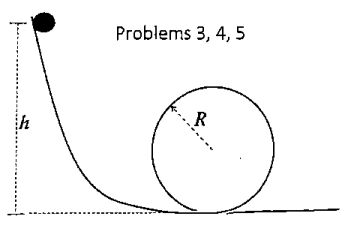
3. A solid sphere of mass m and radius r moves along a track with a circular loop of radius R1 as shown in following picture. It is released at height h. Assuming that the track has no friction, the ball thereforeslides down without rotation. Do not ignore the finite size of the sphere, what is the minimal value of h such that the sphere remains on the track at all times?
(A) 2.5R − 1.5r (B) 2R − r (C) 2.5R (D) 2R + r (E) 2R − 1.5r
4. Same arrangement as in problem 3. If the sphere is released at a height h = 3R, what is the force exerted by the track at the top of the loop? (A) 2mg (B) mg (C) 0.5mg (D) mg(R + 3r)/(R − r) (E) mg(R + r)/(R − 4)
5. Same as problem 3, except now the track surface is rough and the sphere rolls without sliding. What is the minimal value of h such that the sphere remains on the track? (A) 2.5R + 0.7r (B) 2.7R + 1.7r (C) 2.7R − 1.7r (D) 2.5R − 1.5r (E) 2.5R + 1.5r
6. In a photoelectric effect experiment, a light ray of intensity I and frequency ν shines on a metal surface. The resulting photo current is j, and the highest energy of the photo electrons is E. Which of the following relations describes the photoelectric effect. (A) j ∝ I (B) j = hν + W (C) E = hI + W (D) E = hν + W (E) E ∝ I. Here h and W are constants.
7. A Carnot engine operated between temperatures TH and TL. What is the entropy gain per cycle? (A) 0 (B) kB N TH (C) (D) (E) kB N(TH − TL). Here kB is the Boltzmann constant, and N is the number of gas molecules.
8. If two objects are in thermal equilibrium, which of the following statements is correct? (A) Their temperatures are the same (B) Their entropy are the same (C) Their specific entropy are the same (D) Their internal energies are the same (E) Their internal energy densities are the same.
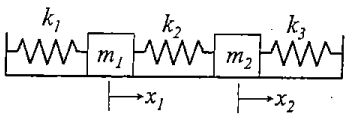
9. Consider a spring-mass complex as shown in the following figure. Assume that there is no friction, what is the force required to hold m₁ at a fixed position of x₁ = δ?
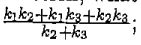
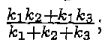
(A) δ × (k₁ + k₂ + k₃) (B) δ × (C) δ × (D) δ × (k₁ + k₂) (E) none of above.
10. Same setup as in problem 9. Let k₁ = k₃ = k and m₁ = m₂ = m. The system oscillates with two eigenmodes. What are the corresponding eigenfrequencies? (A) (B) (C) (D) (E)
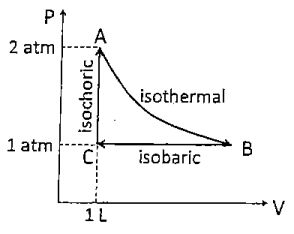
11. An ideal gas engine go through a three step cycle as show in the following P-V diagram. What is the heat absorbed by the engine in every cycle? (1atm = 10⁵ N/m²)
(A) 0.386 J (B) 38.6 J (C) 4J (D) 0.2J (E) 10J.
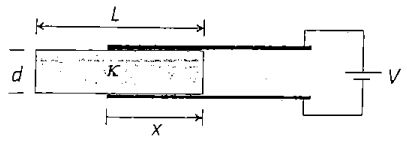
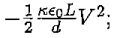
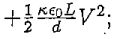
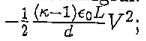
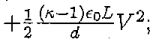
12. A square dielectric slab of side L and width d (d ≪ L), with dielectric constant κ1, is inserted a distance x (x < L) between two plates (separated by d) of a capacitor. A voltage V is applied on the capacitor. What is the electric force on the slab? Note that the sign is meaningful. +(−) indicates that the force is in +x(−x) direction.
(A) (B)(C) (D) (E)
13. Which of the following statements about the 2nd law of Thermodynamics is not correct? (A) In a closed system, the entropy either stays the same or increases with time (B) There is no perpetual motion machine (C) The efficiency of any engine operates between two heat reservoir is less or equal to that of a Carnot engine (D) Heat can never pass from a colder to a warmer body without some other change occurring at the same time (E) None of the above.
14. In our everyday life experiences, light rays propagate along a straight line, while sound can turn around a corner. What is the reason of this difference? (A) Sound wave propagate in air, and light can propagate in vacuum (B) Sound wave can penetrate the material of the wall (C) Light ray is made of particles, which move in straight lines (D) Wavelength of light is much smaller than the length scale of normal objects (E) none of above.
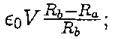
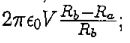
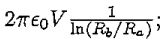
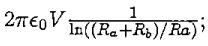
15. A drift tube is made of a conductive cylinder, with inner radius R_b, and a thin conductive wire of radius R_a at the center of the cylinder. Apply a voltage V between the wire and the cylinder, what is the resulting charge density (charge per unit length) on the wire? (A) (B) (C) (D) (E)
16. An infinite conductive sheet lying in the yz plane carries a uniform surface current of density J in the +y direction. Assuming that there is no external field, and the environment is symmetric between +x and −x sides. What is the magnetic field near the sheet on +x side?(Here êx, êy, and êz are the unit vectors in x, y, and z, respectively). (A) (B) (C) (D) (E)
17. Two conductive balls of the same size are put near each other, but not touching. One of the balls is charged with a total charge Q. The other ball has zero total charge. Which of the following is correct? (A) The balls attract each other (B) The balls repulse each other (C) There is no force between them (D) The balls attract each other at long distance, but repulse each other at short distance (E) The balls attract each other if Q > 0, but repulse each other otherwise.
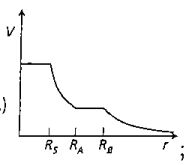
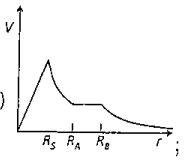
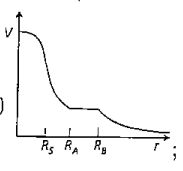
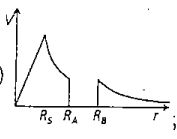
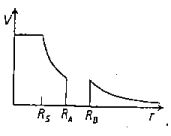
18. A uniformly charged solid insulator sphere is put at the center of a conductive shell. The radius of the sphere is R_S, and the inner and outer radius of the conductive shell are R_A and R_B, respectively. Which of the following diagrams correctly describes the voltage as a function of radial distance from the center? (A) (B) (C) (D) (E)
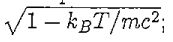
19. The wavelength of the Hα line of the hydrogen spectrum is λ = 656.281 nm. An observer measures the Hα line from an interstellar cloud of hydrogen atoms with temperature T ~ 8000K. Roughly what is the width of the spectrum line due to Doppler broadening? (A) λ(mc²/kBT) (B) λ(kBT/mc²) (C) kBT/mc² (D) (E)
20. Two particles with the same mass m are moving towards each other with a relative velocity of 0.8c. What is the total energy of one of the particles as seen by an observer on the other particle? (A) (B) (C) 1.8mc² (D) 1.09mc² (E) mc².
 阿摩線上測驗
登入
 . The unit of α is the same as: (A) Length (B) Energy (C) Length²/Time (D) 1/Time (E) No unit
 (A) 2.5R − 1.5r (B) 2R − r (C) 2.5R (D) 2R + r (E) 2R − 1.5r
 (D)
 (E) kB N(TH − TL). Here kB is the Boltzmann constant, and N is the number of gas molecules.
 (A) δ × (k₁ + k₂ + k₃) (B) δ ×
 (C) δ ×
 (D) δ × (k₁ + k₂) (E) none of above.
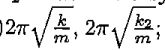 (B)
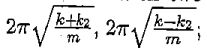 (C)
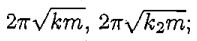 (D)
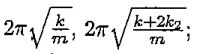 (E)

 (A) 0.386 J (B) 38.6 J (C) 4J (D) 0.2J (E) 10J.
 (A)
 (B)
 (C)
 (D)
 (E)

 (B)
 (C)
 (D)
 (E)

 (B)
 (C)
 (D)
 (E)

 (B)
 (C)
 (D)
 (E)
 (E)
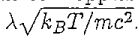
 (B)
 (C) 1.8mc² (D) 1.09mc² (E) mc².