所屬科目:研究所、轉學考(插大)◆普通物理學
1. A particle moving along the x-axis has a position function given by x(t) = (4.00 m/s³) t³ − (5.00 m/s) t + (6.00 m). What is the average acceleration of the particle between t = 1.00 s and t = 2.00 s. (A) 24 m/s² (B) 12 m/s² (C) 36 m/s² (D) 18 m/s² (E) 30 m/s²
2. A dog's hair has been cut and is now getting longer by 1.04 mm each day. With winter coming on, this rate of hair growth is steadily increasing, by 0.132 mm/day every week. By how much will the dog's hair grow during 5 weeks? (A) 12.0 mm (B) 24.0 mm (C) 36.0 mm (D) 48.0 mm (E) 60.0 mm
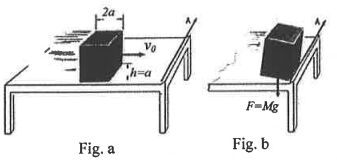
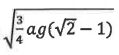
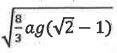
3. A cube of side 2a and mass M is sliding on a frictionless surface with uniform velocity v₀, as shown in the right Fig. a. It hits a small obstacle at the end of the table, which causes the cube to tilt as in Fig. b. Find the minimum value of v₀ such that the cube will fall off the table (g is the gravitational acceleration constant on earth).
(A)(B)(C) (D)(E)
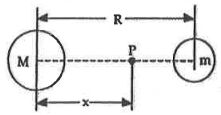
4. Two planets have masses M and m, and the ratio M/m = 25. The distance between the planets is R. The point P is between the planets as shown in the right, and the distance between M and P is x. At P, the gravitational force on an object due to M and m are equal in magnitude. The value of x is
(A) 5R/6 (B) 25R/36 (C) R/25 (D) 6R/5 (E) none of these.
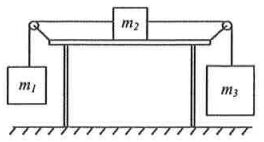
5. A mass m₂ = 1.5 kg rests on a horizontal table. The static and kinetic coefficients of friction between m₂ and the table are μₛ = 0.3 and μₖ = 0.25, respectively. The mass m₂ is attached by strings to masses m₁ = 2.5 kg and m₃ = 4.5 kg as shown in the right. Masses m₁ and m₃ hang freely. The system is initially held at rest. After it is released, the acceleration of m₂ is approximately
(A) 1.9 m/s² (B) 2.4 m/s² (C) 3.0 m/s² (D) zero (E) 13 m/s²
6. If the coefficient of static friction between your coffee cup and the horizontal dashboard of your car is μₛ = 0.800, how fast can you drive on a horizontal roadway around a right turn of radius 30.0 m before the cup starts to slide? (A) 25.2 m/s (B) 20.8 m/s (C) 10 m/s (D) 15.3 m/s (E) 12.6 m/s
7. A 2.00-kg object is attached to a spring and placed on a horizontal, smooth surface. A horizontal force of 20.0 N is required to hold the object at rest when it is pulled 0.200 m from its equilibrium position (the origin of the x axis). The object is now released from rest with an initial position of xᵢ = 0.200 m, and it subsequently undergoes simple harmonic oscillations. The total energy of the oscillating system is (A) 0.50 J. (B) 1.25 J. (C) 1.50 J. (D) 1.75 J. (E) 2.00 J.
8. The "Principle of Equipartition of Energy" states that the energy of a gas is shared equally: (A) among the molecules (B) between kinetic and potential energy (C) between translational and vibrational kinetic energy (D) among the relevant degrees of freedom (E) between heat and work.
9. A source at rest emits light of wavelength 500 nm. When it is moving at 0.90 C (C is light speed) away from an observer, the observer detects light of wavelength: (A) 26 nm (B) 115 nm (C) 500 nm (D) 2200 nm (E) 9500 nm
10. The specific heat of a substance is: (A) the amount of heat energy to change the state of one gram of the substance. (B) the amount of heat energy per unit mass emitted by oxidizing the substance. (C) the amount of heat energy per unit mass to raise the substance from its freezing to its boiling point. (D) the amount of heat energy per unit mass to raise the temperature of the substance by 1°C. (E) the temperature of the object divided by its mass.
11. A Carnot refrigerator extracts 35 kJ as heat during each cycle, operating with a coefficient of performance of 4.60. What is the energy per cycle transferred as heat to the room? (A) 15.0 kJ (B) 21.0 kJ (C) 25.9 kJ (D) 30.4 kJ (E) 42.6 kJ
12. Consider the following procedural steps: 1. ground an electroscope. 2. remove the ground from the electroscope. 3. touch a charged rod to the electroscope. 4. bring a charged rod near, but not touching, the electroscope. 5. remove the charged rod. To charge an electroscope by induction, use the sequence: (A) 1, 4, 5, 2 (B) 4, 1, 2, 5 (C) 3, 1, 2, 5 (D) 4, 1, 5, 2 (E) 3, 5
13. Three particles, each with positive charge Q, form an equilateral triangle, with each side of length d. Then the magnitude of the electric field produced by the particles at the midpoint of any side is (A) Q/(4πε₀d²) (B) Q/(3πε₀d²) (C) 2Q/(3πε₀d²) (D) Q/(πε₀d²) (E) 4Q/(3πε₀d²)
14. Two charged point particles are located at two vertices of an equilateral triangle and the electric field is zero at the third vertex. We conclude: (A) the two particles have charges with opposite signs and the same magnitude. (B) the two particles have charges with opposite signs and different magnitudes. (C) the two particles have identical charges. (D) the two particles have charges with the same sign but different magnitudes. (E) at least one other charged particle is present.
15. Two conducting spheres are far apart. The smaller sphere carries a total charge Q. The larger sphere has a radius that is twice that of the smaller and is neutral. After the two spheres are connected by a conducting wire, the charges on the smaller and larger spheres, respectively, are: (A) Q/2 and Q/2 (B) Q/3 and Q/3 (C) zero and Q (D) Q/3 and 2Q/3 (E) 2Q/3 and −Q
16. An electron has velocity v = (32 i + 40 j) km/s as it enters a uniform magnetic field B = (60 i) μT. (A) The radius of the helical path taken by the electron is 0.38 m. (B) The pitch of that path is 1.9 m. (C) The period of the revolution is 60 μs. (D) To an observer looking into the magnetic field region from the entrance point of the electron, the electron spirals counterclockwise as it moves. (E) The magnetic force points in the +k direction.
17. Relative to reference frame 1, reference frame 2 moves with speed v in the negative x direction. When the origins of the two frames coincide the clocks in both frames are set to zero. An event occurs at coordinate x₁ and time t₁ as measured in reference frame 1 and at coordinate x₂ and time t₂ as measured in frame 2. If γ = 1/√(1 − v²/c²), then the coordinates and times of the event are related by: (A) x₂ = γ[x₁ − vt₁] and t₂ = γ[t₁ − vx₁/c²] (B) x₂ = γ[x₁ − vt₁] and t₂ = γ[t₁ + vx₁/c²] (C) x₂ = γ[x₁ + vt₁] and t₂ = γ[t₁ − vx₁/c²] (D) x₂ = γ[x₁ + vt₁] and t₂ = γ[t₁ + vx₁/c²] (E) none of the above are correct
18. A thin film with an index of refraction of 1.60 is placed in one of the beams of a Michelson interferometer. If this causes a shift of 8 bright fringes in the pattern produced by light of wavelength 580 nm, what is the thickness of the film? (A) 1.5 μm (B) 2.9 μm (C) 3.9 μm (D) 7.7 μm (E) 16 μm
19. A free electron and a free proton have the same momentum. This means that, compared to the matter wave associated with the proton, the matter wave associated with the electron has: (A) a shorter wavelength and a greater frequency (B) a longer wavelength and a greater frequency (C) the same wavelength and the same frequency (D) the same wavelength and a greater frequency (E) the same wavelength and a smaller frequency
20. The figure shows the energy levels for an electron in a finite potential energy well. If an electron in the n = 2 state absorbs a photon of wavelength 2.0 nm, what happens to the electron?
(A) It makes a transition to the n = 3 state. (B) It makes a transition to the n = 4 state. (C) Nothing; this photon does not have an energy corresponding to an allowed transition so it is not absorbed. (D) It escapes the well with a kinetic energy of 730 eV. (E) It escapes the well with a kinetic energy of 280 eV.
1. As shown in the following, three blocks are connected and pulled to the right on a horizontal frictionless table by a force of T₃ = 72 N. Here m₁ = 12 kg, m₂ = 24 kg, and m₃ = 36 kg. In the following, which statements are correct?
(A) The acceleration of m₁ is 1 m/s². (B) The acceleration of m₂ is 2 m/s². (C) The acceleration of m₃ is 2 m/s². (D) The tension T₁ in the interconnecting cords is 12 N. (E) The tension T₂ in the interconnecting cords is 24 N.
2. In the right figure V₂₃ = 3V₁, and n moles of a diatomic ideal gas are taken through the cycle with the molecules rotating but not oscillating. Which of the following is/are correct?
(A) The molar heat capacity CV = (5/2)R (B) The ratio of the pressures P₁/P₃ = 3 (C) The ratio of the temperatures T₁/T₃ = 30.4 (D) Change in the internal energy for the complete cycle is ΔEint = 0 (E) In process 1 → 2, the work done is W₁₂ = RT₁ ln3
3. A proton moving with mass m and speed v in a field-free region abruptly enters an essentially uniform magnetic field B as shown in the right figure (B ⊥ v). If the proton enters the magnetic field region at a 45° angle as shown,
(A) the leaving angle θ of proton is 135°. (B) the leaving angle θ of proton is 45°. (C) the distance x exiting from the field is √2mv/eB. (D) the distance x exiting from the field is 2mv/eB. (E) the distance x exiting from the field is mv/2eB.
4. The conducting rod shown in the following figure has length L and is being pulled along horizontal frictionless conducting rails at a constant velocity v. The rails are connected at one end with a metal strip. A uniform magnetic field B, directed out of the page, fills the region in which the rod moves. Assume that L = 10 cm, v = 5.0 m/s, and B = 1.2 T. Assume that the resistance of the rod is 0.40 Ω. Which of the following statements are correct?
(A) The magnitude of the emf induced in the rod is 1.20 Volt. (B) The direction of the current in the conducting loop is counter clockwise. (C) The current in the conducting loop is 1.5 A. (D) To keep the rod moving at constant velocity, therefore, a rightward force must be continuously supplied to the rod. (E) To keep the rod moving at constant velocity, therefore, a 0.18 N external force must be continuously supplied to the rod.
 阿摩線上測驗
登入
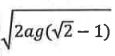
 (A)
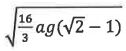
 (B)
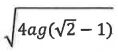
 (C)
 (D)
 (E)
 (A) 5R/6 (B) 25R/36 (C) R/25 (D) 6R/5 (E) none of these.
 (A) 1.9 m/s² (B) 2.4 m/s² (C) 3.0 m/s² (D) zero (E) 13 m/s²
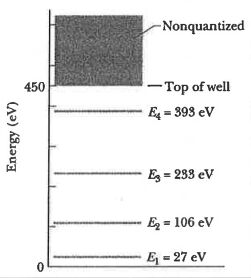 (A) It makes a transition to the n = 3 state. (B) It makes a transition to the n = 4 state. (C) Nothing; this photon does not have an energy corresponding to an allowed transition so it is not absorbed. (D) It escapes the well with a kinetic energy of 730 eV. (E) It escapes the well with a kinetic energy of 280 eV.
 (A) The acceleration of m₁ is 1 m/s². (B) The acceleration of m₂ is 2 m/s². (C) The acceleration of m₃ is 2 m/s². (D) The tension T₁ in the interconnecting cords is 12 N. (E) The tension T₂ in the interconnecting cords is 24 N.
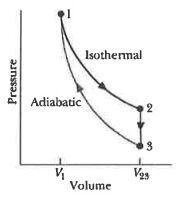 (A) The molar heat capacity CV = (5/2)R (B) The ratio of the pressures P₁/P₃ = 3 (C) The ratio of the temperatures T₁/T₃ = 30.4 (D) Change in the internal energy for the complete cycle is ΔEint = 0 (E) In process 1 → 2, the work done is W₁₂ = RT₁ ln3
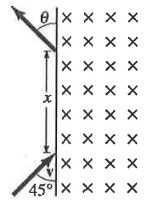 (A) the leaving angle θ of proton is 135°. (B) the leaving angle θ of proton is 45°. (C) the distance x exiting from the field is √2mv/eB. (D) the distance x exiting from the field is 2mv/eB. (E) the distance x exiting from the field is mv/2eB.
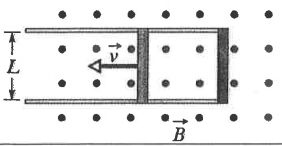 (A) The magnitude of the emf induced in the rod is 1.20 Volt. (B) The direction of the current in the conducting loop is counter clockwise. (C) The current in the conducting loop is 1.5 A. (D) To keep the rod moving at constant velocity, therefore, a rightward force must be continuously supplied to the rod. (E) To keep the rod moving at constant velocity, therefore, a 0.18 N external force must be continuously supplied to the rod.