V. Course Design: 30%“Master Framework for the 12-year Basic Education Curriculum Guidelines (108 課綱)” is going to be put into practice in the following new school year. The new curriculum aims to
(1) develop learners’ individuality by enhancing a few personal qualities, including fundamental knowledge and morale, motivation and passion for learning, realization of individual potential, fulfilled learning, and self-confidence.
(2) empower learners to explore the world via praxis connecting with people, environment, and different cultures.
(3) ensure individual well-being and promote universal harmony. Learners will be bestowed with a caring heart, initiative-taking attitudes, and awareness of global sustainability.
To sum up, the new curriculum aims to help students develop the competence and the ability to
(1) take the initiative.
(2) engage the public.
(3) seek the common ground.
The following is an article that you are going to teach in class. Read the article and then design two follow-up tasks (for students to do), which would implement the new curriculum guidelines mentioned above.
i. The first task must be based on the content of the article, which aims to help students understand the reading better. (20%)
ii. The second task explores the issue(s) related to the article, which aims to help students connect what has been learned to themselves. (20%)
iii. The two tasks must effectively empower at least two of the following students’ abilities: reading, writing, listening, speaking.
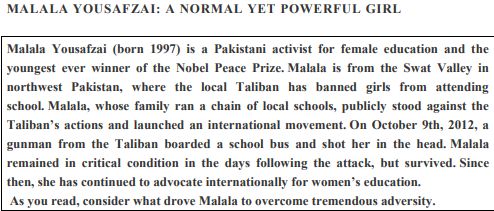
“I think Malala is an average girl,” Ziauddin Yousafzai says about the 16-year-old Pakistani girl who captured the world’s attention after being shot by the Taliban, “but there’s something extraordinary about her.”
A teacher himself, Yousafzai inspired his daughter’s fight to be educated. At a special event with Malala in Washington, D.C., he says that he is often asked what training he gave to his daughter. “I usually tell people, ‘You should not ask me what I have done. Rather you ask me, what I did not do,’” he says. “I did not clip her wings to fly. I did not stop her from flying.”
A year after being shot, Malala is clear about her goal. “I speak for education of every child, in every corner of the world,” Malala says. “There has been discrimination in our society,” which she believes must be defeated. “We women are going to bring change. We are speaking up for girls’ rights, but we must not behave like men, like they have done in the past.”
Perhaps she has learned from her father’s experience. When asked what gave him a passion for girls’ education, Yousafzai points out that he was “born in a society where girls are ignored.” Living with five sisters, he was sensitive to discrimination from an early age. “In the morning, I was used to milk and cream, and my sisters were given only tea,” he says.
Yousafzai felt the injustice even more when Malala was born. He later opened a school that Malala attended in the Swat Valley. At the time, the Taliban’s influence was gaining power and both Yousafzais were firmly on their radar. “But we thought that even terrorists might have some ethics,” Yousafzai says. “Because they destroyed some 1,500 schools but they never injured a child. And she was a child.”
Malala says that the shooting has taken away her fear. “I have already seen death and I know that death is supporting me in my cause of education. Death does not want to kill me,” she says. “Before this attack, I might have been a little bit afraid how death would be. Now I’m not, because I have experienced it.”
Malala knows the Taliban would still like to kill her, but she says she hopes to return to Pakistan one day. “First, I need to empower myself with knowledge, with education. I need to work hard,” she says. “And when I [am] powerful, then I will go back to Pakistan, inshallah [God willing].
 阿摩線上測驗
登入
阿摩線上測驗
登入